
Sign up to save your podcasts
Or



This podcast series looks at labour migration in Africa and focuses on how women experience it on different levels. It highlights how African women experience labour migrations locally, regionally and internationally; featuring expert analysis and tips for journalists who report on labour migration issues.
In this episode we discuss:
Hosted and produced by Andy Mkosi for African Women in Media
Read the labour migration newsletter that looks into the effect of the pandemic on migrant workers and offers story ideas for journalists here
This podcast series looks at labour migration in Africa, and focuses on how women experience it on different levels. It highlights how African women experience labour migrations locally, regionally and internationally; featuring expert analysis and tips for journalists who report on labour migration issues.
In this episode we discuss:
Hosted and produced by Andy Mkosi for African Women in Media
Read the labour migration newsletter that looks into the effect of the pandemic on migrant workers and offers story ideas for journalists here
This podcast series looks at labour migration in Africa, and focuses on how women experience it on different levels.
The series focuses on gendered stories that highlight how African women experience labour migrations locally, regionally and internationally; featuring expert analysis and tips for journalists who report on labour migration issues.
Hosted and Produced by Andy Mkosi for African Women in Media
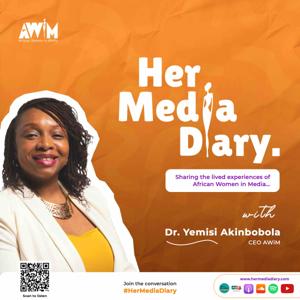
Her Media Diary Episode 8: Nelisiwe Nkosi
In this episode, South African photographer, Nelisiwe Nkosi talks about how photography helped her work through the trauma of being sexually assaulted on two occasions.
Her photographic series, “Breakeven” expresses the feelings of shame, violation, vulnerability and a yearning to be invisible. “Breakeven” went on to be exhibited at prestigious and even earned her a spot in the Mail & Guardian’s 200 Young South Africans' list in 2020.
In this episode of Her Media Diary with Josephine Mahachi, A Deutsche Welle Journalist, founder of Click Africa and host of Live Chat with Josey, we talk conquering fears, perseverance, support systems and strength. Growing up in a family where the girl child played second fiddle to the boy child, she defied all odds and self-sponsored herself into Journalism school.
Her determination and the inspiration she got from Oprah Winfrey saw her wanting to change the narrative of how Africa is portrayed by western media. This gave birth to her first TV show Click Africa, which sought to showcase Africa and its great achievements. Through Click Africa, she has hosted African leaders, high profile business executives, as well as outstanding individuals who are making a mark in their different spheres.
Josephine believes perseverance leads to success. She advocates for originality in content and ideas when producing or pitching media products. This would distinguish an individual from others and leads to scaling greater heights.
Besides being a journalist of naught, she is also an investment consultant and businesswoman. She is aiming to shatter that glass ceiling and make a mark as an African media woman of repute. You can follow her on twitter @MahachieJosey
“If we focus less on leaving a good impression and focus more on presenting the best impression of who we are, we stand a chance of then giving people the truest, most authentic picture of ourselves”.
Arit Okpo, is a television presenter, voice over artist, documentary filmmaker, TV producer, and current host of CNN African Voices ...and a food lover. In this episode of Her Media Diary, Arit talks about growing up, her experiences in school and her work.
A curious child who grew up to become a curious adult, her early education nurtured her innate gift for communication, however this was kept on hold for a while when she was moved towards the science field and earned her bachelors in Biochemistry.
Arit is a believer of nurturing and encouraging curiosity in children, and sees opportunities to explore that curiosity as valuable skills a child takes through to maturity.
On presenting Africa to people who do not share the same lived experience as African, it is important for journalists to acknowledge how much we don’t know, and to not let sharing your reality discount the reality of others who had a different upbringing. Leave a good impression and own who you are so audience remember you. For Arit, impression is like window dressing, and if there is no authenticity in that, you might be building an idea that isn’t true. In spaces, recognise the things that makes you special, and highlight on those things, it’s about identifying your best points and asking yourself how best you can present these points and remain your authentic you. This episodes is full of wise gems like these from Arit.
Her advice to journalists is, to always remember you are telling a narrative not your narrative, remember to humanise the context you are sharing, your story should present that there is more than one way to be African and all those ways are valid. You can follow Arit on twitter @thearitokpo
This week on #HerMediaDiary Podcast, I interview South African award-winning journalist, documentary and film director, Diana Neille. Diana discusses business models, taking storytelling for brands to a new level by involving journalism in traditional advertising and building credibility. She challenges journalists to dig deep and find new ways of making the profession sustainable again.
In her quest to find sustainable business models for journalism, she left the safety of her mainstream media job at eNews to start Chronicle, an Editorial Production company in 2015, which saw her co-directing her first feature film documentary which chronicled the Bell Pottinger scandal. Diana attributes her success to her passion, hard work and determination. Follow her on Twitter @DianaNeille
Biography
Diana Neille is an award-winning journalist from Cape Town, South Africa. Born in Johannesburg, she lived in Germany for a short stint before completing her Master of Science degree in journalism and documentary filmmaking at Columbia University in 2011.
Back in South Africa, she worked as the Executive Multimedia Producer at 24-hour eNews Channel Africa where she was instrumental in the setting up of their online division as Executive Multimedia Producer. She left corporate journalism in 2014 and moved to Cape Town where she freelanced for the Daily Maverick, an award-winning news and opinion website.
In 2015, she founded Chronicle, a production agency and subsidiary of the Daily Maverick which focused on storytelling and producing branded content.
In 2019, she co-directed her first feature documentary, Influence, which chronicled the Bell Pottinger scandal. Influence was invited to the Sundance Film Festival where it held its world premiere in January 2020.
‘Your network is your networth’ is an adage that we often hear about. In this episode, Kenyan multiple-award winning journalist and writer Christine Mungai, shares with us how her network paved her way into journalism after studying for a science degree. Her journey is aspiring and intriguing as she chronicles how she goes beyond descriptive journalism into analytic journalism, making her work outstanding. Christine shares how we need to wrap our story ideas in the “wrapping paper of the editor”. With such a fulfilling journey, one is tempted to think Christine has reached the peak of her career, yet she says she is ready to sprint in the media and writing journey.
I was honoured she shared her journey with me, a classic case of thinking and implementing without a box. Follow her on Twitter @chris_mungai
It was a privilege to interview the writer, performer, and advocate Bassey Ikpi for the third episode of #HerMediaDiary podcast. We talk writing, finding yourself and mental health.
Bassey talks about her diagnosis of bipolar and her journey in developing a successful career. This interview was recorded in October 2018, and since then her book ‘I’m Telling the Truth, but I’m Lying’, was published and became a New York Times Bestseller. The book “explores her life--as a Nigerian-American immigrant, a black woman, a slam poet, a mother, a daughter, an artist--through the lens of her mental health and diagnosis of bipolar II and anxiety”.
I hope you enjoy this episode, I found Bassey open, honest and true. Her live journey and strength inspire me. I also share my experience with postnatal depression. Follow Bassey Ikpi on social media @basseyworld
Yemisi
About Bassey Ikpi
Bassey Ikpi embodies the brilliance of multifaceted creative minds. The writer, performer, and advocate is author of the instant New York Times bestselling book, I’m Telling the Truth, but I’m Lying (Harper Perennial 2019). Essence Magazine esteemed this debut collection of essays as “beautiful and compelling,” while Audible defines the writing as both “visceral” and “comforting.” The compilation, which went into a second pressing on the day of its release, has earned the mental health activist stunning reviews from readers and media outlets nationwide.
Whether written or spoken, Bassey is effortlessly clever--an alchemy of intellect, humor, and pathos. Appearing on stages and screens across the world as a public speaker and TV personality, Bassey first gained public acclaim as an internationally recognized poet. In a past life, she was a featured poet on HBO’s Def Poetry Jam and toured with its Tony Award-winning Broadway show. Also an active voice in pop culture commentary and the mental health community, Bassey has been published by The Root, Huffington Post, and Essence, as well as in anthologies including Rookie On Love from acclaimed editor Tavi Gevinson. Bassey has also been commissioned by Nike’s global nonprofit Girls Effect, writing and performing the short film, Invisible Barriers.
As the founder of The Siwe Project, a mental health organization, Bassey also created the global movement #NoShameDay, an initiative that aims to reduce stigma and increase mental health awareness.
Bassey is represented by UTA for film and television
In this episode with Emmy-nominated journalist, Ruona J. Meyer, we discuss investigative journalism, how to pitch yourself and your stories, and making use of the platforms available to you. Her undercover investigation ‘Sweet, Sweet Codeine’ highlighted the plight of young Nigerians addicted to codeine syrup. Less that 24 hours of broadcasting Sweet, Sweet Codeine, the import and manufacture of codeine-based syrup was banned by the Nigerian government. In 2019, Ruona became the first Nigerian journalist to be nominated for an International Emmy Award.
Interviewing Ruona was insightful, fun and real. Her journey is testimony to the consequences of hard-work and dedication. Follow her on Twitter @RGAMeyer
Yemisi
Links mentions
IJNet
Centre for Investigative Journalism
Wole Soyinka Investigative Journalism Centre
Wits Journalism
Google Alerts
BBC Pidgin
About Ruona J. Meyer
Ruona Meyer is an Emmy-nominated, multimedia journalist with 17 years’ experience in print, radio, wire agency, TV and digital outlets across Nigeria, South Africa, and the UK. Ruona is currently a PhD candidate at De Montfort University, Leicester, UK; her research covers the impact of digital technologies on investigative journalism production within African-Diaspora networks.
Ruona’s investigative documentary Sweet Sweet Codeine gave Nigeria and the BBC World Service its first Emmy nomination (2019), and won the ONE World Media Television Documentary Award category as well as The BBC News Award for Investigation of the Year in June 2019. A training consultant, Ruona has designed and delivered courses for postgraduate students and working journalists in the UK, Nigeria and Ghana.
From the publisher's feed