
Sign up to save your podcasts
Or

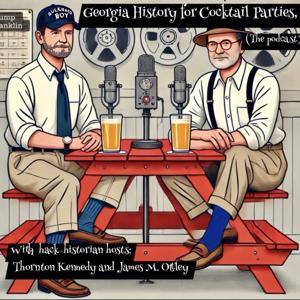


Texas joined the Union in 1845, but the real drama came after. Hack historians James Ottley and Thornton Kennedy explore how a poorly placed semicolon could have split Texas into five states, handing it ten senators and sparking a constitutional crisis. Then we follow Mexican General Santa Anna to his modest Staten Island home, where he accidentally launched the billion-dollar chewing gum industry. Plus: the hurricanes that devastated the Texas coast, and one of the most bizarre and brazen murders in American history, which left a lasting mark on the Lone Star State. So grab a margarita, press play, and enjoy!
Hosted by Simplecast, an AdsWizz company. See pcm.adswizz.com for information about our collection and use of personal data for advertising.
Before it was the 28th star on the American flag, Texas was its own country — complete with a president, a navy, and foreign embassies. In this episode, hosts James Ottley and Thornton Kennedy dig into how a Mexican land-settlement scheme backfired into a full-blown revolution, how a 17-year-old girl from Georgia ended up designing the first Texas flag, and why the newborn Republic spent nearly a decade knocking on America's door only to get turned away.
It's a story of accidental settlers, political brinkmanship, and one wild "what if" — a Texas with ten U.S. senators instead of two. Pour yourself a Ranch Water and settle in for the first half of the saga. Part 2 picks up where the cannons — and the Congress — left off.
Hosted by Simplecast, an AdsWizz company. See pcm.adswizz.com for information about our collection and use of personal data for advertising.
What happens when kidnapping becomes an American epidemic—and no one feels safe? Thornton Kennedy and James Ottley explore the terrifying wave of kidnappings that swept the country during the Great Depression, beginning with the “Crime of the Century”: the abduction of Charles Lindbergh’s infant son. But the story takes a startling turn when James reveals that his own great-grandfather, Atlanta banker John K. Ottley, was kidnapped in 1933 in what is believed to have been the nation’s first executive kidnapping. Two notorious kidnappings, separated by thousands of miles but connected by the same dark chapter in American history—and one of them hits very close to home.
Hosted by Simplecast, an AdsWizz company. See pcm.adswizz.com for information about our collection and use of personal data for advertising.
James Ottley and Thornton Kennedy dig into the story of Phil Walden — the young white promoter who partnered with Otis Redding in the middle of the Jim Crow South to build the first integrated business in central Georgia. From there, the line runs straight through Little Richard, who lit the fuse in Macon, Georgia, to the Allman Brothers Band, who Walden's Capricorn Records would turn into one of the defining rock labels in America. It's a story of the Chitlin' Circuit colliding with long-haired hippies chasing a new hybrid of R&B, jazz, and rock and roll — and somehow, out of one midsized Georgia city, it produced platinum records that still resonate today. Grab a drink — this one's got characters.
Hosted by Simplecast, an AdsWizz company. See pcm.adswizz.com for information about our collection and use of personal data for advertising.
The Revolutionary War's final chapter wasn't written in New England — it was written in the Carolinas and Virginia. In this series finale, James Ottley and Thornton Kennedy trace how the momentum shifted decisively south, starting with patriot militias routing the British at Kings Mountain and Cowpens. Then comes Guilford Courthouse — a battle General Nathanael Greene technically lost, but one that bled Cornwallis's army so badly it never recovered. A few months later, that damage caught up with the Crown at Yorktown, the last major battle of the war. The premise driving this whole series: ask most Americans where independence was won, and they'll say the Northeast. The real answer is the Carolinas and Virginia.
Hosted by Simplecast, an AdsWizz company. See pcm.adswizz.com for information about our collection and use of personal data for advertising.
James Ottley and Thornton Kennedy dig into the Southern Strategy, the brutal, often-overlooked campaign which decided the Revolutionary War: the sieges of Savannah and Charleston, the enslaved individuals who altered the course of battles, and the Polish nobleman, who gave his life for a cause not his own. This episode zeroes in on the man the Patriots learned to fear and rally against in equal measure — Banastre Tarleton, the Terror of the Carolinas — and the massacre at Waxhaws that made his name a battle cry. It's a story of discipline lost, mercy denied, and a civil war fought by neighbors who'd stopped playing by the rules. Press play, and tell us in the comments: is "the South won the Revolution" the hottest take in Revolutionary War history, or just the truth nobody taught?
Hosted by Simplecast, an AdsWizz company. See pcm.adswizz.com for information about our collection and use of personal data for advertising.
Hosted by Simplecast, an AdsWizz company. See pcm.adswizz.com for information about our collection and use of personal data for advertising.
Explore the lesser-known stories behind the American Revolution, focusing on Georgia's unique role, George Washington's early military career, and the pivotal rice boat crisis that marked Georgia's independence.
Key Topics
Titles
Chapters
00:00
Introduction to the Hidden Stories of the American Revolution
01:57
Georgia's Initial Reluctance to Join the Revolution
08:01
George Washington's Early Military Adventures
11:49
The Incident at Jumonville Glen and Fort Necessity
16:03
The Impact of the French and Indian War on Colonial Debt
22:09
The Rice Boat Crisis and Georgia's Independence
26:49
The Significance of Georgia's Break from British Rule
28:04
Conclusion and Next Steps in American History
Hosted by Simplecast, an AdsWizz company. See pcm.adswizz.com for information about our collection and use of personal data for advertising.
Howard Coffin may have dreamed big, but he wasn't the first person to envision Sea Island as a world-class destination. In this episode, Thornton and James trace the fascinating early history of Sea Island and St. Simons Island, from failed resorts and ambitious land schemes to the vision that ultimately created one of America's most exclusive coastal retreats. Along the way, they uncover forgotten stories of entrepreneurs, aviators and dreamers who helped shape Georgia's Golden Isles.
Hosted by Simplecast, an AdsWizz company. See pcm.adswizz.com for information about our collection and use of personal data for advertising.
Georgia's barrier islands have attracted the famous and the infamous for more than a century. During the Gilded Age, wealthy Northern industrialists flocked to Jekyll Island for world-class hunting and unparalleled privacy. Aaron Burr reportedly sought refuge on St. Simons Island after his infamous duel with Alexander Hamilton. Presidents, celebrities and business titans have long retreated to Sea Island, while John F. Kennedy Jr. and Carolyn Bessette chose the seclusion of Cumberland Island for their wedding. Today, only four of Georgia's Golden Isles are accessible by car, so most visitors experience Tybee Island, Jekyll Island, St. Simons Island or, if they have an invitation and a healthy bank account, Sea Island. In this episode, hack historians Thornton and James tell the remarkable story of the unlikely visionary behind Sea Island and St. Simons. Few people realize that the architect of Georgia's premier coastal destination was an Ohio farm boy with a knack for engineering who helped design the Hudson automobile and founded a small regional airline that eventually became United Airlines. It's one of the most fascinating — and least-known — stories in Southern history.
Hosted by Simplecast, an AdsWizz company. See pcm.adswizz.com for information about our collection and use of personal data for advertising.
From the publisher's feed
Ranked by our users in the last 21 days