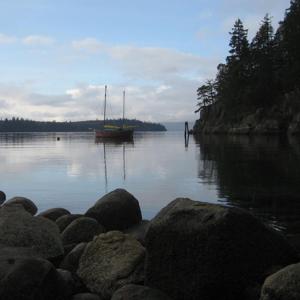
Roy L Hales/ Cortes Currents -Squirrel Cove was much more important during the first part of the 20th century. Union Steamships tied up at the long wharf twice a week. There is still a Squirrel Cove General Store and post office, but there were once log boom, a sawmill, boatyard, machine shop, community hall, church and a school. Much of this infrastructure disappeared during the years that steamships were supplanted by motor boats and floatplanes. However Lynne Jordan, former President of the Cortes Island Museum, has another explanation for Squirrel Cove’s decline.
It starts back in the years when there were no roads on Cortes Island.
“For the longest time, there was no connection from anywhere in Whaletown to the other side of the island. There was a wagon road to where Robertson road is now, then it became a walking trail. You went up over the hill and down into Squirrel Cove on a very rugged rocky trail that more or less follows Whaletown Road,” she explained.
There was a road connection from there to Mansons Landing, but anyone travelling between Whaletown and Mansons had to pass through Squirrel Cove.
Jordan explained that this changed during the late 1950s, when the Hansen brothers started construction of what is now called Gorge Harbour Road.
“Everybody could bypass Squirrel Cove and go to Manson's Landing if they wanted to, rather than the long way around. That made a big difference to Squirrel Cove, because it was a major place that people went to from both Mansons and Gorge and Whaletown,” she explained.
Jordan believes the Squirrel Cove route was still important when BC Ferries arrived in 1969.
“In the first few years I think you had to drive all the way around to get to Mansons. You had to drive through Squirrel Cove. When they put the shortcut through, Squirrel Cove kind of died.”
Construction of the Gorge Harbour Road also changed the face of Whaletown.
“Between where the post office building was and the library, there was actually a little tiny bay. When the connector road was built from Gunflint over to whale town road, the loose rock was used to fill in that bay. Also just below the church on that road, above where the library, is that road had on both sides, rock that kind of narrowed the road. They blasted and all that rock went into that to fill in that bay. It's now a parking area between the old post office and the library.”
You have been listening to part of an interview with Lynne Jordan, who is writing a history of Whaletown for the Cortes Island Museum.



 View all episodes