
Sign up to save your podcasts
Or



In this conversation, I talk with Sarah Downey, founder of Sarah Downey Consulting, about how to use AI to ease workloads while protecting the time and attention people need to do their best work. Sarah helps nonprofit leaders adopt AI in ways that reflect their values and keep people at the heart of the work, but the questions she raises apply to any team navigating AI.
She shares how her own experience with burnout shaped her approach. We explore the promise of AI for people carrying too much, alongside a question for leaders: when AI helps us work faster, does that create room to think, rest, and connect, or does more work simply fill the space?
We also discuss the pressure to keep up as AI becomes more capable. Sarah describes how frequent AI use began to affect her confidence in facing a blank page, and why she makes time to slow down, sit with uncertainty, and find her own ideas. We talk about the role that reflection and mindfulness can play in helping us stay connected to our creativity and judgment.
Throughout the conversation, we return to how leaders can make more deliberate choices about AI. Sarah shares a practical lens for deciding when to use it: does it reduce workload, protect our values, and strengthen human connection? We consider what it looks like to put those questions into practice, from shaping an AI policy with your team to recognizing when a conversation or personal message deserves your own voice.
What you will take away
Learn more at humanequilibrium.ai.
Editing by Earth Dog Films (earthdogfilms.com).
Music by Dan Mahle.
In this conversation, I talk with Adam Rosendahl, founder of Late Nite Art and creator of Human Trust Protocol, about why trust, connection, and human presence become even more important as AI accelerates the pace of work.
We explore what Adam is seeing inside leadership teams as organizations race to adopt AI while navigating layoffs, restructuring, uncertainty, and significant pressure to change. Adam shares why trust is foundational during periods of disruption, how leaders can create space to acknowledge what teams are going through, and why moments of honest vulnerability can strengthen rather than diminish leadership.
We also look at the tension between automation and human connection. Adam shares why he remains cautious about automating interactions that shape relationships with clients and colleagues, and why efficiency should not always be the goal. We discuss the value of preserving some of the friction, imperfection, and struggle that help people build trust, navigate conflict, develop resilience, and create meaningful relationships.
Throughout the conversation, we return to a central question: what parts of work should remain deeply human, even when they could become more efficient? We explore why leaders need to invest deliberately in relationships and cultural rituals as AI changes organizations, and why trust and real human interaction still matter.
What you will take away
Learn more at humanequilibrium.ai.
Editing by Earth Dog Films (earthdogfilms.com).
Music by Dan Mahle.
In this conversation, I talk with Craig Forman, founder of Culture C Consulting, about what becomes more valuable as AI takes on more of the work we once relied on humans to do.
We explore how Craig is using AI to work faster, remove friction, and expand what he can create as an independent consultant, while staying clear about the parts of his work that remain distinctly human. Craig shares how AI has helped him move at the speed of thought, improve the quality of his output, and spend more time on the relational, creative, and strategic work that draws most directly on his experience and strengths.
We also discuss what AI is changing about leadership and management. That includes why managers may need to become more capable even as organizations reduce layers of management, and how more people will increasingly be responsible for managing AI agents alongside human work. And we explore why relationships, creativity, judgment, and accountability become more important as routine forms of output become easier to automate. Craig argues that the real value of expertise is not simply producing the deliverable, but understanding how to get to a good outcome and being willing to stand behind it.
Throughout the conversation, we return to a central question: what is uniquely human about the value we bring to our work? We look at why creativity and originality may become more important in an AI-accelerated world, how overreliance on AI could flatten our thinking and expression, and why leaders need to keep cultivating the capacities technology cannot easily replace. Craig calls this the “revenge of the creatives”: a future in which the ability to connect ideas, build relationships, exercise judgment, and create something genuinely original may matter more than ever.
What you will take away
Learn more at humanequilibrium.ai.
Editing by Earth Dog Films (earthdogfilms.com).
Music by Dan Mahle.
In this conversation, I talk with Cole Hoover, founder of Ponto Social Impact Consulting, about how leaders can use AI while continuing to strengthen the human capacities their work requires.
We explore AI as a tool for reflection, preparation, and sensemaking, while also looking closely at the risks of outsourcing too much of our thinking. Cole shares why he deliberately protects writing as a practice, how the struggle of working through a first draft strengthens critical thinking, and why leaders need to be thoughtful about which forms of friction are worth preserving rather than automating away.
We also discuss what responsible AI adoption looks like inside organizations. That includes creating more openness about how AI is being used, giving teams clearer guidance about where it adds value, and having more honest conversations about what AI means for roles, identity, trust, and the future of work. Cole argues that AI can support better preparation and deeper reflection, but it works best when it strengthens rather than replaces the human interactions that make teams effective.
Throughout the conversation, we return to a central leadership question: how do we remain learners as the technology becomes more capable? We look at why writing, curiosity, critical thinking, human connection, and relational presence may matter even more in an AI-accelerated workplace, and how leaders can use AI more intentionally to make better decisions, work more effectively with others, and continue developing the judgment needed to lead wisely.
What you will take away
Learn more at humanequilibrium.ai.
Editing by Earth Dog Films (earthdogfilms.com).
Music by Dan Mahle.
From the publisher's feed
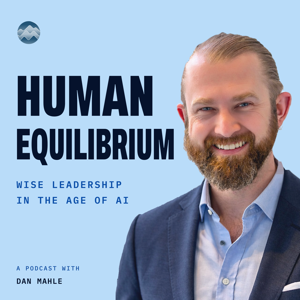
The Human Equilibrium podcast explores leadership at the intersection of artificial intelligence and human wisdom.
Hosted by leadership advisor, executive coach, and facilitator Dan…
Stepping beneath the hype and the doom, each episode explores how leaders can leverage increasingly powerful technology while strengthening the human leadership capacities needed to guide it wisely.