
Sign up to save your podcasts
Or

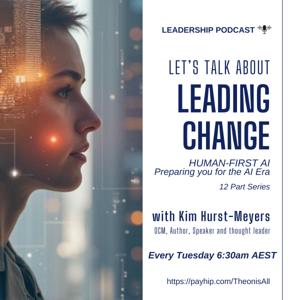


In the Season One finale of Human First AI, Kim Hurst-Meyers shares the deeply personal story of how redundancy at 55 became the catalyst for reinvention, purpose, and a new vision for leadership in the AI era.
Drawing on insights from Brené Brown’s Rising Strong and Tara Mohr’s Playing Big, Kim explores what happens when we lose our sense of relevance, how we rebuild after setbacks, and why human qualities such as courage, wisdom, adaptability, and empathy matter more than ever in a world transformed by AI.
If you’ve ever questioned your value, faced a career transition, or wondered whether you’re being left behind by change, this episode is for you.
Because your experience is not your liability it may be your greatest advantage.
🎧 Human First AI – Season 1 Finale: The Journey Back to Yourself.
Episode 11 of Human First AI explores the hidden layer beneath every AI transformation: the psychological contract between organisations and their people.
Kim Hurst-Meyers examines how AI is reshaping trust, identity, capability, and human value at work — and what leaders now owe their workforce in return. Drawing on neuroscience insights from Dr David Eagleman and leading change frameworks including ADKAR, Kotter, Bridges, Kübler-Ross, and Rogers, this episode reveals why AI adoption is ultimately a human experience, not just a technology one.
A powerful conversation about trust, transition, adaptability, and the future of human-centred leadership in the AI Age.
Are you AI-ready? The answer might not be what you think.
Most professionals assume becoming AI-ready means becoming technical. Learning to code. Understanding machine learning. Keeping up with every new tool that drops.
It doesn’t.
In this episode, Organisational Change specialist and AI Transformation Advisor Kim Hurst-Meyers reframes what AI-readiness actually means — and introduces the Personal Capability Stack: five layers of human and adaptive capability that will define professional relevance for the decade ahead.
But this episode goes deeper than frameworks.
Drawing on Maslow’s Hierarchy of Needs, Kim explores the one thing AI will never replace: our fundamental human need for genuine connection with each other. Not a simulation of connection. Not the convenience of AI interaction. Real belonging. Real trust. Real relationship the kind that only forms between human beings.
As AI handles more of the technical layer of work, the professionals who thrive won’t be those who competed hardest with machines. They’ll be those who understood what machines could never become.
In this episode:
The future won’t belong to those who fear AI.
It will belong to those who understand what makes them irreplaceably human.
AI Most AI conversations focus on tools, speed, and efficiency.
This one is different.
In Episode 9, Kim Hurst-Meyers tackles the hidden impact of AI that leaders and organisations are almost completely ignoring: what happens to people's sense of identity when the work that defined them starts being done by a machine.
This isn't about fear of technology. It's about something much more human — the quiet 2am question that professionals at every level are asking right now:
If the machine can do what I do... who am I?
Drawing on 25 years of leading complex transformation, Kim introduces the Identity Transition Curve — a five-stage psychological framework that explains exactly what your people are going through right now, whether they're talking about it or not.
In this episode you'll learn:
1. Why AI feels different from every previous wave of technology — and why that matters for how you lead through it.
2. The real meaning behind resistance — what people are actually saying when they push back on AI adoption.
3. The 5 stages of identity transition — and how to recognise which stage your team is in.
4. Where human value truly lives in an AI world — and how to help your people find it.
5. Four things every leader must do differently right now.
Whether you're a CEO navigating organisation-wide AI adoption, a manager trying to bring your team with you, or someone privately wondering where you fit — this episode will reframe the conversation in a way that actually helps.
Because the biggest risk of AI isn't job loss.
It's human doubt.
- New episodes every week. Follow Human First AI so you never miss one.
- Connect with Kim on LinkedIn
AI isn't coming for your job. It's coming for your tasks.
And that distinction changes everything.
In this episode of Human First AI, organisational change leader Kim Hurst-Meyers cuts through the noise to answer the question every professional is quietly asking: if AI can do the work — what's left for me?
The answer is more powerful than most people expect.
Kim unpacks the five types of AI now reshaping organisations — from generative AI and agentic systems to embedded intelligence — and reveals exactly where human value increases, not disappears, inside each one.
Then she goes deeper. Into the 7 capabilities that AI simply cannot replicate: judgement, meaning making, trust building, original thinking, complex navigation, adaptability, and change leadership.
And she tells you what leaders must actually do right now to build organisations where those capabilities can thrive.
This is not a conversation about fear. It's a conversation about positioning.
Because the professionals who understand what's happening — and evolve into it — will not just survive this transition.
They'll shape it.
In this episode:
→ Why adaptability is the new intelligence — and what that means for your career
→ The 5 types of AI reshaping work right now (and where humans still lead)
→ The 7 human capabilities AI cannot replace
→ What organisations must do differently to transition their people — not just their tools
→ The leadership actions that determine whether AI transformation succeeds or stalls
Perfect for:
→ Leaders navigating AI transformation
→ HR and People & Culture professionals
→ Organisational change practitioners
→ Anyone who has quietly wondered where they fit in the AI era
About the host:
Kim Hurst-Meyers is an organisational change leader and AI transformation advisor with over 25 years' experience helping organisations navigate technological disruption without losing their people in the process.
Episode 7: How Boards Should Govern AI Risk and Workforce Transition
Most boards are asking the wrong question about AI. They’re focused on technology risk, legal exposure, and return on investment. But the risk that will actually derail their AI strategy? They’re not measuring it at all.
In this episode, organisational change specialist and AI transformation advisor Kim Hurst-Meyers takes the AI conversation where it belongs — into the boardroom. Not to talk about tools, but to talk about what boards must do to protect their people and their investment.
Kim breaks down the five workforce transition risks hiding inside every AI deployment, why structured change models like Prosci and Kotter are risk reduction tools — not theory, and the five practical actions boards can take before their next AI rollout.
If your organisation is deploying AI and you haven’t formally assessed your transition readiness, this episode is essential listening.
You’ll learn:
• Why AI almost never fails because of technology — and what actually causes it to fail
• The four types of capital boards must now govern (including one most have never considered)
• What “human capability capital” is and why it matters more than your platform investment
• The five change risk areas every board should be tracking
• Why leadership readiness — not technology readiness — is the biggest hidden risk in AI right now
Perfect for: Board members, C-suite leaders, HR and people executives, change managers, and anyone leading AI transformation inside their organisation.
AI adoption isn’t failing because the technology isn’t ready.
It’s failing because organisations are still working with yesterday’s habits.
In Episode 6 of Human First AI – Leading Change in the Intelligent Age, Kim Hurst-Meyers explores why successful AI transformation depends on behaviour design, not just strategy, governance, or tools.
This episode examines the reality leaders are facing right now: a workforce already fatigued by digital overload, shifting identity in the age of automation, and the growing need to redefine human value beyond tasks.
Kim explains why Organisational Change Management is no longer project support — it is behavioural architecture — and why the future belongs to organisations that intentionally design AI-ready ways of working.
Because AI will not fix broken ways of working.
It will scale them.
If you’re a leader navigating AI, change, or the future of work, this episode will change how you think about adoption, leadership, and what it really takes to succeed in the Intelligent Age.
Episode 5 – The System That Decides Everything
In this episode of Human First AI, Kim Hurst-Meyers explores why AI governance is quietly becoming the most critical—and most misunderstood—factor in organisational success.
Drawing on lessons from the early days of the internet, Kim reveals a familiar pattern: technology accelerates, governance lags, and human behaviour fills the gap. But with AI now shaping decisions—not just access to information—the stakes are far higher.
This episode challenges leaders to rethink governance not as policy, but as behavioural architecture—brought to life through organisational change, leadership alignment, and workforce clarity.
Because without change, governance fails. And without governance, AI becomes risk.
A powerful conversation on responsibility, trust, and why the future of AI will be decided not by technology—but by how leaders choose to guide it.
Episode 4: How Organisations Assess AI Change Readiness
AI is not a project. It’s a permanent shift in how organisations operate.
In Episode 4 of Human First AI – Leadership in the Intelligent Era, Kim Hurst-Meyers explains why most organisations are investing in AI technology but failing to invest in the one factor that determines success — human readiness.
Drawing on 25+ years leading complex transformations, Kim introduces the concept of Evergreen Change — the shift from traditional change programs to building organisations designed for continuous adaptation.
In this episode you’ll learn:
• Why AI readiness is a leadership issue, not a technology issue
• How the Change Curve explains resistance to AI
• The 6-step Human First AI readiness diagnostic
• Why adaptability is becoming the most important organisational capability
• How OCM must evolve into a strategic survival capability
Because the organisations that succeed won’t be the fastest adopters of AI.
They’ll be the fastest adapters.
AI is not just changing how we work — it’s changing what leadership requires.
In this episode, Kim Hurst-Meyers introduces the 5 capabilities of the AI-ready leader, and explains why leadership — not technology — is the defining factor in successful AI transformation.
Learn why:
Because the future of work is not a technology challenge.
It’s a human leadership challenge.
From the publisher's feed