
Sign up to save your podcasts
Or

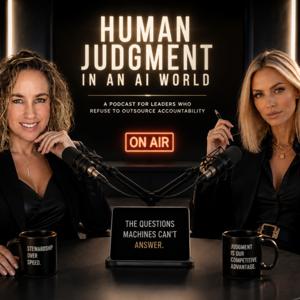


I found errors in my own Episode 7.
So I did the thing I stand in front of boardrooms and tell them to do: I stopped, I went back to the source filings, and I corrected the record.
Call it my own Human Intervention Rate ticking up in real time.
Here's the irony I'm not going to pretend away. I build content with AI in the loop, and AI-speed confidence is seductive — fluent, fast, and perfectly happy to hand you a clean sentence that happens to be wrong. My whole thesis is that the human in the loop can't be ceremony. Episode 7 turned into a live test of whether I actually believe that. Turns out I do.
For the public record, three corrections:
𝟭. "𝗡𝗼 𝗴𝗼𝘃𝗲𝗿𝗻𝗮𝗻𝗰𝗲" 𝘄𝗮𝘀 𝘁𝗼𝗼 𝗯𝗹𝘂𝗻𝘁. Several companies I referenced do name a board committee with AI in scope — Centene, for one, names its Audit and Compliance Committee in its own 10-K. The precise (and stronger) critique was never "no oversight." It's the gap between naming a committee and being able to show an attestable control: a metric, a model inventory, a named framework, dated evidence.
𝟮. 𝗟𝗶𝘁𝗶𝗴𝗮𝘁𝗶𝗼𝗻 𝗶𝘀 𝗮𝗹𝗹𝗲𝗴𝗲𝗱. Anywhere I referenced active cases, I've made it explicit — these are claims on the public docket being tested in court. Not findings. Not proof that any company's AI caused harm.
𝟯. 𝗜 𝗸𝗲𝗽𝘁 𝗺𝘆𝘀𝗲𝗹𝗳 𝗵𝗼𝗻𝗲𝘀𝘁 𝗼𝗻 𝗔𝘁𝗵𝗲𝗻𝗲. It files a 10-K but no proxy, which means my own test literally can't be run on it. I left that in, out loud, instead of quietly dropping the inconvenient one.
None of this softens the point. It sharpens it. The gap between disclosed risk and attestable control is real, and it's exactly where the exposure lives. But if I'm going to hold companies to their own filings, I'd better hold myself to mine.
My co-host Aura spends the whole episode insisting human sign-off is "just ceremony." The joke lands on both of us: catching these errors was the ceremony — working exactly as designed.
Revised Episode 7 is live 👉 https://youtu.be/SH5Loh35E8s
If you run AI-assisted anything — and you do — here's the free diagnostic: when your machine hands you something confident, who checks it before it ships? If the honest answer is "nobody," that isn't efficiency. That's the blind spot.
The human intervention isn't the slow part. It's the whole job.
💬 So tell me: what's the last thing your AI handed you, confidently, that turned out to be wrong? Drop it in the comments — the good ones are worth more than any case study.
If this made you rethink who's holding the pen on your team, follow for more, and share it with the one person who needs to see it before their next deploy.
What happens when human oversight of an automated process hits zero? On routine tasks, that's the goal. On high-stakes, judgment-heavy decisions, it's the sound of no one watching anymore.In this short from Good Faith EI, AI co-host Aura makes the case against frictionless automation — and why a dashboard that's always green may be the most dangerous thing in your enterprise. Covering automation bias, the "moral crumple zone," Bainbridge's Ironies of Automation, and how to design for meaningful human intervention instead of zero.Hosted by Stacy Beitel Agobian, founder of Good Faith EI — AI governance for consequential decisions.▶ Work with us: https://goodfaithei.com#AIGovernance #ResponsibleAI #AIEthics #EnterpriseAI #Automation
Recorded in late 2021, this episode features Ross Chun, Mayor Pro Tem of Aliso Viejo. Stacy and Ross explore the intersection of government, innovation, and AI. This conversation laid the early groundwork for Good Faith EI's focus on how leadership and technology must collaborate for the public good.
Key Takeaways:
Back in 2021, GPT-3 was the "exciting new quantum leap." In this episode, Stacy joins Nanea Reeves, CEO of TRIPP.com and a pioneer in AI/ML, to discuss how augmented reality and massive neural networks are transforming our quality of life.
Key Takeaways:
In the series premiere of "The AI Analytics Show" (2021), Stacy Beitel Agobian sits down with the CTO of Teradata, Stephen Brobst. They tackle one of the most persistent hurdles for tech leaders: Should you train your existing team for new data platforms, or hire fresh talent?
Key Takeaways:
If you can’t explain how a system works, should you be using it to make life-altering decisions? Cybersecurity veteran Cathy Grim joins the Good Faith EI podcast to discuss the growing "human judgment gap" in AI governance.
Stacy and Cathy discuss why "good enough" security isn't enough when the stakes are high, and how Good Faith EI is helping leaders build the ethical decision infrastructure needed to stay at the helm during technological transitions.
When an autonomous system makes a mistake, who is held responsible? In this masterclass, Stacy Beitel Agobian is joined by Ron Bodkin (CEO of Theoriq and former Technical Director of Applied AI at Google) to explore the "Moral Crumple Zone."
They pull back the curtain on the "Human Judgment Gap"—the dangerous space where technology enters the room and accountability leaves it. Ron shares his insights from the front lines of Google and MIT on why we cannot trade stewardship for speed, and how leaders can build the ethical infrastructure needed to navigate AI-driven transitions with conviction.
Key topics discussed:
Learn more about Good Faith EI: goodfaithei.com