Human Rights a Day

Human Rights a Day

Download on the App Store

Human Rights a Day episodes

  • February 19, 1897 - Adelaide Hoodless
    First university for rural women opened by “domestic science” advocate Adelaide Hoodless. When one of her four sons died at 18 months from drinking impure milk, a young Ontario mother named Adelaide Hunter became an advocate for pasteurizing milk. For Hunter, who was born near St. George in 1857 and married John Hoodless in 1881, this grew into a campaign to educate women about child-rearing and household management. Hoodless’ passion for “domestic science” led her to other significant pursuits. As Hamilton’s first president of the YWCA, she was instrumental in the creation of YWCA chapters all across Canada. A tireless public speaker, Hoodless was inspired one night in 1897, while speaking to farmers’ wives in Stoney Creek, Ontario, to create a rural university for women. On February 19, 1897, she spoke at the founding meeting of the Women’s Institute. Ten years later, more than 500 Women’s Institutes operated across Canada. Today more than 18,000 members are found in Canada’s 10 provinces in which they address issues ranging from “agricultural awareness” to “violence against women”. Her work also led to the creation of home economics courses in universities throughout Canada. Hoodless died of a heart attack in Toronto one day before her 53rd birthday on February 26, 1910.

    Hosted on Acast. See acast.com/privacy for more information.

    3 min
  • February 18, 1954 - Joseph McCarthy
    Joseph McCarthy’s search for “Army communists” begins his downfall. Wisconsin Republican Senator Joseph McCarthy was infamous for seeking out and destroying the lives of supposed “communist sympathizers.” While the House of Representatives’ Un-American Activities committee had inflicted damage to the reputations of many people shortly after World War II, McCarthy took it to new heights. He was quick to accuse anyone who’d supported Roosevelt’s New Deal, especially Democrats, of being communists. But when his Permanent Investigations sub-committee levelled accusations against the U.S. Army, his support began to crumble. On February 18, 1954, the day McCarthy’s committee was to investigate communism in the Army, two generals refused to obey their summons to appear. They stayed away on order of Robert T. Stevens, secretary of the Army. Undaunted, McCarthy proceeded to accuse the Army of rampant communism, but this time, when asked to back up his claims, he had very little to reveal. This “stunt” bolstered the president and fellow senators who were growing weary of McCarthy and his campaign. This turning point was strengthened when the military revealed that McCarthy had asked favoured treatment for a former aide drafted into the Army. In December 1954, the Senate finally censured McCarthy, an option exercised only three other times in the Senate’s history. McCarthy never recovered from that political storm, and died in 1957 at the age of 48 from an alcohol-related illness.

    Hosted on Acast. See acast.com/privacy for more information.

    3 min
  • February 17, 2002 - Kuwaiti Women
    Kuwaiti women demand the right to vote. Formal attempts to grant Kuwaiti women the vote began in 1971, following a conference on women’s issues. That bill to the legislative assembly failed as did other bills introduced in 1981, 1986, 1992 and 1996. A coalition of 22 non-governmental organizations made up the Women’s Issues Network, a group that organized various campaigns to put pressure on the government. After years of failed attempts, coalition members gathered by the hundreds on Sunday, February 17, 2002 to protest outside two voter registration centres. Although they were turned away, it marked Kuwaiti women’s first attempt at taking grievances to the streets in protest. The women had the Kuwaiti constitution on their side; it gives various guarantees of equality for all persons of Kuwait. Unfortunately, it seems to be contradicted by Article 1 of Law No. 35/1962 of the Election Law, which specifically denies women the vote and the right to run for public office. Every attempt to challenge the law was dismissed by the courts and tribunals for many years. Then came a move that stunned almost everyone in the country. On May 16, 2005, while the all-male Parliament was considering giving Kuwaiti women the right to run in municipal elections, the government cabinet ministers proposed amending the election laws to allow women to vote and run in local and parliamentary elections – and it passed. However, with one month’s notice, Kuwait’s emir, Sheik Sabah al-Ahmad as-Sabah, dissolved Parliament and called the election for June 29, 2006, a full year early. This caught women off guard. With no political experience or backing, the election results saw tens of thousands of women voting for the first time, yet electing no women to Parliament.

    Hosted on Acast. See acast.com/privacy for more information.

    3 min
  • February 16, 1959 - Fidel Castro
    Fidel Castro sworn in as Cuba’s prime minister, becomes country's youngest leader. In 1951, Cubans were denied democratic elections when right-wing dictator General Fulgencio Batista seized power. Three years later, on July 26, 1953, Fidel Castro – who had sought office in the 1951 election – led an attack on the Cuban government. Unfortunately for Castro, more than half his men were either captured or killed, and he was sentenced to 15 years in prison for conspiring to overthrow the government. When General Batista granted a general amnesty two years later, Castro and his brother Raúl went to Mexico to organize the revolutionary 26th of July movement. They were joined by Argentina’s Ernesto “Che” Guevara, Latin America’s most famous Marxist. Despite setbacks over the years, Castro and his group won the support of many impoverished Cubans. On January 1, 1959, General Batista fled Cuba for the Dominican Republic. Castro became the military’s commander-in-chief then due to other political changes, was sworn in as Cuba's prime minister on February 16, 1959, at the age of 32. American opposition to Castro grew as the Cuban government nationalized U.S. assets and began long-awaited agrarian reform. When the United States made several attempts to overthrow the Cuban government, the Soviet Union stepped in to support the country with supplies and trade. Castro went on to become president of Cuba, and his dictatorship lasted decades.

    Hosted on Acast. See acast.com/privacy for more information.

    3 min
  • February 15, 1930 - Cairine Wilson
    Cairine Wilson is sworn in as Canada’s first woman senator. In October 1929, Canada paved the way for women to enter real politics. It came about because Canada’s “Famous Five” women (Emily Murphy, Henrietta Muir Edwards, Nellie McClung, Louise McKinney and Irene Parlby) won the “Persons Case” before the British Privy Council of the House of Lords. This allowed women to be considered “persons” for appointment to the bench and Senate, as per Canada’s constitution. Less than five months later, Prime Minister William Lyon McKenzie King appointed the country’s first woman senator. Cairine Wilson was sworn in as a Liberal senator for Ontario on February 15, 1930. Wilson was born Cairine Reay Mackay in February 1885, the daughter of a Liberal senator from Quebec. She married Norman Wilson, a Liberal MP, and raised eight children. By the time she had entered the Red Chamber, she'd been involved with the Victorian Order of Nurses, the Young Women's Christian Association and the Salvation Army. As senator, she showed considerable interest in Canada’s role in international humanitarian matters. In 1949, she became Canada's first woman delegate to the United Nations General Assembly. A year later, her involvement with refugee children earned her the Knight of the Legion of Honour. Wilson died on March 3, 1962 in Ottawa.

    Hosted on Acast. See acast.com/privacy for more information.
    3 min
  • February 14, 1989 - Salman Rushdie
    Iranian Muslim leader Ayatollah Khomeini issues death threat against British author Salman Rushdie. British author Salman Rushdie published his book Satanic Verses in September 1988, to critical acclaim and sales of more than 100,000 within a few months. It didn’t take long, however, for Iran’s spiritual leader, Ayatollah Khomeini, to take revenge on the Bombay-born author of the controversial satirical novel, which Khomeini felt cast the Muslim faith in a less than flattering light. On February 14, 1989, Khomeini condemned Rushdie to death. During the Tehran Radio broadcast, the holy man declared a day of mourning and said, "I inform the proud Muslim people of the world that the author of the Satanic Verses book – which is against Islam, the Prophet and the Koran – and all those involved in its publication who are aware of its content, are sentenced to death.” This “fatwa” (an Islamic religious decree) sent Rushdie into hiding as Muslims around the world protested in the streets. He spent nine years in numerous secret locations in Britain before Iranian President Mohammed Khatami declared in 1998 that the state would no longer support the fatwa. Even so, one Iranian foundation put a $2.8 million bounty on Rushdie’s head. In June 2007 Queen Elizabeth II announced that Rushdie, the author of 13 books dealing with issues of faith, religion and culture, would be knighted. This announcement was met with condemnation and outrage by various Muslim religious and political leaders throughout the world. Not recognizing the importance of freedom of speech and the ability to speak and write about religious differences, some leaders suggested the knighthood would lead to suicide bombings. Sir Rushdie resides at an unknown address in London, where he continues to publish books and occasionally make public appearances.

    Hosted on Acast. See acast.com/privacy for more information.

    3 min
  • February 13, 1974 - Alexander Solzhenitsyn
    Dissident Nobel writer Alexander Solzhenitsyn expelled from USSR. Alexander Solzhenitsyn was born in Kislovodsk, Russia on December 11, 1918. There, he pursued a university education in physics and mathematics, even though his real passion was writing. When Soviet authorities discovered his writing criticizing Joseph Stalin, he was imprisoned, first for eight years, then for another two. He used his prison time to write, and much to the dismay of the Soviet leadership, managed to publish his works – sometimes within the USSR, but mostly in the West. His writing included The First Circle, The Cancer Ward and One Day in the Life of Ivan Denisovich. In 1970, when he won the Nobel prize in literature, he was widely condemned by his country’s leadership. On February 13, 1975, Soviet authorities expelled him from Russia, sent him to West Germany and stripped him of his Russian citizenship. A day later, he was charged with treason. He quickly moved to Norway, then Switzerland until 1976, after which he moved to Vermont in the United States. Solzhenitsyn was just as critical of the West’s capitalist system as he was of the Soviet state. When the USSR fell, Russia dropped its treason charges against Solzhenitsyn in 1991. He returned to his homeland and was eventually honoured. In 1997, Russia recognized his work by establishing the Solzhenitsyn prize for literature.

    Hosted on Acast. See acast.com/privacy for more information.

    3 min
  • February 12, 1994 - Victoria Matthews
    Anglican Church of Canada appoints first female bishop: Reverend Victoria Matthews. The Anglican church has allowed women priests since November 30, 1976. However, 1993 was a breakthrough year when Rev. Victoria Matthews became the first woman to be elected to the post of an Anglican bishop in Canada. The following year, on February 12, 1994, Matthews was consecrated as bishop at a service at St. Paul’s church in Toronto. Matthews was a distinguished choice. She’d graduated from Trinity College at the University of Toronto in 1976. She’d also been awarded the North American theological fellowship at Yale University Divinity School in the United States, where she had graduated in 1979. In 1980 she had been ordained as an Anglican priest. Beyond serving her parishioners, she was actively involved with the Anglican Youth Movement and with groups creating dialogue between Christians and Jews. In 1992, Matthews became a member of the National Executive Council, subsequently known as the Council of General Synod. In 1997, Matthews made another step forward for women in her church when she was elected bishop of Edmonton, becoming the only female diocesan bishop in Canada. Two other women became suffagen assistant bishops: Ann Tottenham (retired in 2005) and Sue Moxley (still working in PEI and Nova Scotia). As for Matthews, in June 2007 she was nominated archbishop of the Anglican Church of Canada, to succeed the retiring Archbishop Andrew Hutchison. However, in a tight race that went to five ballots, Fred Hiltz, bishop from Nova Scotia and PEI, ended up getting the top job. There is only one woman in the history of the Anglican church to head up a national body: Katharine Jefferts Schori, who became the presiding bishop of the Episcopal church in the United States in June 2006.

    Hosted on Acast. See acast.com/privacy for more information.

    3 min
  • February 11, 1975 - Margaret Thatcher
    British Conservative Party chooses Margaret Thatcher as leader. The British Conservative Party was not known for being the most progressive. However, on February 11, 1975 the Tories made what was considered great strides for the equality of the sexes by choosing their first woman leader, Margaret Thatcher. In Britain, party leaders are chosen by a vote of the members of Parliament and in 1975 the Conservatives were her Majesty’s Official Opposition party. Thatcher, who was known for showing an interest in the lives of fellow MPs, won handily over her four male opponents in the party. Thatcher began her process by telling former Prime Minister and party leader at the time, Ted Heath, that she would be challenging him for the job. She had served in Heath’s cabinet as Secretary of State for Science and Education when Heath was Prime Minister between 1970 and 1974. The rest, of course, is history: In 1979, Thatcher did indeed become Britain’s first woman prime minister. But if anyone was expecting a more “sensitive” PM in a woman, they didn’t get it in Thatcher. She soon became known as the Iron Lady, and ruled Britain for more than 10 years before being forced to step down. After a decade, her party MPs had had enough of Thatcher’s unbending style, and she lost a leadership vote in November 1990, even though her party remained in power. While Thatcher had many critics, she was credited with making economic reforms that allowed certain members of the public to prosper financially.

    Hosted on Acast. See acast.com/privacy for more information.

    3 min
  • February 10, 1988 - U.S. Army's Homosexual Ban
    U.S. Court of Appeals overturns Army’s ban on homosexuals. The United States Army had a policy of banning gay men from its ranks. The Army took its lead from the British Articles of War of 1775 and felt no need to update it. Many Americans felt the ban was a throwback to the days of paranoia and misinformation about gay men’s abilities. When women were allowed into the combat ranks of the military, many assumed they were lesbians. It was not until February 10, 1988 that a federal appeals court in San Francisco struck down the military’s ban, saying it was unconstitutional. The argument that banning gays preserved morale and discipline did not persuade the court to deny gay men and lesbians the same rights as other Americans. In subsequent years, some courts ruled in favour of gay and lesbian military personnel, while others upheld the government’s stance. Years later, when Bill Clinton became president, he tried to allow gay men and lesbians to serve openly in the military. Knowing his decision would be overturned in Congress, however, he agreed to the compromise policy of “don’t ask, don’t tell” in which theoretically, if a gay or lesbian soldier did not reveal their true sexual orientation, then they would be allowed to serve. In practice, the military continued to seek out the sexual orientation of gay men and lesbians and throw them out of service.

    Hosted on Acast. See acast.com/privacy for more information.

    3 min

About Human Rights a Day

From the publisher's feed

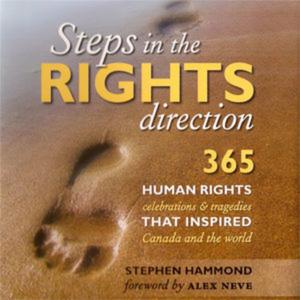
Join me every day for Human Rights a Day. It's a journey through 365 Days of Human Rights Celebrations and Tragedies That Inspired Canada and the World. The short 2 minute readings are from my book…