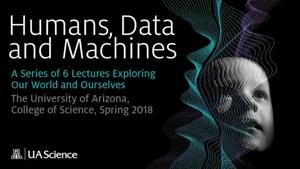
Humans, Data and Machines

Humans, Data and Machines

Download on the App Store

Humans, Data and Machines episodes

  • Machine Influencers and Decision Makers
    Jane Bambauer, Professor of Law, University of Arizona James E. Rogers College of Law
    Machine learning is shaping human lives in both obvious and subtle ways. Important economic and legal decisions about credit, employment, and criminal justice are already made with the aid of complex algorithms, raising difficult questions about whether machines can make decisions that are accurate and fair. Machine learners can become biased when the programmed objectives or the training data used to teach the algorithm are flawed. On the other hand, machines have some advantages over humans since they do not apply pre-existing assumptions and can more quickly recognize unexpected patterns. Machine learning also affects the human experience by creating advertising, suggestions, chat-bots, and even auto-generated news articles tailored to the individual. The government has some power to constrain artificial intelligence, but there are practical and constitutional limits to legal interventions.
    1 hr
  • There is No Such Thing as Big Data
    Vincent J. Del Casino Jr., Vice President, Academic Initiatives and Student Success, Professor, School of Geography and Development, University of Arizona
    This talk challenges the notion that “big data” are what people believe they are – large, singular inanimate manifestations of our proxy selves – and argues that there is no “big data” really, just millions of small bits and pieces brought together through a series of algorithmic possibilities. But, big data analytics and the robotic futures that they engender are clearly producing anxieties for everyday social life and institutions, such as the university, have to manage these anxieties as they rethink themselves in relation to big data analytics and their concomitant robotic futures. As a result, universities have to double-down on investments in a broad education by asking how big data are represented in society, how human life is being organized in relation to big data, and how an interdisciplinary future can help manage the rapid changes produced by advances in robots and robotic technologies.
    58 min
  • What Humans do that Machines Cannot
    Luis von Ahn, CEO and Co-Founder, Duolingo, Professor of Computer Science, Carnegie Mellon University
    This talk is about harnessing human time and energy to address problems that computers cannot yet solve. Although computers have advanced dramatically in many respects over the last 50 years, they still do not possess the basic conceptual intelligence or perceptual capabilities that most humans take for granted. By leveraging human skills and abilities in a novel way, I want to solve large-scale computational problems and collect training data to teach computers many of the basic human talents. To this end, I treat human brains as processors in a distributed system, each performing a small part of a massive computation
    54 min
  • Working Alongside Thinking Machines
    Nirav Merchant, Director Data Science Institute, Data7, University of Arizona
    Machine learning (ML) based systems are rapidly becoming pervasive, powering many applications from recommending music, movies and merchandise to driving our cars to assisting in medical diagnoses. Our daily interactions, behavior, and choices, whether we are aware of them or not, are the sources of data for training these systems. But how are these ML based platforms built and utilized ?. While ML based platforms create amazing opportunities, especially when coupled with advances in cloud computing, reliance on these platforms comes with ethical, security, and technical concerns. How do we strike a balance for enabling pragmatic and productive use of these capabilities? ML powered platforms are gaining proficiency and becoming deeply integrated into existing and emerging automation across many domains of science and society, causing a shift in opportunities impacting many professions. What are the new learning and training opportunities that allow us to stay relevant and lead the way for future innovations
    1 hr 12 min
  • The Minds of Machines
    Mihai Surdeanu, Associate Professor of Computer Science, University of Arizona
    We are inundated daily with news about artificial intelligence (AI) achieving tremendous results, e.g., defeating human champions at Go, driving better than us, etc. But does this mean that we are approaching the technical singularity where artificial intelligence far surpasses the human one? Does this mean that machines truly think? In this talk we will analyze these questions and illustrate that AI does not think that way we think: machines do not have a good way to represent and reason with world knowledge, and, of course, they are not self aware. Instead, AI is designed to automate and scale up pattern recognition for specific tasks. Because of this different goal, AI does perform better than humans at certain tasks. I will review a series of problems where AI outperforms humans, including specific applications of natural language understanding, precision medicine, identifying planetary objects, and other problems, many of which implemented here at University of Arizona.

    50 min
  • Problem Solving with Algorithms
    Stephen Kobourov, Professor of Computer Science, University of Arizona
    The idea of computation and algorithms is old, but modern day computers are a relatively new phenomenon. Even more recent are the notions of artificial intelligence (AI), machine learning (ML) and big data. While it is difficult to clearly define AI and ML it is evident that progress in these fields, combined with access to large datasets, has a significant impact on all aspects of our lives. This raises new mathematical and engineering challenges (can we solve previously unsolvable problems?), but also philosophical questions (can machines think?), and considerations in ethics and law (can machines be more objective than humans?).
    1 hr 5 min

About Humans, Data and Machines

From the publisher's feed

In our automated lives, we generate and interact with unprecedented amounts of data. This sea of information is constantly searched, catalogued, analyzed and referenced by machines with the ability to…

More shows like Humans, Data and Machines

Tucson Humanities Festival 2017 by

Tucson Humanities Festival 2017

0 Listeners

Project POEM Podcasts by Laura Lunsford

Project POEM Podcasts

1 Listeners

Reimagine Medicine by University of Arizona College of Medicine – Phoenix

Reimagine Medicine

9 Listeners

MIS545-1 2018 Fall by

MIS545-1 2018 Fall

0 Listeners

Conversations on Compassion by U. of Arizona Center for Compassion Studies

Conversations on Compassion

0 Listeners

2018 LPL Evening Lectures by

2018 LPL Evening Lectures

0 Listeners

2017 LPL Evening Lectures by

2017 LPL Evening Lectures

1 Listeners

2019 LPL Evening Lectures by

2019 LPL Evening Lectures

0 Listeners