
Sign up to save your podcasts
Or



Got something to say to this podcast? Send a voicemail, and you might hear yourself on the next episode!
Why do narcissists behave the way they do? Why can they seem so emotionally immature, deny the damage they've caused, and leave even the strongest people questioning themselves? In this episode of Moxy Talk, Marie Jorge Rivera explores the relationship between childhood trauma, emotional development, narcissistic behaviour, and the powerful psychological bonds that can keep people trapped in toxic relationships. Drawing on the work of family law attorney and author Rebecca Zung, Marie discusses how early experiences may influence emotional regulation, why narcissistic injury can trigger destructive reactions, and how intermittent affection and rejection can contribute to trauma bonding. Marie also shares personal experiences and an empowering message: understanding harmful relationship patterns can help you regain clarity, establish boundaries, and move forward with confidence. In this episode:
Got something to say to this podcast? Send a voicemail, and you might hear yourself on the next episode!
Why can someone seem so charming when you first meet them—and leave a very different impression weeks later? Marie Jorge Rivera welcomes Dr. Delroy Paulhus for a conversation about narcissism, manipulation, and the psychology of dark personality traits. Dr. Paulhus explains the Dark Tetrad—narcissism, Machiavellianism, psychopathy, and everyday sadism—and discusses how these traits overlap and differ. He also shares research following people over seven weeks: those scoring higher in narcissism initially impressed others, but that favourable impression faded. Together, Marie and Dr. Paulhus explore charisma in dating, internet trolling, ego threats, and why shared interests and reliability matter beyond a powerful first impression.
Got something to say to this podcast? Send a voicemail, and you might hear yourself on the next episode!
Can someone with narcissistic traits truly love another person, or does their need for validation get in the way?
In this episode, I explore narcissism, empathy, insecurity, and the possibility of meaningful change. Which part of the discussion resonated with you most? I'd love to hear your perspective. — Marie | Yaletown Mediation
Got something to say to this podcast? Send a voicemail, and you might hear yourself on the next episode!
Is someone really a narcissist, or are we using the word too loosely? In this compelling episode of I Didn't Know That, host Marie Jorge Rivera of Yaletown Mediation welcomes Dr. Michael Elterman, PhD, MBA, a highly experienced clinical and forensic psychologist, for an eye-opening conversation about narcissism, psychopathy, childhood trauma, and the complicated dynamics of human relationships. With more than four decades of experience and thousands of psychological and forensic assessments behind him, Dr. Elterman brings a perspective that challenges many of the assumptions circulating on social media. One of his most important messages: displaying narcissistic behaviour does not necessarily mean someone has narcissistic personality disorder. Together, Marie and Dr. Elterman explore: Narcissism vs. Narcissistic Personality Disorder (NPD): Why occasional selfishness, manipulation, or controlling behaviour isn't necessarily a clinical diagnosis. The Narcissism Spectrum: Grandiosity, entitlement, admiration, lack of empathy, and the different ways narcissistic traits can appear. Childhood Trauma: How early emotional wounds, shame, and family experiences can shape adult personalities and relationships. Dismissive-Avoidant Attachment: Why some people withdraw emotionally or fear intimacy. Narcissism vs. Psychopathy: How charm, manipulation, exploitation, and empathy can intersect. Social Media and Modern Culture: Are we living in an age that rewards narcissistic behaviour? Family Dynamics: How controlling parenting and unrealistic expectations can influence children. Forensic Psychology: How professionals distinguish genuine personal change from someone simply knowing the right things to say. The conversation closes on a surprisingly heartfelt note when Dr. Elterman answers Marie's signature question: What do you know now that you wish you had known five years ago? Meet Our Guest — Dr. Michael Elterman Dr. Michael Elterman, PhD, MBA Clinical-Forensic Psychology Practice Licensed in British Columbia Fellow of the American College of Forensic Psychology Dr. Elterman has spent decades working in clinical and forensic psychology, including family law assessments, expert court reports, and counselling. Connect with Dr. Elterman: Website: https://melterman.ca Additional website: https://BCparentingassessors.ca Phone: 604-222-4057 Email: [email protected]
Got something to say to this podcast? Send a voicemail, and you might hear yourself on the next episode!
How do you recognize narcissistic traits before a difficult relationship becomes something more harmful? In Episode 2 of I Didn’t Know That, Marie Jorge Rivera of Yaletown Mediation explores narcissistic behaviour, unhealthy relationship patterns, coercive control, and the warning signs that can sometimes precede emotional or domestic abuse. This episode looks at: • Love-bombing and the early stages of unhealthy relationships • Words versus genuine effort • Defensiveness and avoidance of accountability • Honesty versus real transparency • Emotional manipulation and the search for outside validation • Coercive control, psychological abuse, and economic abuse • Why fear, obligation, and guilt can keep people trapped • Rebuilding clarity, boundaries, community, and trust in yourself Recognizing unhealthy patterns is not about living in fear. It is about having the information to recognize warning signs, ask better questions, establish boundaries, and make informed decisions about your relationships. Breaking the silence around domestic abuse and coercive control is an important part of prevention. Marie Jorge Rivera | Yaletown Mediation Helping people navigate difficult conversations, separation, conflict, and major life transitions. If this discussion resonates with you, please share it with someone who may benefit from hearing it, and subscribe for future episodes of I Didn’t Know That. This video is intended for general education and discussion. It is not a diagnosis of any individual and is not a substitute for professional medical, psychological, legal, or emergency assistance.
Got something to say to this podcast? Send a voicemail, and you might hear yourself on the next episode!
Why do intelligent, capable, and caring people sometimes become trapped in toxic or emotionally abusive relationships? In this first episode of “I Didn’t Know That,” Marie Jorge Rivera speaks with Fernanda Selayzin Souza about the relationship patterns, attachment wounds, family systems, and social conditioning that can leave people confused, isolated, ashamed, or unable to understand what is happening to them. The conversation explores why harmful relationships often do not begin with obvious abuse, why charming or high-functioning partners can conceal damaging behaviour, and why good people may remain silent or blame themselves. Together, Marie and Fernanda discuss: • Why capable people can be blindsided by toxic relationship dynamics • Attachment styles and how early family experiences shape adult relationships • Narcissistic traits, narcissistic dynamics, and the danger of casual diagnosis • Emotional abuse, financial abuse, isolation, and the cycle of abuse • Gender roles and the ways boys and girls may be conditioned differently • Intergenerational trauma and family patterns • Chronic relational stress and the nervous system • Why maintaining friendships, financial independence, interests, and support networks matters • Why couples therapy may be inappropriate where domestic or physical abuse is present • How understanding the “why” can help people begin getting unstuck
ABOUT FERNANDA SELAYZIN SOUZA Fernanda Selayzin Souza is a Vancouver-based Registered Clinical Counsellor, RCC 13198. She originally trained as a psychologist in Brazil and holds: • A Master’s Degree in Education from the University of British Columbia • A Master’s Degree in Clinical Psychology from Adler University • Approximately 21 years of counselling experience Fernanda works with individuals, couples, and families in areas including relationships, attachment, trauma, anxiety, grief, stress, family conflict, cross-cultural challenges, and emotional well-being. Her practice is informed by attachment theory, emotionally focused therapy, family systems, Internal Family Systems, trauma-sensitive practice, John Gottman’s work, EMDR, and Sensorimotor Psychotherapy. Fernanda offers counselling in English, Brazilian Portuguese, and Latin American Spanish. In-person and virtual counselling options may be available. Fernanda’s website: https://www.fernandapsychotherapy.com Email: [email protected] Phone: 778-227-2818
ABOUT MARIE JORGE RIVERA Marie Jorge Rivera is a family law mediator and alternative dispute-resolution professional with more than 30 years of experience in the legal industry and involvement in more than 500 family-law matters. Through Yaletown Mediation, Marie helps people navigate separation, family conflict, relationship transitions, and major life changes through practical, compassionate, respectful, and confidential dispute resolution outside of court. This podcast was created from the recurring response Marie heard in conversations with people trying to understand difficult life and relationship experiences: “I didn’t know that. Why is that?”
From the publisher's feed
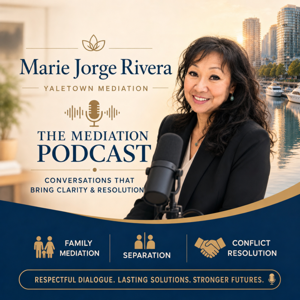
Marie Jorge Rivera is a family law mediator with more than 30 years of experience in the legal industry and involvement in over 500 family law matters. Through Yaletown Mediation,…