
Sign up to save your podcasts
Or



Send us Fan Mail
AI is rewriting job descriptions, and a lot of people hear the same scary message: start over or get left behind. We see it differently. If you’ve spent 10, 20, or 30 years building real expertise, AI does not erase that. It can amplify it, as long as you learn the right pieces at the right time.
We tell a short story that still sticks with us: meeting a young man in Africa wearing a Stanford shirt, only to learn he wasn’t showing off a thrift-store find. He was actually taking a Stanford-taught online course. That moment reframes what “upskilling” can mean in the modern workplace. You don’t need perfect timing, a fancy campus, or a total career reset to reach the knowledge you need.
From there, we get practical. We talk through how experienced professionals in healthcare, government, education, business, and operations can pivot into AI-adjacent roles like AI adoption support, workforce training, pharmacy informatics, compliance and AI governance, or digital transformation. The method is simple: start with your resume, read a stack of relevant job postings, identify the skills that keep repeating, then choose targeted learning options like Coursera, MOOCs, certificate programs, or vendor training to close the gaps.
We also explain why human judgment becomes more important, not less, as automation spreads: someone still has to spot when an AI recommendation is wrong, risky, or out of compliance. If you’re ready to build on what you already know, listen now, then subscribe, share this with a friend navigating career change, and leave a quick review with the field you work in so we can cover more real-world examples.
Support the show
By Edith Campbell Mbuyi
Send us Fan Mail
A shiny AI certificate can be comforting, but it doesn’t answer the only question that matters at work: can you use generative AI to produce something correct, usable, and accountable? We dig into why “completed training” is not the same as “proven capability,” and we share a simple way to evaluate AI skills based on real performance instead of paper credentials.
We use a concrete scenario: an employee drafting a new standard operating procedure with generative AI. The surprising twist is that the AI factor starts offline. Before any prompt engineering, you have to understand the current manual process, the real constraints, and what “good” looks like on the ground. From there, we break down iteration, where strong users actively shape outputs through multiple specific prompts rather than accepting whatever shows up first.
Then we hit the danger zone: the first-draft trap. AI can generate a polished, confident document in seconds, and that polish makes it dangerously easy to skip the hard part. We explain the verification step where human expertise checks AI output against reality to catch errors, prevent downstream rework, and support better AI governance. Finally, we close the loop: the verified procedure improves the workflow and makes coworkers more capable, which is the true sign of scalable AI adoption.
If you want more practical frameworks like this, subscribe, share the episode with your team, and leave a review telling us what you’re trying to automate or improve with AI.
Support the show
By Edith Campbell Mbuyi
Send us Fan Mail
We break down the hidden mechanism that lets AI absorb office work by converting tacit knowledge into codified knowledge. A simple request to write a standard operating procedure becomes the moment human judgment turns into machine readable rules, with entry level roles taking the first hit.
• defining tacit knowledge as unwritten intuition built through experience
• showing how SOPs and flowcharts force messy judgment into rigid steps
• explaining codified knowledge as structured rules an AI can ingest quickly
• connecting easy to map tasks to faster automation of junior work
• highlighting early signs of declining hiring for ages 22 to 25
• raising the risk of losing the entry level training ground for young professionals
Support the show
By Edith Campbell Mbuyi
Send us Fan Mail
AI careers are changing fast, and the biggest opportunities in 2026 are not limited to people who can code. We dig into what the job market data is really saying about AI skills, including why roles that require specific AI capabilities are growing dramatically faster than the overall market and why employers are paying a serious wage premium for people who can apply AI at work.
We also make the shift from “AI jobs” as a narrow technical category to a wider set of collaboration roles: AI implementation consultant, AI workflow specialist, AI trainer, AI governance specialist, and AI business strategist. What these jobs have in common is simple and powerful: they sit between the technology and the organization. The core question companies need answered is not “Can we use AI?” but “How do we use AI to improve the work?” That means mapping processes, redesigning workflows, training teams, evaluating AI tools, and managing risk responsibly.
Certifications come up too, including options from Google, AWS, and Microsoft, but we’re blunt about the trap: collecting credentials without building real skill does not close the AI skills gap. If you want to stay valuable, focus on AI literacy you can apply immediately to your current role, your team, or a portfolio project that proves impact.
If you’re ready to bridge the gap and future-proof your career, subscribe, share this with a friend who’s worried about AI, and leave a review with the role you want to grow into next.
Support the show
By Edith Campbell Mbuyi
Send us Fan Mail
A five minute AI plan can look flawless, then explode the moment real humans touch it. We dig into why that happens and how to prevent it, especially as teams rush to automate, optimize, and “move fast” with generative AI in the workplace.
We start with a broken workflow and the kind of AI-generated optimization plan that feels impossible to ignore: clean steps, crisp logic, and instant momentum. Then we confront the real problem AI often cannot see, the unwritten rules and unpredictable human variables that drive day-to-day operations. That blind spot shows up as resistance, missed edge cases, and changes that technically make sense but fail in implementation.
From there, we lay out a practical framework we call the exchange. First comes the human filter of accumulated experience, the institutional memory that spots patterns no database records and recalls why a similar attempt failed years ago. Next comes the human filter of critical empathy, where the team pressure-tests assumptions and asks who gets negatively impacted by the new procedure. When you combine AI speed with human judgment, you turn raw data into practical wisdom and workflow improvements that actually stick.
If you care about AI adoption, change management, process improvement, and multi-generational collaboration, this is the mindset shift that keeps “perfect” plans from breaking. Subscribe, share this with a teammate, and leave a review with your take: what’s the most important human filter on your team?
Support the show
By Edith Campbell Mbuyi
Send us Fan Mail
If AI can write code, diagnose images, and summarize entire libraries, why can’t it design universal health care for America? I start with that provocation and then strip it down to something more useful than a talking point: what would it look like to use AI to build an actual health care system, grounded in the programs we already have and the tradeoffs we usually avoid naming out loud?
We walk through the current US patchwork, including Medicare, Medicaid, the VA, private insurance, and employer coverage, and I outline a practical way AI could help: study what works around the world, compare costs, and model scenarios that keep choice of doctor, preserve private supplemental insurance, and still guarantee basic coverage for everyone. This is where artificial intelligence and health policy can complement each other: machine learning for pattern-finding, simulation for forecasting, and optimization for stress-testing designs before real people pay the price for bad assumptions.
Then I draw the bright line that matters most. AI can calculate the system, but it cannot answer the biggest question: what kind of society do we want to build? That is our job, and it is the reason I point to CAIRN’s approach, using AI to investigate complicated problems rather than treating it like an authority that tells us what to believe.
If you care about universal health care, healthcare reform, or the real-world limits of AI, listen through and bring your hardest question to the table. Subscribe, share this with a friend who loves policy debates, and leave a review so more people can find the conversation.
Support the show
By Edith Campbell Mbuyi
Send us Fan Mail
AI jobs are not just for programmers, and the 2026 market is making that impossible to ignore. We dig into what the numbers are really saying about AI skill demand, including rapid growth in roles that require specific AI skills and the wage premium companies are willing to pay for people who can apply AI effectively.
From there, we zoom in on the most overlooked opportunity: collaboration careers that bridge the gap between technology and the organization. Think AI implementation consultant, AI workflow specialist, AI trainer, AI governance specialist, and AI business strategist. These roles live in the real world of messy processes, skeptical stakeholders, and “how do we actually use AI to improve the work?” We talk through what these jobs do, why they’re popping up across teams like product, marketing, operations, analytics, HR, education, and finance, and what makes someone effective in the middle of it all.
We also get practical about upskilling. We share how certifications can help you build AI literacy and credibility, including options from Google, AWS, and Microsoft Azure, while warning against collecting certificates without learning to solve a business problem. The AI skills gap is still one of the biggest barriers inside organizations, which means the people who can redesign workflows, train teams, evaluate AI tools, and manage risk are positioned for major career upside.
If you want a clear, non-hype roadmap to future-proof your career with generative AI and enterprise AI adoption, hit play, then subscribe, share this with a colleague, and leave a quick review so more people can find it.
Support the show
By Edith Campbell Mbuyi
Send us Fan Mail
Your GPS says 17 minutes, then five minutes later it says 42, and you have not moved six feet. That is when we stop treating traffic like a nuisance and start treating it like a lab for how AI changes work.
We introduce our newest “coworker,” Grok, and put it to work on real problems that show up in everyday life: why buses run empty (deadheading), how public transportation schedules create hidden waste, and how to turn a simple question into a chain of better questions. We also zoom out to the federal workforce and the loss of institutional knowledge. When someone with 25 years of experience leaves, a PDF and a SharePoint folder cannot replace mentorship, context, and judgment, so we talk through what agencies lose and what rebuilding could realistically take.
Then we get hands-on with nonprofit grant research. We ask for recent grant announcements, deadlines, award sizes, and eligibility rules, and we push for sources so we are not fooled by an answer that sounds perfect but is wrong. Along the way we draw a clear line between a chatbot that waits for prompts and a tasker that can take an assignment like a teammate, then bring back organized options you can verify.
If you are experimenting with AI productivity, AI research workflows, or responsible AI at work, this one is for you. Subscribe, share it with a coworker who is skeptical, and leave a review. And if you want to keep the conversation going, search Cairn on Meetup and bring your questions.
Support the show
By Edith Campbell Mbuyi
Send us Fan Mail
Welcome to Saturday School Scholars and the Khan Tutor! Join us at Saturday School Scholars, where we inspire students to unlock their full academic potential! With the support of the Khan Migo AI Tutor, you’ll receive personalized guidance and innovative resources tailored to your learning needs. Together, we can make your educational journey enjoyable and successful. Don’t miss out on this opportunity to excel!
Support the show
By Edith Campbell Mbuyi
Send us Fan Mail
Treating AI like a chatbot is the fastest way to get boring results. We take a different approach and spotlight Claude Co-Work as something closer to a collaborative partner, the kind that helps you think more clearly when the work gets complex and the stakes are real.
Tech Tool Tuesday, brought to you by the CAREN Initiative (Community AI Research Network), is all about practical AI tools for students, professionals, nonprofits, entrepreneurs, researchers, and everyday people. We break down what Claude Co-Work is best for and why it stands out as an AI productivity tool: brainstorming that doesn’t feel random, organization that turns messy notes into a plan, and support that helps you analyze reports and strengthen your writing without losing your voice.
We also talk through the real moments where a tool like this earns its keep: writing a grant, preparing a presentation, launching a business, studying for school, or leading a community project. When you’re stuck between idea and action, Claude Co-Work can help you outline, prioritize, clarify decisions, and produce stronger, cleaner work faster.
I’m Edith Campbell Mbui, and I want this to be a resource you can actually use. Subscribe, share Tech Tool Tuesday with someone who needs a smarter workflow, and leave a review with the AI task you want us to cover next.
Support the show
By Edith Campbell Mbuyi
From the publisher's feed
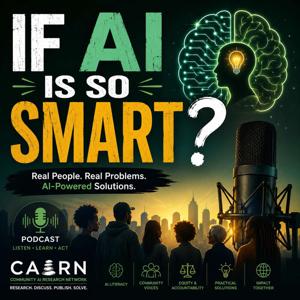
The CAIRN Podcast explores how everyday people can use artificial intelligence to understand complex issues, solve community challenges, and create positive change. Join us as we discuss emerging…
By Global Solidarity Advocates, a non- profit.