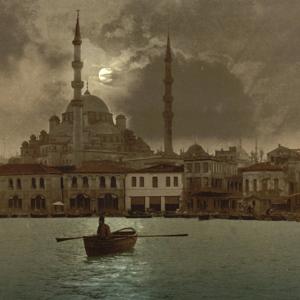
Imagination & Diaspora: Best of 2019

Imagination & Diaspora: Best of 2019

By Ottoman History Podcast
Download on the App Store

Imagination & Diaspora: Best of 2019 episodes

  • Mughal Persian Poetry and Persianate Cultures
    Episode 442

    with Sunil Sharma
    hosted by Shireen Hamza and Naveena Naqvi

    Download the podcast
    Feed | iTunes | GooglePlay | SoundCloud

    In this episode, Professor Sunil Sharma shares his research on the cast of poets who wrote Persian poetry in India, and the poetic idea of Mughal India as a paradise, or an “Arcadia.” (He also shares some excerpts of this lovely poetry with us!) We discuss how specific regions, like Kashmir, became a hot new topic in Persian poetry, and explore the kinds of competitions that emerged between poets from different places across a broader “Persianate” world. The courtly environments in which these poets found patronage were multilingual and multiracial environments — where someone could enjoy poetry in Persian, Braj Bhasha, Hindavi and Chaghatai Turkish — but in this time, Persian poetry was what got you a job. By studying both poetry and painting, he reflects on the racial differences mentioned by poets, especially the initial difference between those born in India and those who had migrated from Iran and were “native speakers” of Persian. Finally, we discuss different meanings of the term “Indo-Persian,” in the study of the centuries that Persian was used as a language of governance, literature and science in India.

    « Click for More »
    0 min
  • Narrating Migration: A Cross-Disciplinary Roundtable
    Episode 436

    with Rawan Arar, Andrew Arsan, Reem Bailony, and Neda Maghbouleh
    hosted by Chris Gratien
    Audience questions by Joshua Donovan, Nihal Kayali, Nova Robinson, and Ben Smith

    Download the podcast

    Feed | iTunes | GooglePlay | SoundCloud

    In this roundtable entitled "Narrating Migration: Emerging Methods and Cross-Disciplinary Directions," held at the 2019 Middle East Studies Association Annual Meeting in New Orleans, two historians--Reem Bailony and Andrew Arsan--and two sociologists--Rawan Arar and Neda Maghbouleh discuss their experiences and approaches to studying migration. Throughout this conversation with our four authors about their own research, we speak to the following questions: What are the promises and dangers of narrative in migration studies? What role do language and affect play in writing migrant stories? How should we write them? How do different disciplines approach migration? What challenges and possibilities are presented by the source base? How do various sources (e.g., state, personal, oral) intersect or diverge? What are overlooked areas (e.g., spatial, temporal, political, social) with regard to migration and the modern Middle East? How do experiences of MENA migration and diaspora contribute to migration studies broadly speaking? How does this work impact historiographies of the Global North, South-South relations, and other places where MENA migrants have gone? What promise might the study of MENA migration hold for decolonial scholarship?

    « Click for More »

    0 min
  • Family Papers and Ottoman Jewish Life After Empire
    Episode 434

    with Sarah Abrevaya Stein
    hosted by Sam Dolbee

    Download the podcast
    Feed | iTunes | GooglePlay | SoundCloud


    In this episode, historian Sarah Abrevaya Stein speaks to us about the journey of one Jewish family from Ottoman Salonica in the late nineteenth century to Manchester, Paris, Rio de Janeiro and beyond during the twentieth century. In her new book Family Papers, she reveals the poignant continuities and changes that accompanied the Sephardic family's movement from an imperial world into a national one through stories of displacement and genocide, endurance and survival. She also discusses the cache of family papers that allowed her to provide this uniquely intimate vantage on large-scale historical transformations.
    « Click for More »
    0 min
  • The Politics of Armenian Migration to North America
    Episode 433

    with David Gutman
    hosted by Sam Dolbee

    Download the podcast
    Feed | iTunes | GooglePlay | SoundCloud

    Beginning in the 1880s, thousands of Ottoman Armenians left the Harput region bound for places all around the world. The Ottoman state viewed these migrants as threats, both for their feared political connections and their possession of foreign legal protections. In this episode, David Gutman discusses the smuggling networks that emerged in response to these legal restrictions, as well as the evolving understandings of citizenship they entailed. Restrictions on movement were repealed after the Constitutional Revolution in 1908, but the respite from control of motion would be short-lived for Harput's Armenians, many of whom were killed in the genocide of 1915.
    « Click for More »
    0 min
  • Islamic Law and Arab Diaspora in Southeast Asia
    Episode 430

    with Nurfadzilah Yahaya
    hosted by Chris Gratien

    Download the podcast

    Feed | iTunes | GooglePlay | SoundCloud

    During the 19th century, Southeast Asia came under British and Dutch colonial rule. Yet despite the imposition of foreign institutions and legal codes, Islamic law remained an important part of daily life. In fact, as our guest Fadzilah Yahaya argues, Islamic law in the region underwent significant transformation as a result of British and Dutch policies. But rather than merely a top-down transformation, Yahaya highlights the role of the small and largely mercantile Arab diaspora as a major factor in European policy towards Islamic law in Southeast Asia. In our conversation, we  discuss Islamic law and the Arab diaspora in Southeast Asia during the colonial period as well as some of the more unusual court cases arising from this period and the implications of this history for Southeast Asia today.

    « Click for More »
    0 min
  • Medical Metaphors in Ottoman Political Thought
    Episode 425

    with Alp Eren Topal
    hosted by Susanna Ferguson and Sam Dolbee

    Download the podcast
    Feed | iTunes | GooglePlay | SoundCloud


    In this episode, Alp Eren Topal traces the history of medical metaphors for describing and diagnosing state and society in Ottoman political thought. From the balancing of humors prescribed by Galenic medicine to the lifespan of the state described by Ibn Khaldun and the germ theory of nineteenth-century biomedicine, we explore some of the ways people thought about the state and its health or illness in the early-modern and modern Mediterranean world. How did these metaphors and images change over time, and how did they inform the policies of the Empire and its rulers?

    « Click for More »
    0 min
  • 1001 Nights at the Cinema
    Episode 424

    with Samhita Sunya
    hosted by Chris Gratien

    Download the podcast

    Feed | iTunes | GooglePlay | SoundCloud

    The 1001 Nights, an Arabic collection of tales, have been translated into numerous languages and adapted to many cultural contexts. In this episode, we explore the impact of the 1001 Nights on the history of cinema. As our guest Samhita Sunya explains, the 1001 Nights corpus influenced Western cinema from the earliest decades of the medium's rise. However, in our conversation, we focus on the cinematic influence of the tales beyond Europe and North America. From Japan and South Asia to Iran and the Caucasus, we discuss the many forms the 1001 Nights have assumed in cinema the world over and reflect on the significance of the often ignored connections between these different world regions.

    « Click for More »
    0 min
  • Tarihçilerden Başka Bir Hikâye
    Bölüm 422

    Fatih Artvinli ve Ebru Aykut
    Sunucu Can Gümüş


    Podcast'i indir
    Feed | iTunes | GooglePlay | SoundCloud

    Edebiyat ve kurmacanın tarihyazımına sunduğu imkânlar nelerdir? Bu bölümde, aynı kuşaktan 14 genç tarihçinin arşiv belgesi, gazete kupürü, günlük, mektup gibi tarihsel bir malzemeden ya da metinden yola çıkarak kurguladığı öykülerden oluşan "Tarihçilerden Başka Bir Hikâye" kitabı üzerine sohbet ediyoruz. Kitabın editörlerinden Fatih Artvinli ve Ebru Aykut ile tarihsel gerçeklik, edebiyat ve kurmacanın ilişkisini değerlendirirken, kitabın nasıl bir tarihyazımsal müdahaleye işaret ettiğini tartışıyoruz.

    « Click for More »
    0 min
  • The Story Has It
    Episode 419

    with İpek Hüner Cora
    hosted by Işın Taylan

    Download the podcast
    Feed | iTunes | GooglePlay | SoundCloud

    Ottoman literature is heavily associated with verse, namely, Ottoman court poetry, and to some extent, folk literature. Ottoman stories, however, remain unexplored, even though they circulated in the empire and entertained many. For us, today, they are an invaluable source to study daily life, gender and space in the early modern Ottoman world. What is an Ottoman story? What do Ottoman stories tell us? In this episode, İpek Hüner Cora joins the podcast to talk about fictional prose stories in the Ottoman Empire and we discuss the gendered and spatial aspects of stories scattered in manuscript collections.

    « Click for More »
    0 min
  • Mexico and the Modern Sephardi Diaspora
    Episode 417

    with Devi Mays
    hosted by Chris Gratien

    Download the podcast

    Feed | iTunes | GooglePlay | SoundCloud

    After their expulsion from the Iberian peninsula during the 15th century, Jewish communities settled throughout the Mediterranean, with many finding new homes in the cities of the ascendant Ottoman Empire. Centuries later, Ottoman Jews descended from this early modern diaspora still spoke a language related to Spanish, often referred to as Ladino. During the late 19th century, a new wave of migration out of the Eastern Mediterranean began, giving rise to a modern Sephardi diaspora of migrants from modern-day Turkey, Greece, Bulgaria, and other parts of the former Ottoman world. As our guest Devi Mays explains in this interview, the Iberian heritage and language of these migrants played a distinct role in their global migration experience, as many ended up settling in countries like Mexico, Cuba, and Argentina. In this episode, we explore the history of the modern Sephardi diaspora and its relationship to the history of Mexico. In some cases, Ladino-speaking Jews from the former Ottoman Empire appeared as welcome immigrants in Mexico even when Jews from other parts of the world faced discrimination and increased immigration restriction during the 20th century. In other cases, Iberian heritage meant that Jews looking to settle in the United States could pass as Mexican or Cuban nationals when seeking to cross the border. Through the individual experiences and lives that comprise the modern Sephardi diaspora, we highlight the unique experiences of migrants mediated by gender and class, and we appreciate the strategies such people developed to navigate an increasingly anti-immigrant world.

    « Click for More »
    0 min

About Imagination & Diaspora: Best of 2019

From the publisher's feed

Our picks for the best and most popular episodes of OHP in 2019 on this year's theme of imagination and diaspora