
Sign up to save your podcasts
Or



This is an update on the episode that was supposed to go live today. My guest for this last episode of the season is an artist and art teacher living in Gaza, Noura Al Qasasia. Ahead of our interview, she and her family was pushed to pack up and move to another area of the Gaza Strip. My hope is that this interview will still happen, if Noura is willing, able, and wanting to use this platform to share about that experience and about her art and teaching. If this episode is not possible at this time, Imagination State will resume again in the new year.
Find Noura's work here.
Learn more about Noura and support her family's GoFundMe here.
What might an imagination curriculum look like? How is learning the art of interruption a key part of that?
This week's guest is Barbara Leckie, professor at Canada's Carleton University, author of Climate Change Interrupted: Representation and the Remaking of Time, and host of the podcast Commons Sense. Barbara’s work moves between Victorian literature, climate communication, and environmental humanities, and she is one of the most creative thinkers I know.
Our conversation begins with a drawing exercise (join us!) and moves into Barbara’s frameworks of interruption, re-storying, and nonlinear time. We talk about why climate “alarms” so often fail to generate action, what it means to think beyond linear narratives of progress, and how love for the world and for one another might be the most powerful climate response. Barbara also shares how stories hold communities together and how tending to our imaginations - both personal and collective - is vital for attention and care.
Mentioned in this episode:
Invitation:
Barbara's invitation: take a stone, any stone, and spend time meditating on it. Consider its origins, its weight, its place in the wider world, and how it connects you to histories, ecologies, and futures beyond your own.
Ideas? Visions? Imaginaries? Email [email protected].
This episode was edited by Angela Ohlfest, typographer from Simon Walker, music from Cosmo Sheldrake.
César Jung-Harada has a wildly adventurous life: He’s a justice-oriented philosopher-inventor traversing the world’s oceans to help humanity adapt to climate change. He has built oil-spill robots, shape-shifting boats, floating cities, and hydrogen devices. The inventions range in technology and scale, but the heart and soul remains the same. César uses imagination and inclusion to scaffold all he does, believing that children, students, refugees, artists, and local “non-experts” belong at the design table and have contributions that are just as - if not more - valuable than those more credentialed.
Listen to hear César talk about everything from equality and inclusion, to animism and Shintoism, to “returning to the animal” that we are.
Mentioned in this episode:
César‘s invitation, from his mother’s wisdom:
To return to the animal that you are, you need to forget. How much can you forget? Can you let go of your name, material attachments, problems and worries? Humans can experience so much unnecessary suffering, but if you can forget, you get closer to experiencing the simplicity of being an animal among animals.
Ideas? Visions? Imaginaries? Email [email protected].
This episode was edited by Angela Ohlfest, typographer from Simon Walker, music from Cosmo Sheldrake.
Daniel Tam-Claiborne is a writer, producer, and nonprofit leader whose work bridges cultures and builds belonging. His debut novel Transplants (Simon & Schuster, 2025), a finalist for the PEN/Bellwether Prize for Socially Engaged Fiction, follows two young women navigating borders, responsibility, and the search for home. A former Fulbright Scholar and NEA Fellow, Daniel is now Deputy Director of The Serica Initiative, where he works to illuminate Asian American stories.
In this episode, we talk about what it means to see the world from the periphery, with Daniel sharing how that outsider vantage point can sharpen observation skills and deepen empathy. We explore the responsibilities that come with connecting - and writing - across cultures and genders, the rise of anti-Asian hate, the tension between nuance and didacticism in socially engaged fiction, and the ways characters and story can guide an author through unexpected imagination landscapes.
Imagination invitation from Daniel:
Daniel invites us to experiment with a digital Sabbath: turning off devices from Friday sundown to Saturday sundown. For him, this weekly practice interrupts the cycle of external validation and opens space for more embodied presence.
Mentioned:
Ideas? Visions? Imaginaries? Email [email protected].
This episode was edited by Angela Ohlfest, typographer from Simon Walker, music from Cosmo Sheldrake.
This week on Imagination State, we are joined by Amelia Hruby - feminist writer, podcaster, and creator of Off the Grid, a podcast and community for people reclaiming their attention from social media. With Off the Grid and as the founder of Softer Sounds, Amelia helps artists and entrepreneurs build thriving creative lives beyond the extractive attention economies of social media. A former philosophy professor and the author of Fifty Feminist Mantras, Amelia’s work spans feminist philosophy, digital well-being, and spiritual practice.
In our conversation, Amelia revisits her imagination origins, from her early days in North Carolina to Chicago, where activism, feminist theory, and community radio reshaped her worldview and creative practice. She shares how she came to see social media as fundamentally misaligned with her values of liberation, gentleness, and integrity and what happened when she finally decided to leave.
We talk about imagination and attention: what we lose when we outsource our creativity to platforms, what opens up when we escape, and how podcasts and voice can create spaces of connection that resist the flattening effects of screen living.
This episode is for anyone who has ever wondered what we give up when we spend one month of every year in billionaire-controlled social media landscapes, and what becomes possible when we step into a different world altogether.
Imagination Invitation:
Amelia invites you to keep a “should diary.” For one day, write down every time you think I should… or I shouldn’t. Then revisit the list to notice which “shoulds” are truly yours, and which come from systems and expectations outside of you. This is a self-liberation invitation.
Mentioned:
Ideas? Visions? Imaginaries? Email [email protected].
This episode was edited by Angela Ohlfest, typographer from Simon Walker, music from Cosmo Sheldrake.
Why wouldn’t we want all stories together? We miss out when we’re segregated.
Marcie’s stories open the door to her home and her heart - and, somehow, to your own. She once wrote that newsletters are like the Off-Broadway productions of what’s happening in Midtown. Her recent Love Letters on Substack feel like the main show: intimate, arresting, and something you carry with you long after it’s over. She doesn’t turn away from sorrow or injustice, but she shows us another way to live in this world: magically, generously, full of care.
In this conversation, we talk about home - the one you carry inside you - and the different forms it can take. We talk about her memoir Everybody Come Alive, we talk about hobbits and banned books, paper dolls and Toni Morrison, childhood beauty and the moments that made it feel fragile. We talk about bookstores and “staying in your lane,” and why joy and romance matter just as much to the work of change as outrage or protest.
Marcie Alvis-Walker is a writer, theologian, and cultural critic. Her work explores the sacred beyond the walls of institutional religion, and invites deep reckonings with history, belonging, and how we care for each other.
I don’t know if we can overcome the loneliness of this internet era while within online spaces, like this one. I don’t know if it’s possible to truly be together in fragmented, digital places. But I do know that Marcie is applying romance, beauty, and enchantment to that question.
Imagination Invitation
Marcie invites you to choose a sacred text... Not necessarily scripture, but any story, book, or world where the hero wins in the end. Let it be your place of return, a source of beauty, magic, and resilience. Marcie shares that the sacred text can be any story that you connect to: The Lord of the Rings, an Emily Henry romance, or a favorite video game. Lean into the stories that remind you of wonder and carry you through difficult times.
Mentioned in this episode:
Ideas? Visions? Imaginaries? Email [email protected].
This episode was edited by Angela Ohlfest, typographer from Simon Walker, music from Cosmo Sheldrake.
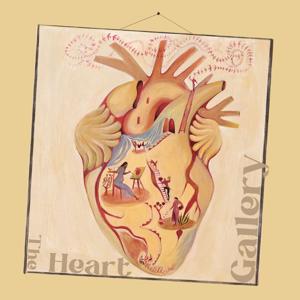
Hello again, and a warm welcome to new listeners! This is the first episode of a new season and, in a way, the first chapter of an entirely new story. Old friends will remember The Heart Gallery; now, we’ve stepped out into the wider - and wilder? - landscape of the imagination.
In this short opening episode, I share the tale of a matrescence-sparked imagination awakening, the first beginning of a curriculum experiment drawn from works of those on the imagination frontlines, and a glimpse of what’s to come this season.
Mentioned in this episode:
- Krista Tippet, On Being pod, & Adrienne Maree Brown's On Radical Imagination and Moving Towards Life.
- Tani Cade Bambara on making revolutionary change irresistible - secondary source.
- Remarkably Bright Creatures by Shelby Van Pelt.
- Ocean Vuong on Talk Easy pod.
- Murmuration example.
Ideas? Visions? Imaginaries? Email [email protected].
This episode was edited by Angela Ohlfest, typographer from Simon Walker, music from Cosmo Sheldrake.
In this episode, we step into the world of ethnomusicology with Angela Impey. Angela is a researcher, author, and senior lecturer at the School of Oriental and African Studies in London, where she explores the links between music, culture, and social change.
Angela shares her experiences during apartheid in South Africa, where music became a powerful form of political expression, along with stories from several ethnomusicology projects across the African continent. She explains how performance-based knowledge systems are important in addressing global challenges like the climate crisis, and what constitutes “proper knowledge”. We discuss how we can bridge between mainstream paradigms and other, but no less valid, frameworks of understanding our surroundings.
Songs around the world hold histories, clues, concepts, connections, and characters that have been not listened to, not heard, by so many. You surely won’t listen to your surroundings the same way after hearing from Angela. I hope you enjoy this invitation into the world of ethnomusicology with Professor Angela Impey.
Mentioned
- Merlyn Driver and his curlew project
- Musician Jeremy Dutcher
- Angela’s book Song Walking: Women, Music, and Environmental Justice in an African Borderland
- Scholar Donna Haraway
- Acacia karroo tree
- Chinspot batis bird
Connect
- Angela Impey’s work
- Rebeka Instagram
- The Heart Gallery Instagram
Credits
Jonathan Raz for podcast editing, Cosmo Sheldrake for use of his song Pelicans We, podcast art by me, Rebeka Ryvola de Kremer.
In this episode launching on Juneteenth, come on a trip down the road from Selma, Alabama - home of the 1960s Selma Voting Rights Movement and the Selma to Montgomery marches - to the tiny little enclave of Gee’s Bend, situated in a bend of the Alabama river. This is the home of the famous Gees Bend quilters.
The community of Gee’s Bend, Alabama, traces its roots back to the enslaved individuals who toiled on Joseph Gee’s cotton plantation established in 1816. After the Civil War, ancestors continued to live and work on the plantation as sharecroppers. The economic downturn of the 1930s, marked by plummeting cotton prices, threatened the community's survival. In response, the Federal Government intervened during the Depression, purchasing ten thousand acres of the former plantation. They offered loans to the residents, enabling them to own and cultivate the land their forebears once worked unpaid. The people of Gee’s Bend managed to keep their land and homes, preserving and cultivating cultural practices… Such as quilt-making.
In the 1960s, inspired by a visit from Martin Luther King Jr., the Gees Bend community became active in the Civil Rights Movement, traveling by ferry to Camden to register to vote. In retaliation, authorities discontinued the ferry service, isolating Gee’s Bend from essential services. During this challenging time, local women established the Freedom Quilting Bee, a cooperative that provided vital economic opportunities and political empowerment.
Despite this past filled with hardship, the quilting tradition of Gee’s Bend, which began in the 19th century, has survived and flourished. The New York Times has praised Gee’s Bend quilts as “some of the most miraculous works of modern art America has produced.” These quilts represent a significant chapter in American art history and are now part of the permanent collections of over 30 major art museums.
Set against this historical backdrop is the conversation I had with Loretta Pettway Bennett. Loretta is a celebrated member of the Gee's Bend quilters, a group of (mostly) women whose incredible works not only bring their beauty to museum walls but have also weave important stories of Black American history, culture, and vision. Listen to hear about Loretta's stories and experiences growing up in this incredible arts community.
Connect:
- About Loretta Pettway Bennett
- Gee's Bend Quilters Instagram
- Rebeka instagram
- The Heart Gallery Instagram
- Episode blog post - coming shortly!
Credits:
- Samuel Cunningham: podcast editing
- Cosmo Sheldrake: music from his song Pelicans We.
Did you know that the average person encounters 10,000 commercial images in a day? That neighborhoods where people have lower incomes tend to have more advertisements for unhealthy foods and have more stores selling and advertising commercial tobacco? That the majority of images we see of the African continent are mostly from Western sources? This is some of what I’ve learned from the new book, The Digital Detox, by Marine Tanguy, who is my guest in this episode.
Manufactured visuals surround us everywhere we go, offline and online, and if we aren’t vigilant, it is almost impossible not to be overstimulated and manipulated from when we wake to when we sleep. Naomi Klein said in an interview recently something that’s stayed with me: “we’ve become machine food!” That visual of human machine food stuck in my mind while reading the Marine’s book. Her book is essentially a guide on how not to become machine food. And according to Marine, a key to that is art, which helps us activate our critical thinking and our imagination, while also being a medicine for our spirits.
Marine is CEO of MTArt Agency, a talent agency for artists. She has held high profile positions in the art world since she was 21, starting as a gallery manager of the Outsider's Gallery in London, which was the first to showcase the work of Banksy, and she was on a Forbes 30 under 30 Art & Culture list.
The thread that runs through The Heart Gallery podcast is that art and stories are what bring us together and move our society forward into a more caring future. So of course I was so excited to talk to Marine. Marine’s mission is to bring art out of what we think of traditional art spaces - galleries, theaters, museums, fancy places - and into the heart of society, art representative of everyone and for all. That is a mission we can all get behind. I hope you enjoy listening to Marine Tanguy.
Homework from Marine: "Take a couple of minutes to close your eyes and think, "what have I seen today?" Try to understand how what you saw made you feel. This will help you to start to be aware of the impact that images have on you."
Mentioned:
- The Imagination Muscle by Albert Read
- Humankind: A Hopeful History by Rutger Bregman
- "The media is the message" - here's a great article about Marshall McLuhan, Neil Postman, Jenny Odell and others
- The Body Keeps the Score, Bessel van der Kolk
Connect:
- Marine instagram
- MTArt instagram
- Rebeka instagram
- The Heart Gallery Instagram
- Episode blog post
Credits:
Samuel Cunningham for podcast editing, Cosmo Sheldrake for use of his song Pelicans We, podcast art by me, Rebeka Ryvola de Kremer.
From the publisher's feed
Welcome to Imagination State, with Rebeka Ryvola de Kremer. This is a podcast about imagination: how it shapes our lives, our world, and our futures. You’ll hear from people on the…