
Sign up to save your podcasts
Or

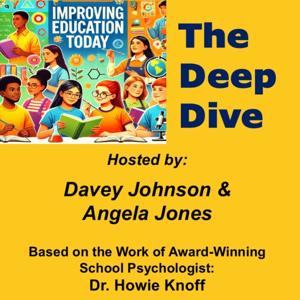


Davey and Angela reflect on Dr. Howie Knoff's March 30, 2024 blog post (from Project ACHIEVE Educational Solutions) exploring how cognitive biases influence perceptions and decisions within educational settings.
Your hosts define cognitive biases and their relationship to stereotypes, prejudice, and discrimination--providing examples of eight common biases. These biases are categorized by when they impact decision-making: before, during, and after.
Davey and Angela--through Dr. Howie--also offer strategies for recognizing and mitigating these biases, emphasizing the importance of objective criteria and fostering open communication.
Finally, they highlight the challenges and necessity of addressing these biases for improved educational outcomes.
Davey and Angela use Dr. Howie Knoff's March 16, 2024 Blog to address the challenges schools face in selecting and implementing evidence-based programs. They highlight five common mistakes educators make when evaluating programs, emphasizing the need to move beyond simplistic metrics like effect sizes and to critically examine the research methodology.
They also advocates for replacing the terms "best practices" and "pilot projects" with "effective practices" and "field-tested," arguing that these changes foster more realistic expectations and collaboration.
Davey and Angela, through Dr. Howie, stress the importance of aligning chosen programs with a school's specific context and available resources for successful and sustainable implementation. Ultimately, they recommend a data-driven, context-aware approach to educational program selection and implementation.
Based on Dr. Howie Knoff's February 24, 2024 Blog, Davey and Angela examine the importance of media and product literacy for educators, drawing parallels between Super Bowl commercials' persuasive techniques and the marketing of educational products.
They emphasize the need to critically evaluate marketing claims, particularly the terms "scientifically-based," "evidence-based," and "research-based," by examining the underlying research methodology and its applicability to specific contexts.
Their discussion highlights the crucial questions educators should ask when assessing educational products to ensure effectiveness and cost-effectiveness for their students and institutions. Moreover, they stress the importance of independent verification of research claims and avoiding reliance on superficial marketing strategies.
On February 6, 2024, Jennifer Crumbley was found guilty of four counts of involuntary manslaughter for allowing her son to bring a gun to school where he killed four and injured seven others. Facing up to 60 years in prison, Davey and Angela discuss Dr. Howie's Blog on this situation, analyzing the case and asking:
Will this decision move the pendulum toward greater parental accountability when schools recommend outside supports to address their children’s significant health, mental health, and wellness needs?
Will the threat of litigation motivate these parents to take timely and effective action—consistent with the recommendations? and
Will schools become more assertive in their interactions with parents, especially when there is a documented threat of student, staff, and school violence?
Davey and Angela explore the complexities of school-parent communication regarding student mental health needs, discussing the factors influencing parental responsiveness to school recommendations for outside services. They agree that the Crumbley case is a tragic example emphasizing the need for stronger collaboration between schools and parents in addressing student behavioral and mental health issues.
The discuss Dr. Howie's strategic approach for schools to effectively communicate with and engage parents in seeking appropriate community-based services. Finally, they underscore the potential impact of the Crumbley verdict on future school policies and parent-school interactions.
Many challenging, controversial, and emotional social issues have impacted the climate and interactions across students, staff, and schools. To ensure that discussions around these issues are safe and productive, staff need to be trained to teach and guide students in the necessary discussion expectations, ground rules, and conflict prevention and resolution strategies.
Davey and Angela unpack Dr. Howie's Blog on this topic. The conversation offers strategies for leading productive classroom discussions on sensitive topics like race, religion, and current events. The Blog is anchored by an antisemitic incident at a girls' basketball game, highlighting the need for proactive, rather than reactive, teaching of social-emotional skills and conflict resolution.
The presentation provides a framework for preparing and facilitating challenging discussions, including choosing appropriate teachers, preparing students with ground rules and respectful disagreement techniques, and managing challenging moments.
Specific strategies for pre-lesson, in-lesson, and post-lesson phases are detailed, drawing upon research from various educational institutions. Ultimately, the goal is to cultivate a safer, more inclusive classroom environment where students can engage respectfully with diverse perspectives.
Davey and Angela analyze Dr. Howie's first Blog of 2024. The Blog reviews a major study demonstrating that high school grades across the country have been inflated from 2010 through 2022. At the same time, it emphasizes that grades are less important than the mastery of specific academic skills when predicting success in the next course, the next level of education, or a graduate’s performance once employed.
Davey and Angela discuss a study revealing significant grade inflation in high school, particularly impacting Black students and those from disadvantaged backgrounds. They note that Dr. Howie argues that inflated grades, often inconsistently assigned, fail to accurately reflect students' actual skill mastery. This inaccuracy hinders future academic success and equitable educational opportunities.
Dr. Howie emphasizes the importance of assessing students' skill proficiency rather than solely relying on grades to gauge their learning and readiness for advancement. Ultimately, Davey and Angela note that Dr. Howie advocates for a shift in focus from grades to demonstrable skill mastery to better serve students and improve educational outcomes.
Davey and Angela end this year (and Volume) by reviewing the critical issues that highlighted the 2023 calendar year. Guided by Dr. Howie Knoff's year-end Blog--summarizing all of his 2023 Blog posts-- your Hosts tackle the persistent challenges faced by virtually every educator.
Five key themes are examined: (a) Hiring, Supervising, Supporting, and Retaining School Staff; (b) Encouraging Effective and Eliminating Ineffective Staff Policies and Practices; (c) Special Education Services for Students with Disabilities; (d) Social-Emotional Learning’s Illusions and Realities; and (d) Race and Equity: Research and Effective Practices.
Angela and Davey emphasize the importance of strategic planning, data-driven decisions, and a cautious adoption of new programs to improve student, staff, and school outcomes. A final summary encourages the critical evaluation of research and practices before classroom or school-wide implementation.
Angela and Davey discuss the essence of Dr. Howie Knoff's December 9, 2023 blog which critiques the oversimplification of educational solutions to address students' complex mental health issues. Knoff argues that diluting sophisticated interventions within the multi-tiered system of supports (MTSS) undermines their effectiveness, delays appropriate help for students, and may actually make the original problem worse.
Your Host provide analogies to illustrate how simplifying complex processes in other fields would be unacceptable, emphasizing the need for fidelity when implementing evidence-based practices at the classroom and student levels.
They also highlight the ethical and practical consequences of choosing expediency over quality in education, ultimately advocating for comprehensive, data-driven interventions tailored to individual student needs.
Davey and Angela talk about the importance of teaching students how to control their emotions, and yet many schools are teaching these emotional self-control or self-regulation skills in ways that ignore the neurobehavioral and psychological research-to-practice.
Their discussion is anchored by a Blog post by Dr. Howie Knoff on effective social-emotional learning (SEL) in schools. This post--and your Hosts' discussion-- details the correct science-to-practice blueprint needed to teach emotional self-control, describing (a) the four interdependent components needed; (b) the neuro-physiological and psychological science of self-control; (c) the components of the Emotional Control Paradigm; and (d) how to condition
Davey and Angela describe the science-based approach that emphasizes emotional awareness, control, communication, and coping; and the Stop & Think Social Skills Program's approach to helping students manage their emotional triggers, physiological cues, positive self-statements, and behavioral responses and interactions.
The ultimate goal is to train students to control their emotions, think through the challenging situation, prepare a prosocial response, and enact that response. . . all in three to five seconds. All of this results in students who are able to control their emotional, impulsive reactions to highly charged situations.
Angela and Davey discuss Dr. Howie Knoff's recent blog post, discussing twelve elements that are essential for continuous school improvement.
They highlight a current trend in education where school leaders focus more on motivating staff and students that identifying and addressing systemic deficits in curriculum, instruction, and support services.
Three school-specific case studies illustrate what happens when schools either neglect their deficits or identify the weaknesses. . . implementing significant, strategic improvement strategies.
Angela and Davey emphasize the importance of data-driven decision-making, shared leadership, and a comprehensive approach that includes both academic and social-emotional learning. The twelve components provide a framework for analyzing existing school practices and developing targeted action plans.
From the publisher's feed