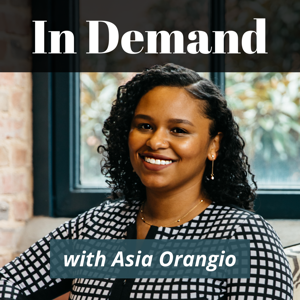
In Demand: How to Grow Your SaaS and Stay In Demand

In Demand: How to Grow Your SaaS and Stay In Demand

By Asia Orangio & Kim TalarczykBusinessEntrepreneurshipTechnologyMarketing
Download on the App Store

In Demand: How to Grow Your SaaS and Stay In Demand episodes

  • EP22: Unaware Audiences

    Your business growth feels like it’s plateauing and so you’re thinking about focusing on a less aware audience is that a bad idea? 

    In this episode of In Demand, Asia Orangio, CEO of DemandMaven, breaks down 5 levels of audience awareness and where it makes sense to place your marketing attention and budget. 

    TL;DR

    • 3:00 - Going after unaware audiences is the last thing you should plan to do when you're growing your company, but there are lots of marketing agencies that will recommend you do just that.
    • 6:20 - Going through an example of why a founder might get to a place where they want to go after unaware audiences.
    • 7:30 - "Unaware audience" comes form Eugene Schwartz's idea on 5 levels of awareness:
      • Unaware - people don't even think they have a problem or a pain point.
      • Problem Aware - people who experience the pain, but don't know there is a solution to it.
      • Solution Aware - people who have decided that they want to find a solution to the problem they've faced or pain they're experiencing and are beginning a search.
      • Product Aware - people that have become specifically aware of your product and have likely started engaging with your marketing.
      • Most Aware - people that have done their research, watch reviews and tutorials, downloaded a guide, attended a webinar, etc.
      • 13:45 - You should not focus on an unaware audience because convincing someone they have a problem, when they don't care is an incredibly difficult and costly challenge.
      • 18:00 - If you get to a position where you are a market leader and feel that the marketed is capped, it may make sense to allocate resources to unaware audiences, but is likely a better strategy to look at other problems and paint points you could solve for a different problem aware audience. Hubspot starting in marketing automation and expanding into sales and customer success is a great example of this. 
      • 27 min
      • EP21: First marketing hire

        Now that you know the basics of how to get started with building out a marketing team it’s time to diving into how and when to hire your first marketing leader. 

        In this episode of In Demand, Asia Orangio, CEO of DemandMaven, breaks down types of marketers that makes since as a first hire, where to sources them from, and how to set them up for success in the first 90 days. 

        TL;DR

        • 1:36 - Who is the best type of marketing to hire?
          • If you are in the software space, you should really only be looking at a generalist who is well versed on demand generation or content marketing.
          • If you are a self-serve, low LTV business, then content marketing makes the most sense. If you have a high LTV and a longer buying cycle, then demand generation is more important.
          • 6:40 - The single most important thing when making this hire though is finding someone who has worked in a similar stage of growth for a similar company.
          • 9:00 - When you are creating your job description you want to focus on what stage of growth you're in and after that, what type of tech experience do you want them to have.
          • 9:55 - There are a few different places that you can focus on for sourcing talent:
            • Your own personal network
            • LinkedIn
            • Recruiting sites like Indeed, Monster, etc.
            • Recruiting and headhunting firms
            • 12:45 - What is important for your hire to know after you've hired them?
              • The vision of your company
              • The specific goals for the company
              • Clearly outlined expectations for the role
              • Existing marketing strategies and plans
              • 21:25 - Defining the first projects for your first hire
                • Creating a 90 day plan for what you want to accomplish over the first 3 months is a great way to get started.
                • Right from the start talking to customers and listening to any recorded customer interviews that exist
                • 27 min
                • EP20: Hiring a marketing team

                  One of the questions most founders have is, "How do I start building a marketing team?"

                  In this episode of In Demand, Asia Orangio, CEO of DemandMaven, breaks down the options that exist for founders starting to build out their marketing teams and what is the best fit for companies depending on the budget and time constraints they are facing.

                  TL;DR: 

                  • 1:20 - The four options for building your marketing team are:
                    • Generalist or specialist contractors
                    • Agencies or consultancies
                    • Full-time or part-time employees
                    • Learning marketing and growth yourself as a founder
                    • 2:36 - The best option for you will depend on your budget, what the business needs, and what you need as a founder.
                    • 5:00 - There is no perfect formula for who to hire, but there are patterns.
                      • When you have less than $10K in MRR, usually contractors and limited consulting are the best options for you.
                      • If you are above $10K in MRR, then you could start thinking about hiring an employee to focus on marketing. Some say wait to $50K in MRR, but when it makes sense for you will depend on your growth track.
                      • 7:00 - Contractors work in some different ways:
                        • Sometimes they charge a flat rate and sometimes will work as per hour or per project.
                        • You can find jack-of-all-trades type contractors up to hyper-specialized contractors.
                        • Typically it is easier to find talent and it is pretty low risk to hire contractors.
                        • The potential downside to contractors and freelancers is that you end up taking on more management work as a founder.
                        • 11:15 - Agencies and consultancies
                          • Agencies tend to be more expensive. At the lower end from $5,000 to $7,000 and at the high range $10,000 to $30,000 a month.
                          • Agencies specialize in execution. They can usually work fast and deliver quickly.
                          • Typically with consultancies, they are not actually doing the work but helping you bring clarity and perspective on how to overcome the challenges facing your businesses.
                          • The range for consultancies is also very large all the way from $6,000 or $7,000 up to close to six figures.
                          • Not all agencies are great at every aspect, so make sure to really work to understand the agency before you decide to work with one.
                          • 20:30 - Full-time and part-time employees
                            • Before you make your first marketing hire you should have the budget or runway for one year of that employee's salary.
                            • 31 min
                            • EP19: High performing CEO

                              What are the four traits that separate the highest performing CEOs from their peers? In this episode of In Demand, Asia Orangio, CEO of DemandMaven, breaks down the decision-making and approaches great CEOs use to consistently generate results. 

                              Here’s the link to the article discussed in todays episode: https://hbr.org/2017/05/what-sets-successful-ceos-apart

                              TL;DR: 

                              • 2:24 - What set's successful CEOs apart from their counterparts?
                                • Deciding with speed and conviction
                                • Engaging for impact
                                • Adapting proactively
                                • Delivering reliably
                                • 3:08 - Deciding with speed and conviction, for a CEO it is more important to make good decisions fast than to make great, but slow, decisions.
                                  • You almost never have perfect information, so you will always be making a decision with uncertainty
                                  • Wrong decisions are usually better than making no decision at all
                                  • 10:30 - When you are struggling to make decisions in a team, a CEO needs to be able to make decisions with conviction and be able to get their team onboard.
                                  • 12:00 - Two good questions to ask yourself in the decision-making process are:
                                    • What is the impact if I get it wrong?
                                    • How much will it hold up other things if I don't move forward on this?
                                    • 13:50 - It's also important for a CEO to know when a decision should be made by someone else. A CEO doesn't have infinite energy, so they can't be responsible for all decisions. Often it is better for the CEO to guide and coach others on making the decision.
                                    • 19:59 - Engaging for impact is about how do you align your resources and how to you ultimately plan and create paths to execute. It means that you as CEO are aware of the challenges you are facing and that you've got the right people on board to address those challenges.
                                    • 25:00 - CEOs that engage for impact are not afraid of conflict. They dive head first into solving contentious problems if it will affect the company.
                                    • 27:55 - Adapting proactively may be a lot more important for a large company, but even at the early stages of a SaaS business, it is important for a CEO to understand the changes that are taking place in the company and marketplace. A way to think about this is how are you filling the time you have with thought-provoking information or insights that you can use to act in new or different ways?
                                    • 30:45 - When you're making the transition from founder to CEO, it is a great time to conduct structured research about your customers.
                                    • 34:45 - Delivering reliably is not about hitting home runs every time, but equally importantly, being able to learn lessons from the strikeouts and losses. A great CEO is constantly learning from what is not working well and is also able to have grace for themselves and others when results are not perfect.
                                    • 39:45 - What makes a high-performing CEO?
                                      • They are able to decide with speed and conviction
                                      • They are able to engage for impact
                                      • They are able to adapt proactively
                                      • They are able to deliver reliably
                                      • 40:00 - Book recommendations
                                        • How to Decide by Annie Duke
                                        • Traction by Geno Wickman
                                        • 43 min
                                        • EP18: Founder to CEO

                                          As a founder it can be hard to pull back and step into the role of CEO, but usually that is the most important move you need to make for the long term success of your company. 

                                          In this episode of InDemand, Asia Orangio, CEO of DemandMaven, breaks down how to think about making the transition from being a great founder to being a great CEO!

                                          Timestamps for TLDR:

                                          0:35 - Welcome back to the In Demand podcast!

                                          1:25 - The focus for this upcoming season of the show is on being and becoming a better CEO.

                                          3:22 - What does it mean to be a CEO? Making great decisions, being a therapist, being the coach for the team, creating vision, framing the firms business challenge,

                                          8:30 - It is important to understand the role of CEO no matter the business because when founders start taking themselves seriously as CEOs they make better decisions, build better teams, and help evolve the business.

                                          11:15 - Being a better marketer boils down having a better sense of psychology and awareness about your target audience on top of having a really good understanding of the landscape that is available to you.

                                          15:00 - When it comes to founders who don't transition to CEO, they often get bogged down in tasks because they haven't figured out how to delegate and then spend time in roles that don't fit the zone of genius of the founder.

                                          17:45 - How do you make the transition from founder to CEO? You start by taking a step back and looking objectively at where things in your business are getting stuck because you don't have enough room on your plate

                                          19:00 - When a founder is not acting like a CEO they struggle to see challenges within the organization from an objective perspective

                                          22:10 - Finally when founders don't transition to CEO they usually move slower than the rest of the market

                                          29 min
                                        • EP18: Attribution Part I: How to think about attribution and analytics
                                          When it comes to marketing, you can’t improve the things you’re not measuring. That is why understanding and knowing how to use and measure your marketing efforts is so important as a founder.
                                          In this episode of InDemand, Asia Orangio, founder of DemandMaven, starts a three part series on analytics and attribution. We start by overviewing the different types of analytics that a SAAS startup is likely to work with (and should be focused on), and then discuss the five key principles to keep in mind for attribution.
                                          48 min
                                        • EP17: The 3 stages of marketing

                                          Is your marketing great, good, or non-existent? No matter where it is today, it’s important to recognize where you are and what your next steps should be.

                                          In this episode of InDemand, Asia Orangio, founder of DemandMaven, breaks down the three stages of marketing, how to know which stage you're in, and what to do to level up from one stage to the next!

                                          The three stages of marketing are:

                                          1. From No Marketing to Some Marketing
                                          2. From Some (or bad) Marketing to Good Marketing
                                          3. From Good Marketing to Great Marketing
                                          4. 29 min
                                          5. EP16: The 3 stages of growth

                                            Is your growth strategy working? There are few questions as important. In this episode of InDemand, Asia Orangio, founder of DemandMaven, walks through the three stages of growth, and the key actions for assessing and planning for improvement from each stage. 

                                            Understanding where we are at when it comes to growth will help you know where to focus and what next steps make the most sense on your growth journey.

                                            23 min
                                          6. EP15: How to prioritize your growth ideas

                                            As a founder, you probably think of new growth ideas everyday. But how many of the ideas do you follow through on? Deciding how to prioritize your growth ideas is the critical first step to implementing them. 

                                            In this episode of InDemand, Asia Orangio, founder of DemandMaven, walks through the different frameworks you can use to evaluate your growth ideas and decide which you will prioritize.

                                            29 min

                                          About In Demand: How to Grow Your SaaS and Stay In Demand

                                          From the publisher's feed

                                          Growing a SaaS? Yeah, that's hard. Growing a SaaS without a clue what you're doing from a marketing and growth perspective? Pretty much impossible — especially if you want to break the $1M and $10M ARR marks. Kim Talarczyk sits down with Asia Orangio to extract and unpack all the strategic insights she holds in her brain from working with hundreds of SaaS companies and interviewing thousands of their customers. Together, they break down how to diagnose and troubleshoot growth challenges across every part of a B2B SaaS business.