
Sign up to save your podcasts
Or

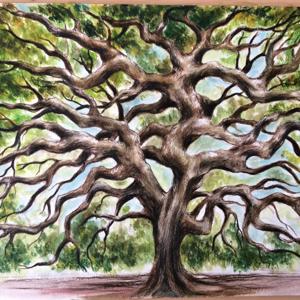


Sponsored in part through a grant from the Houston Arts
Original artwork courtesy of Tania Day Magallon.
Image courtesy of Creative Commons.
This story is inspired by Orphic tales of creation and the ancient Greek creation story of Eurynome who danced and created/mated with the serpent Ophion. In this re-envisioned myth, the sacred creation story or origin story of the first Serpent comes from Night and Chaos itself. The story is said to be held by the serpents of Mesopotamia, such as Sakina, the guardian of the Tree of Immortality/Life and Sabr, the great serpent rescued from the Flood (found wound around the little hupullu saved by Inara (Inanna)) . See “Sakina Speaks of Gilgamesh: A Serpent’s Perspective,” Inara & the Hupullu Tree: A Retelling & “Inara’s Return.”
Original artwork courtesy of Tania Day Magallon.
Based on “The Hupullu Tree” from Diane and Samuel Noah Kramer, Inanna: Queen of the Heaven and Earth; Her Stories and Hymns from Sumer. Harper & Row, 1983.
Original artwork courtesy of Tania Day Magallon.
from Inara & the Tree of Souls: an Anthology of Tales & Poems
This soliloquy is told from the perspective of the last surviving An Zu bird found by Inara (Inanna) in the little hupullu tree rescued from the great Flood (see Inara & the Hupullu Tree: A Retelling). In this poem, the An Zu is a giant Phoenix-like bird who has suffered greatly at the hands of the Sky Gods and wishes to correct their version of history and the demonic portrayal of his kind as seen in traditional Mesopotamian myth. (Stay tuned for more in “ An Account of An Zu history by Ki, the last surviving An Zu of the Great Wars”)
Based on the character of Ki in “An Zu" from Dalley, Stephanie. Myths from Mesopotamia: Creation, the Flood, Gilgamesh, and Others. Oxford University Press, 1989. pp. 205-227.
Original artwork courtesy of Tania Day Magallon.
from the collection Inara & the Tree of Souls: An Anthology of Tales & Poems
One creature living in the little sacred hupullu tree that was
Based on “The Hupullu Tree” from Diane and Samuel Noah Kramer, Inanna: Queen of the Heaven and Earth; Her Stories and Hymns from Sumer. Harper & Row, 1983.
Original artwork courtesy of Tania Day Magallon.
The traditional Mesopotamian myth “The Epic of Gilgamesh” relates a tale of how Gilagamesh, the well known hero of Mesopotamian myth has his journey’s goal, the herb of immortality, stolen from him by a serpent. The serpent rises up out of the waters of the Tigris-Eurphrates, swallows the herb from the hand of Gilgamesh and returns to the waters before he could blink. Effectively preventing the hero from restoring the life of his beloved and becoming immortal, the serpent is then demonized for its action. In this story however, the serpent herself speaks, sharing her version of events.
*Loosely based on the character of Gilgamesh as seen “The Epic of Gilgamesh” and “Gilgamesh” from Dalley, Stephanie. Myths from Mesopotamia: Creation, the Flood, Gilgamesh, and Others. Oxford University Press, 1989. pp 39-153.
Original artwork courtesy of Tania Day Magallon.
In this clip, the traditional myth of Inanna’s descent to the
In this clip, the traditional Sumerian myth of “The Hupullu Tree” is retold to address the violence against the little date palm (hupullu) and the powerful, magical creatures it houses, as well as its savior, the great goddess, Inara (trad. Inanna or Ishtar). In this poetic rendering, the goddess does not run to
Original artwork by Tania Day Magallon.
from the collection Inara & the Tree of Souls: An Anthology of Tales & Poems
From the publisher's feed