
Sign up to save your podcasts
Or



Editorial note: This conversation was recorded during the early development of the European Urban Initiative. While the initiative has continued to evolve since then, the reflections shared on inclusion, urban innovation, public service, and European cooperation remain relevant today.
In this episode of Inclusive Urban Futures, our host Dr Orna Rosenfeld had the pleasure of speaking with Tim Caulfield, Director of the European Urban Initiative (EUI), whose career has been dedicated to supporting cities, encouraging innovation, and creating opportunities for communities across Europe.
Drawing on his experience leading both Urban Innovative Actions and its successor, the European Urban Initiative, Tim reflects on the importance of giving cities the resources, knowledge, and confidence to experiment with new ideas. From funding innovative projects to encouraging cooperation and learning between cities, he shares a vision of European urban development built around collaboration, practical support, and the willingness to try something different.
At the heart of the conversation is a simple but powerful understanding of inclusion: everyone should have the opportunity to participate, feel part of their community, and contribute to shaping its future.
Throughout the interview, Tim explores how this vision can become a reality through urban policies and projects. Drawing on examples from across Europe, he discusses initiatives supporting the integration of migrants and refugees, improving access to employment and skills, and creating opportunities for people living in disadvantaged communities.
The conversation also reflects on the challenges cities face in times of crisis. From the consequences of the COVID-19 pandemic to rising costs and increasing social pressures, Tim considers how difficult circumstances can affect cities' capacity to deliver services and maintain their commitment to inclusion.
Beyond policies and programmes, however, the discussion reveals something deeply personal about Tim's approach to leadership. His commitment to public service, his international experiences, and his curiosity about different cultures have shaped a career centred on supporting others and making a positive difference in people's lives.
And perhaps fittingly, the conversation ends with a reminder that even when our work addresses serious challenges, we should not forget the importance of enjoying what we do, learning from others, and finding reasons to smile along the way.
Join. Listen. Share.
INCLUSIVE URBAN FUTURES
https://inclusiveurbanfutures.org/
More About Tim Caulfield
Tim Caulfield is the Director of the European Urban Initiative (EUI), a European Union initiative supporting cities in developing innovative solutions to urban challenges through funding, capacity building, knowledge sharing, and cooperation.
Tim has dedicated his career to urban development, working at local, regional, and European levels to design, manage, and implement strategic programmes and projects. He joined the Urban Innovative Actions (UIA) initiative as Director in September 2015, overseeing its development and implementation before moving on to lead its successor, the European Urban Initiative.
His professional experience includes work in social inclusion and community development in the United Kingdom, regional development and regeneration, and European territorial cooperation. Throughout his career, he has focused on helping cities and organisations develop new approaches, exchange experiences, and translate ideas into practical improvements for communities.
Tim holds a master's degree in Regional Development in Europe and has lived and worked in the United Kingdom, Germany, and France. His international experience and longstanding commitment to public service have shaped his approach to leadership, cooperation, and inclusive urban development.
Through his work, Tim continues to champion the role of cities as places of innovation, learning, and opportunity, helping urban communities across Europe address shared challenges while responding to their own local needs.
In this episode of Inclusive Urban Futures, our host Dr Orna Rosenfeld had the pleasure of speaking with Andrea Sommer, entrepreneur, investor, advisor, and founder of Womankind Ventures, whose work focuses on supporting and investing in women-led businesses and helping founders navigate the complex world of entrepreneurship and finance.
Drawing on her own journey from corporate technology and strategy to entrepreneurship and investment, Andrea reflects on the barriers she encountered as a woman building and raising capital for a business—and how those experiences led her to question the systems that determine who gets access to funding, networks, and ultimately opportunity.
At the heart of the conversation is a powerful understanding of inclusion: not simply inviting more people into existing systems, but recognising the different barriers they face and intentionally redesigning those systems so that individuals are not left to navigate those obstacles alone.
Andrea explores how access to capital is about far more than money. Relationships, networks, introductions, knowledge, and access to the right rooms all influence which ideas receive attention and which businesses have the opportunity to grow. When those networks are not diverse, she argues, the consequences extend beyond individual founders: potentially valuable ideas and innovations may never have the opportunity to reach society.
The conversation then takes these questions into the urban context. Cities today face enormous investment needs—from housing and regeneration to infrastructure and climate transition—but often struggle to translate public needs and social outcomes into propositions that investors can understand. Andrea offers an investor's perspective on how these two worlds might find a common language, encouraging us to think more broadly about value and return.
Affordable housing provides a particularly important example. Rather than looking only at the financial return of an individual project, Andrea invites us to consider the wider value that investment can create across a city—from access to employment and reduced commuting to stronger local economies and increased activity within neighbourhoods.
The discussion also turns to artificial intelligence and its potential to lower some of the barriers faced by entrepreneurs, making it faster and less expensive to develop and test new ideas. But as Andrea reminds us, technology alone cannot create inclusion. What matters is how we use it—and whether the systems around it allow a wider range of people and ideas to participate in shaping our future.
Despite the persistence of many of the inequalities she has witnessed throughout her career, Andrea remains committed to change. Her message is ultimately one of determination: creating more inclusive systems may be difficult, but it remains a battle worth having.
Join. Listen. Share.
Inclusive Urban Futures
www.inclusiveurbanfutures.org
More About Andrea Sommer
Andrea Sommer is an entrepreneur, investor, advisor, and educator with international experience across technology, innovation, entrepreneurship, investment strategy, and business growth.
She is the founder of Womankind Ventures, a global angel investment group focused on increasing access to funding for women-led businesses. Andrea also works closely with early-stage founders, supporting them through fundraising, commercial strategy, and growth, while helping new and emerging angel investors develop a more disciplined approach to investment decisions.
Andrea also runs Hive Founders, a global network supporting thousands of women and non-binary founders as they launch, fund, and scale their businesses. Alongside her work with entrepreneurs and investors, she teaches entrepreneurial finance at the Bates Center for Entrepreneurship and Leadership at Lewis & Clark College.
Before becoming an entrepreneur and investor, Andrea worked in the technology sector, including as Director of Strategic Initiatives Europe at Avanade, where she focused on growth, optimisation, and strategic initiatives including M&A. She has also worked with major technology organisations across the United States, South America, and Europe.
Having experienced the challenges of fundraising first-hand as a founder, Andrea has made increasing access to capital and opportunity a central part of her work. Through investing, education, and founder support, she continues to advocate for a more inclusive entrepreneurial ecosystem in which a broader range of people, perspectives, and ideas have the opportunity to succeed.
Find out more about Andrea's work:
Hive Founders
www.hivefounders.net
Womankind Ventures
www.womankindventures.com
Follow Andrea and Hive Founders on LinkedIn:
Andrea Sommer
https://www.linkedin.com/in/andrealsommer/
Hive Founders
https://www.linkedin.com/company/hive-founders/
In this episode of Inclusive Urban Futures, our host Dr Orna Rosenfeld had the pleasure of speaking with Salla Eckhardt, architect, innovation executive, and expert in digital transformation and the built environment, whose career has evolved from architecture and construction to the forefront of AI, data, digital twins, and emerging technologies.
Drawing on many years of international experience, Salla invites us to explore what the rapid digital transformation of our cities could mean for the people who live in them. As artificial intelligence, digital twins, immersive technologies, and increasingly sophisticated data platforms reshape the way we plan and manage the built environment, she argues that technology should not distance us from people—but help us understand them better.
Throughout the conversation, Salla reflects on the importance of moving beyond fragmented, project-by-project approaches towards a more connected understanding of the entire lifecycle of our buildings and cities. Data, she explains, can become an extraordinarily powerful resource—but only when it is reliable, secure, and managed with a clear understanding of how it can create long-term value.
At the heart of the conversation is a fundamental question: how do we ensure that increasingly digital cities remain human-centred and inclusive?
For Salla, part of the answer lies in keeping people firmly within the process. Emerging technologies can allow communities to experience places before they are built, explore different possibilities, and contribute to decisions in new ways. But technology cannot replace human interaction, empathy, or leadership. Instead, it can become a tool for widening participation and helping us hear perspectives that might otherwise remain unnoticed.
The conversation also explores the role of cities and public institutions in shaping this transformation. Rather than allowing new technologies to create another generation of disconnected systems and digital silos, Salla invites us to think bigger—about common platforms, collaboration, governance, and the digital foundations that could allow innovation to benefit society over the long term.
Optimistic about the possibilities ahead, Salla reminds us that the future of smart cities is ultimately not just about becoming more digital. It is about using technology intelligently and responsibly to make better decisions, create greater value, and build cities that remain centred on people.
Join. Listen. Share.
Inclusive Urban Futures
https://inclusiveurbanfutures.org/
More About Salla Eckhardt
Salla Eckhardt is an architect, innovation executive, and internationally recognised expert in digital transformation across the built environment. Her work sits at the intersection of artificial intelligence, data platforms, emerging technologies, and digital lifecycle management, with a particular focus on translating technological innovation into practical, scalable solutions.
As the founder of the Digital Building Lifecycle framework, Salla has dedicated much of her career to exploring how organisations can move beyond isolated technology initiatives and build connected digital ecosystems that create long-term operational, business, and societal value.
Currently, Salla leads product strategy and enterprise innovation for Autodesk's AEC Data organisation, helping shape cloud-native, AI-enabled data ecosystems across architecture, engineering, construction, and operations. Previously, she led Microsoft's global Digital Building Lifecycle transformation, developing enterprise platforms that brought together digital twins, IoT, BIM, and AI-driven analytics across its global real estate portfolio.
Her international career spans architecture, construction, real estate, technology, research, and strategic advisory roles, giving her a unique perspective on the transformation currently reshaping the built environment.
Alongside her executive work, Salla is conducting doctoral research exploring smart cities as a catalyst for the digital transformation of the construction industry. Through her research and professional practice, she continues to investigate how technology, governance, industry, and people can come together to create more intelligent, connected, and human-centred built environments.
In this episode of Inclusive Urban Futures, our host Dr Orna Rosenfeld had the pleasure of speaking with Dr Teri Okoro MBA ChPP FRIBA FAPM, architect, project management expert, and founder of TOCA London, whose work is dedicated to embedding diversity, inclusion, and social value into the way we plan, design, and deliver projects.
Drawing on the ideas behind her new three-book series on inclusive project management (links to the first book below), Dr Okoro challenges us to rethink inclusion—not as a final objective or a simple compliance exercise, but as an ongoing process that must be intentionally woven into every stage of decision-making. From the earliest vision of a project to its delivery and long-term governance, she argues that inclusion should become part of the way organisations think, collaborate, and create value.
Throughout the conversation, Dr Okoro explores what an inclusive urban future truly means. She reminds us that cities are constantly evolving and that our buildings, neighbourhoods, and public spaces should evolve with them. Designing for inclusion means creating places that are flexible, adaptable, and capable of responding to the changing needs of diverse communities throughout their lives. It also means looking beyond regulations and asking a deeper question: Who might we be unintentionally leaving behind?
The discussion also highlights the importance of broadening the voices involved in shaping our cities. Dr Okoro advocates for engaging communities from the outset, recognising different lived experiences, and slowing down decision-making when necessary to challenge assumptions and uncover hidden biases. Whether designing housing, public spaces, or major infrastructure projects, she demonstrates how an inclusive approach can lead to better outcomes—not only for specific groups, but for everyone.
Despite the many challenges facing our cities today, Dr Okoro remains optimistic. She believes that meaningful change is already underway as more organisations, project teams, and decision-makers recognise that inclusion and sustainability are inseparable. Her reflections remind us that truly successful projects are not measured solely by what they build, but by the positive and lasting impact they have on people's lives and the communities they serve.
Join. Listen. Share.
INCLUSIVE URBAN FUTURES
https://inclusiveurbanfutures.org/
More About Dr Teri Okoro
Dr Teri Okoro is an architect, project management expert, author, and founder of TOCA London, with extensive international experience leading complex programmes across the built environment. Throughout her career, she has championed the integration of diversity, inclusion, and social value into project management, infrastructure, and urban development.
Combining a background in architecture with expertise in project delivery and organisational strategy, Dr Okoro works with public and private sector organisations to help embed inclusive thinking into every stage of projects—from initial vision and governance to design, delivery, and long-term impact.
She is the author of a three-book series on inclusive project management, exploring the foundations of diversity and inclusion, practical approaches to embedding inclusive practices within projects, and the organisational systems needed to create lasting change.
An internationally recognised speaker, mentor, and advocate for inclusive leadership, Dr Okoro continues to work at the intersection of the built environment, project management, and social impact, helping organisations create places and projects that deliver better outcomes for people, communities, and society.
Links to Dr Teri Okoro's first book:
Hard Copy - https://www.apm.org.uk/book-shop/foundations-of-diversity-and-inclusion-in-project-management-book-one/
Digital/Kindle - https://www.amazon.co.uk/Foundations-Diversity-Inclusion-Project-Management-ebook/dp/B0FZY61NDX
In this episode of Inclusive Urban Futures, recorded live at the World Urban Forum, we had the pleasure of speaking with Keith Thorpe, an internationally recognised expert in housing, urban development, and public policy, whose career spans more than five decades of public service and international collaboration.
Drawing on his extensive experience in housing policy, planning, and local government—including senior leadership roles within the UK Government and his work with the OECD—Keith reflects on one of the defining challenges of our time: housing. But as the conversation unfolds, it becomes clear that housing is about much more than the homes we build. It is about creating communities where people can thrive—places that provide not only affordable homes, but also jobs, education, services, transport, biodiversity, and opportunities for people to build meaningful lives.
Throughout the conversation, Keith highlights the complexity of today's housing crisis and reminds us that there are no simple solutions. Housing is shaped by economic, social, demographic, and political factors, meaning that effective responses require long-term thinking rather than isolated interventions. Housing challenges also differ across the world: in some countries the priority is addressing homelessness, while in others the greatest concern is the growing lack of affordable housing. Rising house prices, stagnant wages, declining investment, lengthy planning processes, and shortages of social housing all contribute to a problem that continues to deepen.
Rather than searching for quick fixes, Keith advocates for integrated and balanced approaches. He discusses the importance of innovative tools such as land value capture, while also acknowledging the delicate balance governments must strike when designing housing policies. Well-intentioned legislation, he explains, can sometimes produce unintended consequences if it fails to consider the wider housing market and the perspectives of all those involved.
Ultimately, Keith reminds us that successful housing policy begins with listening. Governments must understand what people actually need—not what policymakers assume they need. Only by placing communities at the centre of decision-making can we create places where people genuinely want to live, work, and thrive.
Thoughtful, measured, and deeply insightful, Keith's reflections remind us that solving the housing challenge requires more than increasing supply. It requires creating inclusive communities where housing, employment, public services, nature, and quality of life are considered together. Because ultimately, building homes is only part of the solution—building thriving communities is the real goal.
Join. Listen. Share.
Host: Dr Orna Rosenfeld
Edition : Clara Marcuard Fregonese
More About Keith Thorpe
Keith Thorpe is an internationally recognised expert in housing, urban development, and public policy, with more than four decades of experience advising governments, international organisations, and cities on sustainable and inclusive urban development.
Throughout his career, Keith held senior leadership roles within the UK Government, where he contributed to national housing and regeneration policies, and worked extensively with the OECD and other international organisations, supporting countries in addressing complex urban challenges through integrated policy approaches.
A regular participant in the World Urban Forum since its early editions, Keith has developed a deep understanding of the evolution of global urban policy, bringing together practical government experience with international expertise.
Known for his thoughtful and pragmatic approach, Keith continues to contribute his experience and expertise to international discussions on how cities can respond to today's housing challenges while improving quality of life and promoting more inclusive urban futures.
In this episode of Inclusive Urban Futures, recorded live at the World Urban Forum, we had the pleasure of speaking with Antonio Campagnoli, lawyer, real estate expert, and World President of FIABCI – the International Real Estate Federation.
Our host Dr Orna Rosenfeld, and Antonio reflect on one of the greatest challenges facing cities today: how to rebuild communities in an increasingly fragmented world. While our cities continue to grow, many people feel more isolated than ever before.
Drawing on his international experience, Antonio explores the importance of collaboration between the public sector, private sector, policymakers, and communities themselves. Through FIABCI's approach to the 5Ps – Public, Private, People and Policy Partnerships, he argues that sustainable urban development can only succeed when citizens are actively involved in shaping the places where they live. Listening to communities, gathering their feedback, and building trust between all stakeholders are essential to creating cities that genuinely respond to people's needs.
The conversation also addresses some of the major transformations shaping our urban future. From Europe's ageing population and the growing pressure on the middle class to housing affordability and the migration towards smaller towns, Antonio highlights the need for greater flexibility in the way we design our cities. Homes, neighbourhoods, infrastructure, and financial models must all be capable of adapting to changing demographic, social, and economic realities.
When asked what inclusion means to him, Antonio offers a simple yet powerful answer: happiness and trust. Happiness because people choose to remain in places where they feel they belong; trust because no meaningful partnership—or city—can thrive without it. His reflections remind us that creating inclusive urban futures is not only about building better cities, but also about strengthening the relationships that allow communities to flourish.
Join. Listen. Share.
More about Antonio
Antonio Campagnoli is a lawyer, real estate expert, and urban development leader whose work focuses on the intersection of cities, infrastructure, investment, and social impact. Throughout his career, he has promoted real estate as a catalyst for improving quality of life, creating social value, and supporting long-term sustainable development.
As World President of FIABCI – the International Real Estate Federation, Antonio has worked with governments, investors, developers, and professional organisations across the globe to advance innovative approaches to urban development. His work places particular emphasis on public-private partnerships, social infrastructure, mixed-use communities, and governance models that bring together institutions, businesses, and citizens to create more resilient and inclusive places.
A lawyer admitted to the Milan Bar, Antonio is the founder of IL PUNTO / CORFAC International and LEXCC Law Firm. He has extensive international experience advising on public-private partnerships, cross-border transactions, valuation, regulatory frameworks, and real estate investment. Increasingly, his work focuses on knowledge exchange, institutional cooperation, ESG principles, and impact-driven urban development, helping cities adapt global best practices to local contexts.
An active speaker at international forums and a member of numerous global professional organisations, Antonio continues to advocate for cities where collaboration, trust, and community are recognised as essential foundations for inclusive urban futures.
In this episode of Inclusive Urban Futures, recorded live at the World Urban Forum, we had the pleasure of speaking with Professor Ali A. Alraouf, architect, urban thinker, researcher, and educator, whose work is driven by a profound commitment to social justice, cultural identity, and more inclusive cities.
Throughout the conversation, Professor Alraouf reflects on the experiences that shaped his professional journey and inspired his lifelong commitment to creating urban environments where public space belongs to everyone, regardless of income or social status.
A powerful message that emerges from the conversation is his call to move beyond the image of cities and focus instead on their lived experience. Rather than asking how a city can become "the next Singapore," he challenges us to ask how it can become a better version of itself—one that responds to its own people, culture, and aspirations. For Professor Alraouf, successful cities are not defined by iconic buildings or impressive skylines, but by the quality of their public spaces, the everyday interactions they enable, and their ability to foster community and belonging.
The conversation also explores the opportunities and limitations of emerging technologies. While recognising the value of artificial intelligence, Professor Alraouf reminds us that technology can never replace community. Cities must continue to be shaped by people's needs, experiences, and relationships, creating places that genuinely reflect the lives of those who inhabit them.
Speaking candidly about his experience at the World Urban Forum itself, Professor Alraouf also reflects on the gap that can exist between global discussions and urban reality. Discussing inequality, housing, and poverty inside the conference halls, only to step outside and be confronted by neighbourhoods defined by extreme wealth, serves as a powerful reminder that meaningful change requires more than ambitious conversations—it demands action.
Throughout the conversation, Professor Alraouf's deep empathy for people living in disadvantaged circumstances is unmistakable. His reflections reveal a genuine concern for growing inequalities and a belief that architecture and urban planning should ultimately serve people before prestige. Thoughtful, compassionate, and quietly provocative, he reminds us that the future of our cities depends not only on better planning, but on our willingness to place dignity, community, and justice at the heart of urban development.
Join. Listen. Share.
Linkedin Ali A. Alraouf : https://www.linkedin.com/in/ali-a-alraouf-76516521/
IUF instagram : https://www.instagram.com/inclusive_urban_futures/?hl=en
More About Professor Ali A. Alraouf
Professor Ali A. Alraouf is an architect, urban designer, planner, researcher, and educator whose work explores the relationship between architecture, cities, culture, and social justice. With decades of international academic and professional experience, he has dedicated his career to understanding how urban environments can become more inclusive, sustainable, and responsive to the communities they serve.
A registered architect and urban planner in Egypt, Bahrain, and Qatar, Professor Alraouf has held teaching and research positions at universities across the Middle East and internationally, including as a Visiting Scholar at the University of California, Berkeley. His academic work spans architectural history and theory, urban design, and design studios, while his research focuses on knowledge-based urban development, post-carbon cities, urban regeneration, cultural identity, creative cities, and the transformation of Gulf cities.
Professor Alraouf has published more than 150 peer-reviewed papers, books, book chapters, and critical essays, and has been invited to present his work at leading universities and international institutions around the world. He has also served as a consultant to organisations including UN-Habitat, UNESCO, ESCWA, and ICOMOS, contributing his expertise to projects that promote sustainable and inclusive urban development.
Today, Professor Alraouf is based in the United States, where he is the Founder and first Head of the Urban Lab and Design Studio at the Center for Middle East Architecture and Urbanism. Through his research, teaching, and professional practice, he continues to advocate for cities that celebrate local identity, strengthen communities, and place people, rather than prestige, at the centre of urban development.
In this episode of Inclusive Urban Futures, recorded live at the World Urban Forum, we had the pleasure of speaking with Pietro Elisei, urban and regional planner, founder of URBASOFIA, and former President of ISOCARP.
As cities around the world face growing pressures from housing shortages, climate change, social fragmentation, and economic uncertainty, Pietro invites us to look beyond individual challenges and consider the city as a complex and interconnected system. While housing remains one of the most pressing urban issues of our time, he argues that sustainability is the fundamental challenge that underpins them all. Creating cities that can thrive socially, environmentally, and economically requires a more integrated and long-term perspective on urban development.
Throughout the conversation, Pietro reflects on the importance of building more inclusive and less segmented cities. He highlights the need to move beyond siloed approaches and embrace systemic thinking, recognising how housing, mobility, public space, governance, and social inclusion are deeply interconnected. For him, the future of cities depends on our ability to understand these relationships and develop solutions that respond to the complexity of urban life.
Recorded amidst the energy and global conversations of the World Urban Forum, this episode offers thoughtful reflections on the challenges and opportunities facing cities today, and why collaboration, integration, and inclusion must remain at the heart of urban futures.
Join. Listen. Share.
Pietro Elisei is an urban and regional planner with more than 25 years of international professional and academic experience working at the intersection of urban geography, spatial planning, and European urban policy. His work focuses on urban policy design, urban regeneration, strategic planning, sustainable urban development, governance models, and participatory planning processes.
He is the founder and owner of URBASOFIA and served as President of the International Society of City and Regional Planners (ISOCARP) between 2021 and 2024. Pietro is currently President of the Global Design Association and a founding member of the International Urban Professionals Forum (IUPF).
Throughout his career, he has supported cities and regions across Europe and beyond in developing integrated urban strategies, contributing to EU Cohesion Policy, the Urban Agenda for the EU, Horizon Europe, URBACT, and Urban Innovative Actions programmes. He has also worked as an expert for the European Commission, UN-Habitat, and UNECE.
Alongside his professional practice, Pietro is a lecturer, researcher, and academic specialising in urban and regional planning, urban geography, strategic spatial planning, sustainable urban development, and the governance of territorial systems.
Linkedin: https://www.linkedin.com/in/pietro-elisei-a1a2071b/
Host: Orna Rosenfeld
www.ornarosenfeld.com
In this opening episode of Season 2, recorded following the 13th World Urban Forum (WUF13) in Baku, Dr Orna Rosenfeld reflects on one of the most significant shifts in international urban policy in recent years: the growing recognition of housing as a strategic system shaping economic resilience, social cohesion, climate adaptation, territorial development, and the future of cities.
Drawing on over two decades of work across 56 countries, Orna explores why housing has become one of the defining questions of the twenty-first century and why the next frontier is no longer understanding the housing crisis, but developing the capacity to respond to it.
The episode examines:
• Why housing has finally moved to the centre of global urban conversations;
• The shift from policy ambition to delivery capacity;
• The importance of trust between public institutions, private actors, investors, and communities;
• How participation and inclusion can strengthen implementation and reduce risk;
• The growing mismatch between global demographic realities and existing financial systems;
• The changing geography of urban growth, investment, and development ambition.
At its core, this episode asks a simple but critical question:
Can our institutions, governance systems, and financial architectures adapt quickly enough to deliver the housing, infrastructure, and urban futures that the twenty-first century demands?
This conversation also reflects the mission of Inclusive Urban Futures: to explore how cities, regions, institutions, communities, and decision-makers can create more inclusive, resilient, sustainable, and equitable futures through better governance, stronger partnerships, and integrated approaches to urban development.
Learn more about Inclusive Urban Futures association:
🌍 https://inclusiveurbanfutures.org
This episode sets the stage for a new season featuring conversations recorded at the World Urban Forum with city leaders, international organisations, academics, practitioners, and innovators from around the world.
Because the future of cities will not be determined by what we know.
It will be determined by what we are capable of delivering.
In this episode of Inclusive Urban Futures, we had the honour to interview Professor Amira Osman, a Sudanese/South African Professor of Architecture at the Tshwane University of Technology and the 70th President of The South African Institute of Architects (SAIA).
What is the most inspiring about Professor Osman’s work is her unshakable commitment to building inclusion in some of the most challenging places in the world where in her words, 'separation in the built environment was engineered through hundreds of Apartheid laws'. While the laws are cancelled, their physical manifestation still shapes the way the people live today.
As the South African Research Chair in Spatial Transformation, Professor Osman believes in positive change in the built environment and the architectural profession's critical role in achieving more inclusive and equitable cities. She believes in architecture as a path to offer people a better chance in life, improving livelihoods and connecting communities. ‘Every project and site level intervention has the potential to be transformational’ she says.
We were inspired by her words, leadership, unwavering optimism and crystal-clear vision to transform the South African urban landscape in service of inclusive urban futures. We hope you will be too.
Join. Listen. Share.
More about Professor Amira Osman
Amira Omer Siddig Osman is a Sudanese/South African Professor of Architecture at the Tshwane University of Technology. In 2023 The South African Institute of Architects (SAIA) inaugurated Amira Osman as its 70th President. Professor Osman holds the position of SARChI: DST/NRF/SACN Research Chair in Spatial Transformation (Positive Change in the Built Environment) and is the Joint Coordinator of the international group CIB W104 Open Building Implementation. She is also the Chair of the Local Organising Committee (LOC) for the 9th International Conference on Appropriate Technology (ICAT), Pretoria, November 2020. Amira obtained a B.Sc. in 1988 and an M.Sc. in 1996 both from the University of Khartoum in Sudan. She has a diploma from the Institute for Housing Studies in Rotterdam (IHS) in 1992 and PhD in Architecture from the University of Pretoria in 2004. Amira hosted and convened the World Congress on Housing in 2005 at the University of Pretoria and the Sustainable Human(e) Settlements: the urban challenge in 2012 at the University of Johannesburg. She served as UIA 2014 Durban General Reporter and head of the Scientific Committee for the International Union of Architects (UIA) and the South African Institute of Architects (SAIA).
Discover more about Professor Amira Osman: https://amiraosman.co.za/
Find our Host and Executive Producer, Dr Orna Rosenfeld at: https://www.ornarosenfeld.com/
From the publisher's feed
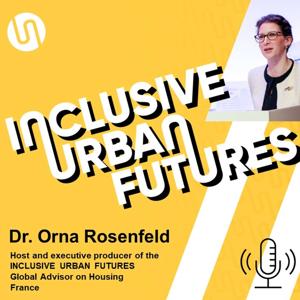
Inclusive Urban Futures explores one of the defining questions of our time: how do we build inclusive urban futures in a world shaped by rapid urbanisation, technological disruption, demographic…
Hosted by Dr. Orna Rosenfeld, global advisor on housing systems, investment and inclusion, the podcast brings together leaders, policymakers, researchers, investors, practitioners and innovators from around the world to examine the forces shaping the future of cities and societies.
Through conversations, reflections and thought leadership, Inclusive Urban Futures explores topics including housing affordability, urban development, social cohesion, migration, climate adaptation, digital transformation, artificial intelligence (AI), governance, and the evolving geography of urban growth. Episodes draw on perspectives from across disciplines, sectors and global regions, connecting global trends with practical experience and implementation.
Produced by the Inclusive Urban Futures Association, the podcast creates a space for dialogue across boundaries and borders — linking ideas with action, policy with practice, and ambition with delivery. It is a platform for exploring how inclusion can be embedded in the systems, institutions and investments that will shape the future of urban life.
Learn more: www.inclusiveurbanfutures.org
Contact: [email protected]