
Sign up to save your podcasts
Or



The conversation with Nancy Kobrin explores the psychology behind supremacism and shame-honor cultures, drawing on psychoanalysis and counterterrorism work. It examines why groups like Hamas and Hezbollah won't give up their weapons, how early maternal attachment and the failure to separate from the mother shape group behavior, and what October 7th revealed about herd mentality and rage. The conversation explores how victimhood, envy and the fear of public shame drive control over criticism, and how this has shaped the West's response since 9/11. It also looks at the role of education, the diaspora, and the tipping point at which cultures abandon harmful practices.Takeaways
Chapters
The conversation with Danny Burmawi explores the complexities of leaving Islam, the experiences of individuals who have distanced themselves from Islamic beliefs, and the psychological and cultural factors influencing their journeys. It delves into the challenges faced by those who attempt to reconcile their identities with their past beliefs, the role of triggers in this process, and the dynamics of cultural versus religious identity. The conversation explores the complexities of individual experiences within Islamic culture, particularly focusing on education, the struggle between personal beliefs and group dynamics, and the challenges faced by those who leave Islam. It delves into the psychological and cultural implications of de-Islamization, the role of triggers in this process, and the ongoing influence of Islamic identity on former Muslims, including those who identify as atheists or culturally Muslim. The conversation explores the complexities of individual and group dynamics within Islam, the challenges of cultural education, and the struggle for genuine belief amidst cognitive dissonance. It emphasizes the importance of personal relationships in fostering understanding and trust across cultural divides, while also addressing the legitimacy of new interpretations of Islam.
Takeaways
Chapters
The conversation with Harold Rhode explores the themes of Islamic warfare, the historical context of territorial claims in Islam, the challenges of compromise in peace processes, and the cultural dynamics of honor and shame that influence perceptions of conflict. Harold Rhode provides insights into the mindset of Islamic leaders and the West's misunderstanding of these dynamics, particularly in relation to the Israeli-Palestinian conflict. The conversation explores the complexities of Islamic identity, the impact of peer pressure on moderate voices, and America's role in addressing radicalism. It highlights the need for independent thinking within the Muslim community and the challenges posed by supremacist ideologies.
Takeaways
Chapters
The conversation explores the concept of Covenantal Pluralism in the context of interfaith dialogue, particularly focusing on Islam's historical and theological perspectives. It delves into the complexities of Islamic traditions, the impact of imperialism, and the importance of spirituality in fostering peaceful coexistence among diverse religious communities. The conversation explores the complexities of Islamic teachings, the historical context of the Prophet Muhammad, and the need for a peaceful interpretation of Islam that fosters coexistence. It emphasizes the importance of developing a covenantal theology that promotes harmony and understanding among different faiths.
Takeaways
Chapters
The conversation features Jasem Aljuraid, a Kuwaiti political refugee in Canada, discussing his journey from Kuwait to Canada, his experiences with censorship, and his advocacy for freedom of speech and human rights in the Middle East. He highlights the challenges he faced due to his liberal views on Israel and the backlash from radical Islamist groups, as well as his efforts to raise awareness about these issues in Canada. The conversation delves into the complexities of the Israeli-Palestinian conflict, exploring historical narratives, political dynamics, and the influence of Western perceptions on the situation. Jasem Aljuraid articulates a perspective that emphasizes the need for rational discourse and historical understanding while critiquing the current political landscape and its implications for peace.
Takeaways
Chapters
In this conversation, Danny Burmawi shares his experiences and insights on the ideological landscape surrounding Islam and the West, particularly in light of recent events. He discusses his journey from the Middle East to the United States, the implications of October 7th, and the need for a shift in how Western societies understand and engage with Islamic ideologies. The conversation delves into the complex relationship between Western ideologies and Islam, exploring themes of political alignment, societal fears, and the role of 'useful idiots' in perpetuating certain narratives. It emphasizes the need for open critique of Islam to foster understanding and progress.
Takeaways
Chapters
In this podcast episode, Juliana Taimoorazy interviews Uzay Bulut, a journalist and political analyst, discussing her journey from being a secular Muslim in Turkey to leaving Islam and advocating for the rights of religious minorities. The conversation explores themes of cultural identity, the impact of Islam on Western civilization, and the persecution of Christians in the Middle East.
Takeaways
Chapters
The conversation explores the complexities surrounding the Oslo peace process, highlighting the differing perspectives of Israelis and Palestinians, the failures of the peace camp, and the ideological underpinnings of Palestinianism. It emphasizes the need for a new political discourse that acknowledges Palestinian agency and the realities of the conflict.
Takeaways
Chapters
The conversation with Itamar Marcus of Palestine Media Watch explores the Oslo peace process, highlighting its misinterpretation and the dual messaging of the Palestinian Authority. Itamar Markus discusses the historical precedents of deception in negotiations and the ongoing challenges faced by Israel in understanding Palestinian intentions. The conversation delves into the complexities of the Israeli-Palestinian conflict, emphasizing the misconceptions surrounding peace processes and the psychological dynamics at play in Europe. Itamar and Richard discuss the need for awareness and leadership to address these issues effectively.
Takeaways
Chapters
The conversation features Coptic Kapara (Michael Gamal) discussing his journey from extremism and anti-Semitism to Israel advocacy, highlighting key moments that shifted his perspective. He reflects on the complexities of identity, the impact of political narratives, and the challenges of discussing Islam and its implications in the West. The conversation delves into the complexities of criticism towards Islam, the dynamics of Western perceptions of Muslims, and the implications of political Islam. It explores the challenges of free speech, the role of media, and the societal consequences of radicalization.
Takeaways
Chapters
From the publisher's feed
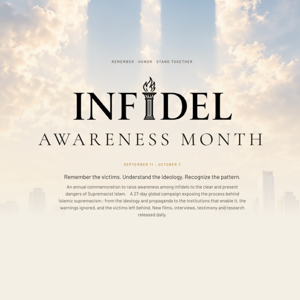
The podcast in support of Infidel Awareness Month.
Remember the victims. Understand the ideology. Recognize the pattern.
An annual commemoration to raise awareness among…
A 27-day global campaign exposing the process behind Islamic supremacism; from the ideology and propaganda to the institutions that enable it, the warnings ignored, and the victims left behind.
New films, interviews, testimony and research released daily.