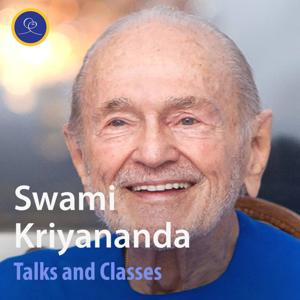
Inspiring Talks and Classes by Swami Kriyananda — a Disciple of Paramhansa Yogananda

Inspiring Talks and Classes by Swami Kriyananda — a Disciple of Paramhansa Yogananda

Download on the App Store

Inspiring Talks and Classes by Swami Kriyananda — a Disciple of Paramhansa Yogananda episodes

  • Swami Kriyananda: Easter Talk 2013 in Assisi (Italian with English Subtitles)
    Swami Kriyananda's talk at Ananda Assisi on Easter Sunday, remastered with two cameras in full HD. English subtitles are available through YouTube captions.
    In this talk, his last public address before his passing three weeks later, Swami Kriyananda opens by having an aide read aloud a letter he wrote. In it, he speaks with unusual candor about physical and spiritual exhaustion, describing a "personal Armageddon" in which worldly attachments, achievements, and even his own fame have become meaningless to him. At the same time, his love for Ananda devotees has only deepened.
    He shares about recent health setbacks (sudden hearing loss, colitis, pneumonia, several falls) with characteristic humor before turning to his Easter message: that resurrection symbolizes the soul's awakening from the illusion of ego into oneness with God. He weaves in teachings on karma and reincarnation, the story of the Sufi saint Rabia on true love of God, and the idea that suffering dissolves in the presence of divine joy. He closes by urging listeners to share joy with others as a form of service.
    29 min
  • Calming the Heart's Feelings
    "Whatever comes of itself, let it come." Swami Kriyananda says, "I think you'll find great freedom in that." Feelings tie us to the ego and make us restless. Only when we become calm, but not apathetic, can we perceive truth. The way to become calm is by not being attached to the body. When you're not attached to the body, then nothing will bother you.
    Questions include:
      Should we endure emotional pain?
      How do you accept the currents of life when you still feel hurt?
      Is it possible to forgive someone who isn't alive anymore?
      The conversation centers on calming the heart's feelings as a path to liberation and overcoming delusion. It explains that our feelings create waves of separateness on the ocean of spirit, tying us to the ego and preventing us from perceiving the divine. The key is to calm these waves by not reacting to external events with strong emotions like happiness, sadness, love, or hate.
      Swami Kriyananda emphasizes that calmness doesn't mean apathy, but rather accepting everything with joy and detachment. He shares personal anecdotes to illustrate how refusing to be bothered by pain or adversity can lead to inner peace. He further explains that forgiveness is crucial, and it begins with oneself by accepting that everything, even negative experiences, is part of one's karma and ultimately guided by God.
      Kriyananda suggests placing one's security in God and trusting that everything will work out, even if it doesn't align with our expectations. He defines God as the highest potential one can imagine for themselves and encourages listeners to move towards inspiration, peace, kindness, and love.

      14 min
    • The Importance of Seeing God as the Doer
      One key way to overcome the ego, Kriyananda explains, is to practice the presence of God — to see Him doing everything, both good and bad, through you.
      Questions include:
        You talked about the ways of getting rid of the ego as being willpower, self-offering… are there other ways?
        How about in daily, moment-to-moment life, to become more free?
        On the spiritual path, people need to take responsibility for what comes to them — how do you reconcile this with the practice of seeing God as the Doer?
        It's not that we ignore evil necessarily, it's just that we don't concentrate on it?
        You mentioned the practice of keeping your attention at the point between the eyebrows — is that good to do all of the time?
        14 min
      • How to Begin on the Spiritual Path
        Spirituality begins when you start thinking: "What is true? How can I discover what life is all about?"
        The goal of spirituality, Swami Kriyananda explains further, is to become free of the ego — and he talks about the ways to do so.
          Many people are interested in spirituality, but don't know where to start. Do you have any advice for these people?
          Can you recommend any books?
          I've heard it said that "It is a blessing to be born into a religion but a misfortune to die in one." What does that mean?
          If a seeker comes across a teacher, how can they know if he is a true teacher?
          What is the role of the guru?
          What qualities of the Higher Self are there? — So we can know when we are reaching it?
          What is the best way to pray?
          How can you overcome the ego?
          14 min
        • The Benefits of Right Attitude
          Every attitude is self-reinforcing, Swami Kriyananda shows in this recording. Negative attitudes are wrong not because religions say they are wrong, but because they make us less happy. The best way to change an attitude is to change our own state of consciousness.
          Questions include:
            I'd like to ask you about the right attitudes in which to live. Many people have a fear of death, for example. How does one overcome that?
            Is there more involved than just positive thinking?
            How does one overcome judgment of others?
            14 min
          • Education
            We want to fill children not just with knowledge, but with the ability to use that knowledge to help others, says Swami Kriyananda. That requires from the student a certain level of spiritual evolution.
            Topics of discussion include the caste system in India, racial prejudice in America, the Education for Life education system founded by Swami Kriyananda, and the scale of organizations.
            We can help everyone rise to their own natural level of perfection.
            Questions include:
              Among many challenges facing our education system is the question, Can you educate all children equally?
              True teaching is individual, then — it has to relate to the level of consciousness of the individual student?
              Do you think a smaller scale is the way of the future?
              14 min
            • What Is True Self-Sufficiency
              Self-sufficiency is very important, but it doesn't mean that you need to live alone. Having the support of others is very strengthening.
              Questions include:
                In this age, there's a lot of talk about being self-sufficient — to get away from all the political drama, the economic crisis — could you talk a little bit about self-sufficiency?
                It seems like your own energy is extremely important to what you experience?
                Is material self-sufficiency a pre-requisite for spiritual self-sufficiency?
                Can one develop self-sufficiency spiritually?
                When we have a supportive environment around us, are we dependent on that environment?
                14 min
              • What Is Courage?
                We have to stop justifying our wrong actions, Swami Kriyananda says. Courage is the willingness to accept whatever comes, because the results, the benefits, are worth the difficulty.
                Questions include:
                  How can we accept where we are and grow at the same time?
                  What is courage?
                  Courage must be rooted in faith, then. Otherwise, how would you know to continue on?
                  Does discouragement relate to courage?
                  How can one not be discouraged in, say, a situation like a concentration camp?
                  Was Yogananda ever discouraged?
                  Were people in America ready to hear what he had to share?
                  Did he run into prejudice because of his dark complexion?
                  14 min
                • The Law of Magnetism
                  The world is consciousness, and responds consciously to our intentions and energy. The law of magnetism operates automatically and can also be controlled at will.
                  Questions include:
                    Could you describe the law of magnetic attraction?
                    What you're describing sounds like it could be dangerous.
                    It sounds like the law operates automatically, but it is possible to operate it consciously?
                    Can inspiration be drawn by will power?
                    I read a book, Talks with Great Composers, and Handel's Messiah seems to have come in a similar way.
                    When you receive an inspiration, does it come fully formed?
                    For people just starting out and trying to develop these things, what can they do?
                    Would it help to mix with a certain type of people?
                    14 min
                  • Religion vs. Spirituality
                    Religion is the form — of rituals and beliefs — and spirituality is your relationship with God.
                      How would you differentiate between religion and spirituality?
                      Does God have a particular form?
                      How did reading Autobiography of a Yogi change your life?
                      What does intuition mean to you?
                      How can we develop intuition?
                      14 min

                    About Inspiring Talks and Classes by Swami Kriyananda — a Disciple of Paramhansa Yogananda

                    From the publisher's feed

                    Inspiring talks and classes by Swami Kriyananda, a direct disciple of Paramhansa Yogananda. This is a collection of all the other talks.