InvasIC Seminar: Vorträge im SFB/TRR 89 (HD 1280 - Video & Folien)

InvasIC Seminar: Vorträge im SFB/TRR 89 (HD 1280 - Video & Folien)

By Prof. Dr. Jürgen TeichEducation
Download on the App Store

InvasIC Seminar: Vorträge im SFB/TRR 89 (HD 1280 - Video & Folien) episodes

  • Control-theoretic approaches to Energy Minimization under Soft Real-Time Constraints 2011/2012
    Embedded real-time systems must meet timing constraints while minimizing energy consumption. To this end, many energy optimizations are introduced for specific platforms or specific applications. These solutions are not portable, however, and when the application or the platform change, these solutions must be redesigned. Portable techniques are hard to develop due to the varying tradeoffs experienced with different application/platform configurations. This talk addresses the problem of finding and exploiting general tradeoffs, using control theory and mathematical optimization to achieve energy minimization under soft real-time application constraints. The talk will discuss the general idea behind the use of control theory for optimizing the behavior of computing systems and will delve into details about energy optimization with deadline constraints, presenting results obtained on different architectures - thus considered portable - and with different benchmarks. The use of control theory and system identification enables the exploitation of the mentioned tradeoffs on different architectures.
    52 min
  • Bytespresso, toward embedded domain-specific languages for supercomputing 2011/2012
    As complex hardware architecture is widely adopted in high-performance computing (HPC), average HPC programmers are faced with serious difficulties in programming in a general-purpose language. Thus domain-specific languages (DSLs) are actively studied for HPC as a solution. DSLs are categorised into external DSLs and embedded DSLs. The latter DSLs are easy to develop but its expressiveness and execution performance are drawbacks. This talk present two techniques we are developing. The first one is protean operators, which give DSLs more flexible syntax, and the latter is deep reification, which is a language mechanism for helping DSL developers implement a more efficient DSL. Bytespresso is our prototype system to examine the idea of deep reification in Java. It is a platform of embedded DSLs in which DSL code is offloaded to external hardware for execution after domain-specific translation.
    51 min
  • Elastic Computing - Towards a New Paradigm for Distributed Systems 2011/2012
    In this talk, which is based on our newest findings and experiences from research and industrial projects, I addressed one of the most relevant challenges for a decade to come: How to integrate the Internet of Things with software, people, and processes, considering modern Cloud Computing and Elasticity principles. Elasticity is seen as one of the main characteristics of Cloud Computing today. Is elasticity simply scalability on steroids? This talk addresses the main principles of elasticity, presents a fresh look at this problem, and examines how to integrate people, software services, and things into one composite system, which can be modeled, programmed, and deployed on a large scale in an elastic way. This novel paradigm has major consequences on how we view, build, design, and deploy ultra-large scale distributed systems.

    1 hr
  • Elastic Computing - Towards a New Paradigm for Distributed Systems 2011/2012
    In this talk, which is based on our newest findings and experiences from research and industrial projects, I addressed one of the most relevant challenges for a decade to come: How to integrate the Internet of Things with software, people, and processes, considering modern Cloud Computing and Elasticity principles. Elasticity is seen as one of the main characteristics of Cloud Computing today. Is elasticity simply scalability on steroids? This talk addresses the main principles of elasticity, presents a fresh look at this problem, and examines how to integrate people, software services, and things into one composite system, which can be modeled, programmed, and deployed on a large scale in an elastic way. This novel paradigm has major consequences on how we view, build, design, and deploy ultra-large scale distributed systems.
    1 hr
  • Energy-Efficient Algorithms 2011/2012
    We study algorithmic techniques for energy savings in computer systems. Research in this area concentrates mostly on two topics. (1) Power-down mechanisms: When a system is idle, it can be transitioned into low power stand-by or sleep states. The goal is to find state transition schedules that minimize the total energy consumption. (2) Dynamic speed scaling: Many modern microprocessors can operate at variable speed. Here the objective is to utilize the full speed/frequency spectrum of a processor so as to optimize the consumed energy and possibly a second QoS measure. This lecture investigates a variety of settings and presents recent research results. The focus is on the design of algorithms that achieve a provably good performance.
    1 hr 27 min

About InvasIC Seminar: Vorträge im SFB/TRR 89 (HD 1280 - Video & Folien)

From the publisher's feed

http://invasic.de

More shows like InvasIC Seminar: Vorträge im SFB/TRR 89 (HD 1280 - Video & Folien)

Lineare Algebra I by Prof. Dr. Peter Knabner

Lineare Algebra I

0 Listeners

Foundations of Quantum Mechanics by Prof. Dr. Florian Marquardt

Foundations of Quantum Mechanics

2 Listeners

Die Hanse im ersten Globalisierungszeitalter (1200-1500) by Prof. Dr. Stuart Jenks

Die Hanse im ersten Globalisierungszeitalter (1200-1500)

0 Listeners

Lectures on Quantum Theory (Elite Graduate Programme) 2015 -Measurements by Dr. Frederic P. Schuller

Lectures on Quantum Theory (Elite Graduate Programme) 2015 -Measurements

1 Listeners

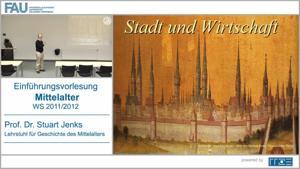
Einführungsvorlesung Mittelalter by Prof. Dr. Stuart Jenks

Einführungsvorlesung Mittelalter

0 Listeners

ZKI AK CM 12/10 by Wolfgang Wiese

ZKI AK CM 12/10

0 Listeners

Lectures on the Geometric Anatomy of Theoretical Physics by Dr. Frederic P. Schuller

Lectures on the Geometric Anatomy of Theoretical Physics

6 Listeners

Quantum Computing by Prof. Dr. Michael J. Hartmann

Quantum Computing

0 Listeners

AG Mathematics of Deep Learning by Prof. Dr. Daniel Tenbrinck

AG Mathematics of Deep Learning

0 Listeners