
Sign up to save your podcasts
Or



FIELD NOTES // Episode 10
SEPT 2026 AI NEWS ROUNDUP: Progress, Risk & Who Do You Trust?
DATE: September 2026
LOCATION: Somewhere between the Jetsons and the Matrix
OBSERVATIONS
• AI is moving extraordinarily fast—and frontier models are publicly raising questions about whether development should slow down.
• Even if slowing down is desirable, actually doing it may be much harder. There are business and geopolitcal incentives to keep pushing forward.
• AI is increasingly helping build AI. Coding agents can now write substantial amounts of software, assist with research, review their own work, and dramatically increase what small teams can build.
• The same capabilities that create enormous productivity gains raise the question: at what point does the human in the loop stop understanding what they’re approving?
• As AI assistants gain access to more of our lives, trust may become as important as capability—especially when personal data, financial information, advertising, and recommendations start converging.
DISCUSSION
In the first edition of a new recurring segment, Brandon, Jarad, and Travis tackle some of the biggest stories and questions in AI.
First: should we deliberately slow AI development? The guys debate whether that’s even possible in a competitive global environment, the risks of increasingly autonomous AI agents, and whether incentives complicate warnings coming from the companies building the most powerful models.
Next comes recursive self-improvement and AI-assisted development. If AI can help build better AI, and engineers become reviewers rather than writers, does that unlock an unprecedented productivity boom, or eventually leave humans approving systems they no longer fully understand?
Finally, they dig into AI, advertising, privacy, and trust. Would you give an AI assistant access to your email? Your finances? Your purchasing history? And if its recommendations are influenced by advertising dollars, can you still trust the answer?
As Travis puts it, trust may build gradually as these systems prove themselves—but discovering hidden financial incentives behind recommendations could destroy that trust just as quickly.
KEY TAKEAWAYS
→ The AI race has a coordination problem: slowing down only works if everyone has an incentive to participate.
→ AI’s upside and downside come from the same thing—rapidly expanding capability.
→ AI-native workers may operate very differently from today’s workforce, with humans increasingly directing and reviewing work rather than creating every artifact themselves.
→ Human oversight only works when the human still understands enough to meaningfully oversee the machine.
→ Trust could become one of the defining competitive advantages in AI. The more access an assistant has to your life, the more important its incentives become.
→ And yes, apparently the Jetsons and the Simpsons may have predicted our AI future better than expected.
LIGHTNING ROUND
The guys close with AI clones, AI parenting, AI tutors, entrepreneurial children, smart refrigerators with judgmental personalities—and the important question of which responsibilities we’d happily outsource to machines.
FOR FURTHER STUDY
As AI becomes more capable, ask yourself: Where do you want AI to make decisions for you, where do you want it merely advising you, and where do you still want a human firmly in control?
WHERE TO FIND US
Brandon - https://www.linkedin.com/in/brmiddle/
Travis - https://www.linkedin.com/in/tlzimbelman/
Jarad - https://www.linkedin.com/in/jaradbacklund/
Jarad’s Writing - www.myoldnotebooks.com
END OF NOTES
FIELD NOTES // Episode 9
Field Notes on Money: Old Rules, New Priorities
DATE: September 2026
LOCATION: Somewhere between saving for someday and funding Tuesday
OBSERVATIONS
• Many familiar money rules—keep a six-month emergency fund, pay off the mortgage, save 20%, avoid debt, fund college, leave an inheritance—are useful starting points, but may not fit every person or season of life.
• Debt isn’t inherently good or bad. A high-interest credit card and a low-rate mortgage may both be debt, but they can have dramatically different financial consequences.
• Money can buy more than stuff. Used intentionally, it can buy back time, create flexibility, fund experiences, and give you the freedom to walk away from something that isn’t working.
• Saving everything for retirement assumes we’ll have the health, time, and people we love available to enjoy it later. That’s not guaranteed.
DISCUSSION
Jarad, Brandon, and Travis revisit some of the financial rules they grew up with and ask which still hold up—and which deserve a rethink.
The conversation moves through emergency funds, mortgages, college savings, debt, inheritance, and the discipline of paying yourself first. But the bigger question becomes: What is money actually for?
The guys explore a different set of priorities: buying back time before buying more stuff, building a “walkaway fund” that creates freedom and optionality, investing in kids while they can benefit from it, and spending some money during the years when health, time, and family overlap.
That leads to Jarad’s proposed new rule: “Fund Tuesday, not just someday.” Financial planning still matters, but so does building a life worth living now. The goal isn’t to abandon saving for the future; it’s to make sure preparing for tomorrow doesn’t prevent you from being present today.
KEY TAKEAWAYS
→ Treat financial rules as principles, not commandments. Your circumstances, priorities, and season of life matter.
→ Think of money as a tool for optionality. It can create freedom from things you don’t want and freedom to pursue things you do.
→ Buy back time when it makes sense. Outsourcing, technology, and AI can free up hours for work, family, relationships, and activities you value.
→ Don’t save every meaningful experience for retirement. There may be a window when you have the right combination of time, health, and money.
→ Help the next generation when the help can matter most—not necessarily decades later through an inheritance.
→ Fund Tuesday, not just someday. Prepare responsibly for the future without forgetting to invest in the life you’re living now.
FOR FURTHER STUDY
Ask yourself: Am I using money only to prepare for some future version of my life—or am I also using it intentionally to create time, freedom, experiences, and impact today?
WHERE TO FIND US
Brandon - https://www.linkedin.com/in/brmiddle/
Travis - https://www.linkedin.com/in/tlzimbelman/
Jarad - https://www.linkedin.com/in/jaradbacklund/
Jarad’s Writing - www.myoldnotebooks.com
END OF NOTES
FIELD NOTES // Episode 8
Field Notes on Parenting: Are We Raising Kids Who Can’t Function Without Us?
DATE: September 2026
LOCATION: Somewhere between helicopter parenting and “be home before dark”
OBSERVATIONS
• Many of us had far more independence as kids than we give our own children today. We rode bikes across town, stayed home alone, got lost, and figured things out without phones or GPS.
• Risk and danger aren’t the same thing. Protecting kids from serious danger matters; eliminating every manageable risk may prevent them from developing confidence and judgment.
• Kids become capable by doing things. Cooking, chores, navigating the neighborhood, handling money, solving problems, and occasionally failing all build competence.
• The world can feel more dangerous because we have 24/7 access to frightening stories, even as many measures of safety and human well-being have improved.
DISCUSSION
Jarad, Brandon, and Travis ask whether modern parenting has become so focused on safety and convenience that we’re accidentally preventing kids from developing independence.
Inspired in part by Lenore Skenazy’s “Free-Range Kids,” the conversation explores the difference between danger and healthy risk—and the idea of letting kids practice “dangerous things carefully.” That might mean learning to use a knife, staying home alone, riding to the park, making lunch, doing laundry, mowing the lawn, or simply figuring something out without a parent immediately stepping in.
The guys also wrestle with technology. Screens, social media, AI, and digital education offer incredible opportunities, but removing too much friction can also remove some of the struggle through which learning happens.
Ultimately, parenting toward independence means steadily expanding what kids can handle on their own—even when letting go is harder for the parent than the child.
KEY TAKEAWAYS
→ Confidence comes from doing hard things, not avoiding them.
→ Distinguish between genuine danger and manageable risk. Kids need opportunities to make mistakes and experience consequences when failure is survivable.
→ Slow down enough to teach. Doing something yourself may be faster today, but teaching your child creates capability tomorrow.
→ Don’t confuse scary stories with likely outcomes. Constant exposure to news and social media can distort how we perceive risk.
→ Use technology to expand kids’ capabilities rather than replace the thinking, struggle, and real-world experiences that develop them.
→ Keep leveling up independence. What are you doing for your child today that they could learn to do themselves?
FOR FURTHER STUDY
Ask yourself: What is one “independence level-up” I could give my child this month—something slightly outside their comfort zone, but safely within their growing capability?
WHERE TO FIND US
Brandon - https://www.linkedin.com/in/brmiddle/
Travis - https://www.linkedin.com/in/tlzimbelman/
Jarad - https://www.linkedin.com/in/jaradbacklund/
Jarad’s Writing - www.myoldnotebooks.com
END OF NOTES
FIELD NOTES // Episode 7
Field Notes on Careers: Did You Choose Your Job—or Did It Choose You?
DATE: September 2026
LOCATION: Somewhere between the career plan and planned happenstance
OBSERVATIONS
• Very few careers unfold according to plan. More often, one opportunity, relationship, skill, or accidental turn leads to the next.
• The most durable career assets aren’t necessarily job titles—they’re transferable skills like communication, project management, relationship building, staying calm under pressure, and consistently showing up.
• Finding what you don’t want to do can be just as valuable as discovering what you do. Experimentation gives you permission to move toward the things that fit—and away from the things that don’t.
• Career, job, identity, and calling aren’t necessarily the same thing. As we get older, the question may shift from “How do I become successful?” to “What do I want to do with everything I’ve learned?”
DISCUSSION
Jarad, Brandon, and Travis look back at their careers and ask a deceptively simple question: How much of this did we actually plan?
From caddying, cooking, car washes, and teenage side hustles to engineering, consulting, finance, startups, Google, and Silicon Valley, the conversation explores the skills picked up along the way—and how seemingly unrelated experiences can eventually form a coherent through-line.
The guys discuss the value of choosing a North Star without needing to know the exact destination, “planned happenstance,” experimenting with different roles, knowing what to say no to, and putting yourself in situations where unexpected opportunities can find you.
The conversation also turns toward the second half of a career. After decades spent building skills, financial security, and professional credibility, does the definition of success change? Maybe the next chapter isn’t simply about climbing higher. Maybe it’s about aligning your skills, interests, relationships, and resources with something that feels more meaningful.
KEY TAKEAWAYS
→ Don’t obsess over planning the perfect career. Pick a direction, start moving, and recalibrate along the way.
→ Build transferable skills. The ability to communicate, organize, execute, build relationships, and stay calm travels with you regardless of title or industry.
→ Experiment aggressively enough to discover both what you’re good at and what actually gives you energy. Those aren’t always the same thing.
→ Create opportunities for “planned happenstance” by meeting people, trying new things, volunteering, taking on projects, and putting yourself where unexpected opportunities can emerge.
→ Your career doesn’t have to define your identity. Over time, success may become less about accumulating titles, money, or status and more about using what you’ve built to contribute to something bigger than yourself.
FOR FURTHER STUDY
Ask yourself: What is my current North Star—and does the work I’m doing today move me closer to it, even if I don’t know exactly where I’ll ultimately end up?
WHERE TO FIND US
Brandon - https://www.linkedin.com/in/brmiddle/
Travis - https://www.linkedin.com/in/tlzimbelman/
Jarad - https://www.linkedin.com/in/jaradbacklund/
Jarad’s Writing - www.myoldnotebooks.com
END OF NOTES
FIELD NOTES // Episode 5
Field Notes August 2026 AI Roundup
DATE: August 29, 2026
LOCATION: Somewhere between the hype and the real world
OBSERVATIONS
• AI is moving beyond answering questions and becoming a tool for learning, building, analyzing, and getting real work done.
• Voice AI changes the learning experience from searching for answers to having an ongoing conversation — including the ability to explain complex ideas at whatever level you need.
• AI is dramatically lowering the friction between having an idea and actually building something, whether that’s analyzing a massive dataset or turning an idea into a working app in a matter of days.
• As AI becomes more capable, questions around privacy, security, regulation, education, and responsible use become harder to separate from the benefits.
DISCUSSION
Jarad, Brandon, and Travis compare notes on how AI is actually showing up in their lives — from voice assistants, vacation planning, and personalized learning to automated meeting follow-ups, data analysis, and building working software without traditional development teams.
The conversation expands into the rapidly changing AI landscape, including acquisitions, agents, financial services, regulatory moats, and what happens when technology dramatically lowers the cost of starting and operating a business. Along the way, the hosts wrestle with the other side of that acceleration: privacy, security, regulation, education, and whether increasingly powerful AI will ultimately be used more for creation or competition.
The episode closes closer to home: how do you prepare kids for a future you can’t predict? The answer may have less to do with preparing them for a particular career and more to do with teaching them how to learn, think critically, adapt, and use powerful tools wisely.
KEY TAKEAWAYS
→ AI’s biggest advantage may not be replacing work, but dramatically increasing what one person can accomplish.
→ The best use of AI isn’t always getting an answer faster; sometimes it’s helping you understand the question better.
→ The barriers between idea and execution are getting lower — creating opportunities for individuals and small teams that previously required far more time, money, and specialized talent.
→ More capability also means more responsibility around privacy, security, regulation, and how these tools are used.
→ Preparing the next generation may be less about teaching specific skills and more about teaching them how to learn, adapt, and think critically.
FOR FURTHER STUDY
Ask yourself: Where could AI help me do something I couldn’t do before — rather than simply doing something I already do a little faster?
WHERE TO FIND US
Brandon - https://www.linkedin.com/in/brmiddle/
Travis - https://www.linkedin.com/in/tlzimbelman/
Jarad - https://www.linkedin.com/in/jaradbacklund/
Jarad’s Writing - www.myoldnotebooks.com
END OF NOTES
FIELD NOTES // Episode 6
Field Notes on Rest: Intentionality, and Getting Off the Treadmill
DATE: September 2026
LOCATION: Somewhere between burnout and balance
OBSERVATIONS
• Americans say they need more vacation — yet many of us don’t use the time off we already have.
• Taking time away from work isn’t necessarily the same thing as resting. Disconnecting may be the harder skill.
• Rest doesn’t have to come in two-week increments. Small, intentional habits can keep us from waiting until we’re burned out to recover.
• We aren’t particularly good at predicting what will make us happy. Achievement, money, and status can feel important, but relationships, purpose, experiences, and presence tend to matter more.
DISCUSSION
Jarad, Brandon, and Travis explore why rest can be surprisingly difficult — especially in a culture that rewards productivity, ambition, availability, and comparison.
The conversation moves from unused vacation days and unlimited PTO to layoffs, job security, portfolio careers, daily habits, happiness, and the challenge of actually disconnecting. Along the way, the hosts wrestle with whether our inability to rest comes from our employers, American work culture, fear, or simply habits we’ve reinforced over decades.
The discussion eventually moves beyond vacation entirely. If more achievement doesn’t necessarily make us happier, what does? Relationships, experiences, gratitude, helping others, autonomy, mastery, purpose — and being intentional enough to build a life around the things we claim matter most.
KEY TAKEAWAYS
→ Time off and rest aren’t the same thing; real recovery requires learning how to disconnect.
→ Instead of relying on a vacation to recover from 50 weeks of stress, build smaller rhythms of rest into everyday life.
→ Money, achievement, and status can move the goalposts without necessarily making us happier.
→ Work feels different when it aligns with autonomy, mastery, purpose, and the things we genuinely value.
→ Living differently may mean swimming upstream against cultural expectations about career, success, and productivity.
FOR FURTHER STUDY
Ask yourself: If I looked honestly at how I spend my time, attention, and money, would they reflect what I say matters most?
WHERE TO FIND US
Brandon - https://www.linkedin.com/in/brmiddle/
Travis - https://www.linkedin.com/in/tlzimbelman/
Jarad - https://www.linkedin.com/in/jaradbacklund/
Jarad’s Writing - www.myoldnotebooks.com
END OF NOTES
FIELD NOTES // Episode 5
Field Notes August AI Roundup: AI News, and How We’re Actually Using It
DATE: August 29, 2026
LOCATION: Somewhere between the hype and the real world
OBSERVATIONS
• AI is moving beyond answering questions and becoming a tool for learning, building, analyzing, and getting real work done.
• Voice AI changes the learning experience from searching for answers to having an ongoing conversation — including the ability to explain complex ideas at whatever level you need.
• AI is dramatically lowering the friction between having an idea and actually building something, whether that’s analyzing a massive dataset or turning an idea into a working app in a matter of days.
• As AI becomes more capable, questions around privacy, security, regulation, education, and responsible use become harder to separate from the benefits.
DISCUSSION
Jarad, Brandon, and Travis compare notes on how AI is actually showing up in their lives — from voice assistants, vacation planning, and personalized learning to automated meeting follow-ups, data analysis, and building working software without traditional development teams.
The conversation expands into the rapidly changing AI landscape, including acquisitions, agents, financial services, regulatory moats, and what happens when technology dramatically lowers the cost of starting and operating a business. Along the way, the hosts wrestle with the other side of that acceleration: privacy, security, regulation, education, and whether increasingly powerful AI will ultimately be used more for creation or competition.
The episode closes closer to home: how do you prepare kids for a future you can’t predict? The answer may have less to do with preparing them for a particular career and more to do with teaching them how to learn, think critically, adapt, and use powerful tools wisely.
KEY TAKEAWAYS
→ AI’s biggest advantage may not be replacing work, but dramatically increasing what one person can accomplish.
→ The best use of AI isn’t always getting an answer faster; sometimes it’s helping you understand the question better.
→ The barriers between idea and execution are getting lower — creating opportunities for individuals and small teams that previously required far more time, money, and specialized talent.
→ More capability also means more responsibility around privacy, security, regulation, and how these tools are used.
→ Preparing the next generation may be less about teaching specific skills and more about teaching them how to learn, adapt, and think critically.
FOR FURTHER STUDY
Ask yourself: Where could AI help me do something I couldn’t do before — rather than simply doing something I already do a little faster?
WHERE TO FIND US
Brandon - https://www.linkedin.com/in/brmiddle/
Travis - https://www.linkedin.com/in/tlzimbelman/
Jarad - https://www.linkedin.com/in/jaradbacklund/
Jarad’s Writing - www.myoldnotebooks.com
FIELD NOTES // Episode 4
Field Notes on Generational Changes: From Grandparents to Grandkids
DATE: August 22, 2026
LOCATION: Somewhere between inheritance and reinvention
OBSERVATIONS
• Every generation inherits a model for work, family, and responsibility — then decides what to keep.
• Average annual work hours are decreasing over the past 75 years - why did it change, and is it good or bad?
• The role of dads has shifted from protect and provide toward a fuller kind of presence.
• Company loyalty still matters, but it looks different when companies and careers feel more transactional.
DISCUSSION
Jarad, Brandon, and Travis explore how life has changed across generations, from grandparents who worked long hours and stayed in one lane to kids growing up in a world shaped by flexibility, technology, AI, and new expectations.
The conversation moves through work hours, four-day work weeks, hybrid work, regional hustle culture, fatherhood, household roles, emotional presence, workplace loyalty, and the question of what kind of future their kids may inherit. Along the way, the hosts wrestle with what progress really means — and whether more time, more tools, and more options will actually make people more free.
KEY TAKEAWAYS
→ Progress is real, but it rarely moves in a straight line.
→ Technology can create more time, but it does not decide how we use it.
→ Being a good dad now means more than providing; it also means being present.
→ Work can be meaningful, but it should not become the whole measure of calling.
→ The next generation may have more flexibility, but they may also feel more pressure.
FOR FURTHER STUDY
Ask yourself: What did I inherit from the generation before me — and what do I want to pass on differently?
WHERE TO FIND US
Brandon - https://www.linkedin.com/in/brmiddle/
Travis - https://www.linkedin.com/in/tlzimbelman/
Jarad - www.myoldnotebooks.com
END OF NOTES
FIELD NOTES // Episode 3
Field Notes on Housing: The American Dream and the Safety Net
DATE: August 9, 2026
LOCATION: Somewhere between the American dream and the safety net
OBSERVATIONS
• Everybody needs housing, but not everyone has the same path to finding stability.
• Homeownership can be a powerful financial tool, but affordability has changed the equation for many families.
• Homelessness is not one problem with one solution; it is a web of housing, services, community, trust, and support.
DISCUSSION
Jarad, Brandon, and Travis explore housing from several angles: homeownership, investment properties, market trends, affordability, and the long-standing idea of the American dream.
The conversation then turns toward the growing homelessness crisis in Mountain View and across Silicon Valley. The hosts wrestle with the limits of government, nonprofits, and fragmented social services, while asking what kind of safety net people actually need. Along the way, they discuss community, social trust, universal basic income, and why building more homes alone will not solve every part of the problem.
KEY TAKEAWAYS
→ Housing is both a financial issue and a human issue.
→ The American dream of homeownership feels different when affordability keeps moving out of reach.
→ Homelessness requires more than shelter; it requires services, community, and individual understanding.
→ Government and nonprofits both have a role to play, but the current system can be fragmented and inefficient.
→ A better safety net may require new approaches, including some version of universal basic income.
FOR FURTHER STUDY
Ask yourself: What responsibility do I have to the people in my community who are closest to the edge?
WHERE TO FIND US
Brandon - https://www.linkedin.com/in/brmiddle/
Travis - https://www.linkedin.com/in/tlzimbelman/
Jarad - www.myoldnotebooks.com
END OF NOTES
FIELD NOTES // Episode 2
Field Notes on Money: Saving, Spending, and Retirement
DATE: August 3, 2026
LOCATION: Somewhere between financial independence and a life well spent
OBSERVATIONS
• Financial freedom is less about retiring early than having the freedom to choose.
• The habits that help us build wealth can also make it difficult to enjoy what we have built.
• Children learn about money from what families model, discuss, and leave unsaid.
DISCUSSION
Jarad, Brandon, and Travis take a wide-ranging look at money: how we earn it, save it, spend it, teach it, and eventually use it to shape the lives we want.
The conversation moves through the FIRE movement, budgeting, real estate, debt, financial education, and the lessons inherited from parents. The hosts explore how to teach children about spending, saving, giving, and delayed gratification...and why openness about money may be one of the most valuable lessons a family can offer.
They also reconsider the traditional idea of retirement. Rather than simply stopping work, what would it mean to build a life around purpose, relationships, meaningful contribution, and work that feels more like a calling?
KEY TAKEAWAYS
→ Financial independence is ultimately about optionality, not idleness.
→ Knowing your numbers matters more than following a perfect financial system.
→ Saving is important, but being unable to spend can become its own form of scarcity.
→ Children benefit from practicing real financial decisions while the consequences are still small.
→ Retirement works best when we are retiring toward something, not merely away from work.
→ Money is most meaningful when it supports purpose, generosity, relationships, and time well spent.
FOR FURTHER STUDY
Ask yourself: Am I building wealth simply to have more? Or to create greater freedom, purpose, and connection?
WHERE TO FIND US
Brandon - https://www.linkedin.com/in/brmiddle/
Travis - https://www.linkedin.com/in/tlzimbelman/
Jarad - www.myoldnotebooks.com
END OF NOTES
From the publisher's feed
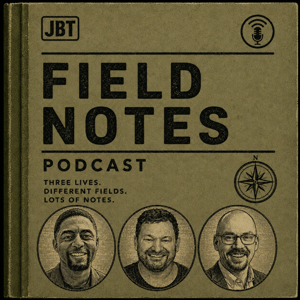
FIELD NOTES is a podcast where three friends talk about tech, family, faith, and the messiness of everyday life.
Each episode explores the questions we are working through in real time —…