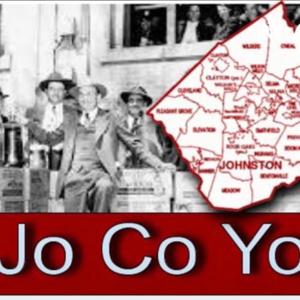
JoCoYo

JoCoYo

Download on the App Store

JoCoYo episodes

  • Put Me In Coach. I'm Ready to Play
    This year's World Series is over and a miracle happened. A baseball team from Washington somehow won the big one. Heck, the fact that any professional sports team from Washington won a championship is near-miraculous.
    Well, baseball wasn't always this big. In its purest form, baseball was small, like the towns that formed the teams. Sometimes, we had players that made it big. Maybe you've heard of them, maybe not. But Johnston's baseball and its history sorta reflect each other.
    Welcome to the Tobacco State League.
    20 min
  • I Coulda Been Somebody! I Coulda Been a Contender!
    In our stories of how the towns of Johnston came to be, we see that a lot of their existence was either by sheer fortune, or the whims of outsiders, Or both. So many of our communities That did not receive the fortune of a railroad were actually more cohesive And therefore better candidates to become municipalities than the ones that did receive railroad depots. This is the story of a few.
    17 min
  • A Town by Any Other Name Would Smell as Sweet.
    We have a pretty clear idea how some of the towns in Johnston and surrounding areas were established. Some were named for community leaders, geographic features, economic hubs. Others...yeah...not so sure.
    One named after a possum hunt? Really?
    This is the brief story of the names of Princeton, Four Oaks, and Archer Lodge
    10 min
  • Stuck in the Middle with You
    The towns of Wilson’s Mills and Micro Have been completely shaped by their position in between larger depots. Micro had to change its name and Wilson’s Mills had to die temporarily. Talk about middle child syndrome.
    11 min
  • Eat the Rich.
    You think you're hungry? Have you ever met a pine tree? Tobacco? Corn? They, like Mikey, will eat anything. 
    And everything. They are the plants that, if they were people at a restaurant, would eat all their food fast, then look at your plate and ask, "Are you gonna finish that?" Then, eat your scraps. They may even go to the kitchen insearch of more. 
    They don't do leftovers.
    What does that have to do with our communities? Well, for one town...everything.

    12 min
  • Let’s Go, Twins!
    Did you know that Johnston has its own Twin Cities? Born on the same day, for the same reason, and with the same purpose, the towns of Kenly and Benson are going to develop differently and not look quite the same. I guess they’re fraternal twins.
    20 min
  • Look Sharp!
    This is Part 5 of a 6 part series that shows just how Johnston's strongest connections to its neighbors came to be. In the late 1800's and early 1900's, so many things (and people) outside of Johnston, wove the web, so to speak. This episode is  about Selma and its Clayton connections.
    9 min
  • Red Clay Halo
    This is part of a series that shows just how Johnston's strongest connections to its neighbors came to be. In the late 1800's and early 1900's, so many things (and people) outside of Johnston, wove the web, so to speak. This episode is about Stallings Station/Gulley's Store. You know it as Clayton.
    10 min
  • Blue Jean Baby.
    This is Part 3 of a series that shows just how Johnston's strongest connections to its neighbors came to be. In the late 1800's and early 1900's, so many things (and people) outside of Johnston, wove the web, so to speak. This episode is about the town of Duke. It may be in Harnett, but the connections are undeniable. Oh, you can call it Erwin.
    8 min
  • Movin Out
    This is Part 2 of a series that shows just how Johnston's strongest connections to its neighbors came to be. In the late 1800's and early 1900's, so many things (and people) outside of Johnston, wove the web, so to speak.  This episode is about the towns of Lucknow and Troyville. They may be in Harnett, but the connections are undeniable.
    9 min

About JoCoYo

From the publisher's feed

One of the first descriptions of North Carolina by the English that would later colonize the area was given by Ralph Lane, the governor of the first attempted colony. In 1585, Gov. Lane referred to the land as "the goodliest soil under the cope of heaven" in his letters back to England.