
Sign up to save your podcasts
Or

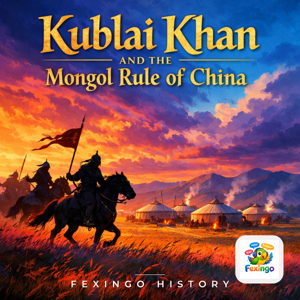


In this episode of Fexingo History, Lucas and Luna explore Kublai Khan's transformative relationship with Tibetan Buddhism. Discover how the Mongol emperor forged a priest-patron bond with the Sakya lama Drogön Chögyal Phagspa, granting him imperial preceptor status and unifying Tibet under Mongol protection. Learn about the creation of the 'Phagspa script—a universal writing system for the Yuan dynasty—and its impact on administration and culture. We also delve into the political and spiritual motivations behind Kublai's patronage, from legitimizing his rule over China to integrating diverse ethnic groups. Featuring details on the Sakya monastery, the role of Buddhism in the Yuan court, and the lasting consequences for Tibet, this episode offers a fresh angle on Kublai Khan's empire.
#KublaiKhan #TibetanBuddhism #Phagspa #Sakya #YuanDynasty #MongolEmpire #DrogonChogyalPhagpa #ImperialPreceptor #Buddhism #Tibet #CentralAsia #SteppeHistory #MongolHistory #ReligionAndPower #ScriptWriting #PaxMongolica #History #FexingoHistory
Keep every episode free: buymeacoffee.com/fexingo
In 1279, a fleet of thousands of ships clashed off the coast of Guangdong, marking the final, tragic end of the Song dynasty. After twenty years of war, Kublai Khan's Yuan forces cornered the last Song emperor—a seven-year-old boy—and his loyal court at Yamen. This episode tells the story of that desperate naval battle: the Han Chinese admiral Zhang Hongfan who commanded the Mongol fleet, the Song general Zhang Shijie who chained his ships together, and the scholar-official Lu Xiufu who jumped into the sea with the child emperor rather than surrender. We explore how the battle became a symbol of loyalty in Chinese culture, the role of defectors, and the finality of the Mongol conquest of China. This is a story of courage, betrayal, and the end of an era.
#Yamen #ZhangHongfan #LuXiufu #ZhaoBing #ZhangShijie #SongDynasty #YuanDynasty #KublaiKhan #MongolConquest #NavalBattle #1279 #ChinaHistory #SongLoyalists #WenTianxiang #History #FexingoHistory #MongolEmpire #SouthernSong
Keep every episode free: buymeacoffee.com/fexingo
In 1293, Kublai Khan launched a massive naval expedition to the island of Java, aiming to add the spice-rich kingdom to his empire. A fleet of over a thousand ships carrying 20,000 troops sailed from China to demand submission from the Javanese ruler. The Mongol commanders—Shi Bi, Gao Xing, and Yiqiechi—found a fractured island: the powerful kingdom of Singhasari had recently fallen, and its prince, Vijaya, was fighting a rebel named Jayakatwang. Vijaya cleverly allied with the Mongols to defeat his enemy, then turned on them, ambushing the invaders and forcing a humiliating retreat. The Java campaign, though a military failure, reveals Kublai's relentless ambition and the limits of Mongol power in Southeast Asia. This episode explores the motives, the key figures, the dramatic betrayal, and why this little-known invasion mattered for the Yuan dynasty's trade and prestige.
#KublaiKhan #JavaInvasion #MongolExpedition #YuanDynasty #ShiBi #GaoXing #Yiqiechi #Vijaya #Majapahit #Singhasari #Jayakatwang #SpiceTrade #SoutheastAsia #MongolNavy #1293 #MedievalHistory #FexingoHistory #History
Keep every episode free: buymeacoffee.com/fexingo
When Kublai Khan moved his capital to Dadu (modern Beijing), he faced a logistical nightmare: how to feed a city of half a million people from the fertile south. His solution was a massive reconstruction of China's ancient Grand Canal, a project that took four years, mobilized tens of thousands of laborers, and reshaped the country's geography. In this episode, Lucas and Luna explore the engineering feats behind the canal's new Shandong section—including the innovative use of locks and reservoirs by the brilliant Guo Shoujing—and the human cost of moving mountains of earth. They trace the route from Hangzhou to Dadu, discuss the grain shipments that sustained the Yuan capital, and reflect on how this water highway tightened Mongol control over China while inadvertently laying the groundwork for a unified national economy. The conversation also touches on the canal's role in cultural exchange and its lasting legacy as the longest artificial waterway in the world. A story of ambition, ingenuity, and the unseen infrastructure that holds empires together.
#GrandCanal #KublaiKhan #YuanDynasty #GuoShoujing #Dadu #BeijingHistory #ChineseInventions #CanalEngineering #MongolEmpire #MedievalChina #WaterTransport #Infrastructure #HistoryOfEngineering #ForcedLabor #GrainTribute #Hangzhou #Shandong #History
Keep every episode free: buymeacoffee.com/fexingo
After conquering China, Kublai Khan set his sights on the south, demanding submission from the kingdom of Đại Việt. When the Trần dynasty refused, the Mongols launched a massive invasion in 1285, led by Prince Toghon. But they faced an enemy unlike any before: a disciplined Vietnamese army under General Trần Hưng Đạo, who used guerrilla tactics, river defenses, and the legendary stake traps of Bạch Đằng River to devastating effect. This episode dives into the 1288 battle that shattered the Mongol fleet, the roles of Emperors Trần Nhân Tông and Trần Thánh Tông, and the surprising tribute arrangement that followed. Learn how the Mongols, for all their power, could not conquer the jungle and rivers of Vietnam, and how this war shaped Southeast Asian history.
#KublaiKhan #MongolInvasion #DaiViet #TranHungDao #BachDangRiver #VietnameseHistory #TrầnDynasty #MongolEmpire #YuanDynasty #PrinceToghon #BattleOfBachDang #SoutheastAsianHistory #MedievalWarfare #MongolFleet #History #FexingoHistory #Podcast #MongolConquests
Keep every episode free: buymeacoffee.com/fexingo
In this episode of Fexingo History, Lucas and Luna explore Kublai Khan's struggle to maintain authority over the vast Mongol Empire after his victory in the Toluid Civil War. Focus shifts to the persistent challenge posed by Kaidu, a grandson of Ögedei Khan, who led a rebellion from Central Asia that lasted decades. The conversation delves into the complex web of alliances and conflicts between the Yuan dynasty, the Chagatai Khanate, the Golden Horde, and the Ilkhanate, highlighting key figures like Baraq, Abaqa, and Ghazan. Lucas explains how Kublai's attempts to assert supremacy through military campaigns and diplomatic missions ultimately failed, leading to the permanent fragmentation of the Mongol world. The episode also examines the economic and logistical strains of projecting power across such distances, and reflects on the irony that the Great Khan could not hold the empire together. Listeners will gain insight into a lesser-known aspect of Kublai's reign—his role as a Mongol emperor struggling against his own kin—and how this shaped the political landscape of Eurasia.
#KublaiKhan #Kaidu #MongolEmpire #ChagataiKhanate #GoldenHorde #Ilkhanate #YuanDynasty #Ögedei #CentralAsia #GreatKhan #ToluidCivilWar #MongolWarfare #EurasianHistory #Khanbaliq #PaxMongolica #History #FexingoHistory #MongolFragmentation
Keep every episode free: buymeacoffee.com/fexingo
In this episode, Lucas and Luna explore the construction and significance of Shangdu, Kublai Khan's summer capital—known to the West as Xanadu. They discuss the city's planning by Liu Bingzhong, its blend of Chinese and Mongol architecture, the role of the mobile imperial court, and how Marco Polo's descriptions of its luxury and grandeur captured European imagination. The episode also touches on the city's later decline and its legacy as a symbol of Mongol rule in China. Specific topics include the layout of the palace grounds, the use of felt tents alongside permanent structures, the seasonal migrations of the court, and the strategic reasons behind choosing a site on the Mongolian steppe near the Chinese border. Learn how Shangdu was not just a pleasure dome but a carefully designed administrative and political center that reflected Kublai's vision of a multicultural empire.
#Shangdu #Xanadu #KublaiKhan #YuanDynasty #MongolEmpire #LiuBingzhong #MarcoPolo #Dadu #Karakorum #SummerCapital #ChineseArchitecture #MongolCourt #History #FexingoHistory #CentralAsia #MedievalChina #ImperialPalaces #Steppe
Keep every episode free: buymeacoffee.com/fexingo
After conquering China, Kublai Khan set his sights on Japan, sending demands for submission that were ignored by the Kamakura shogunate. In 1274, a Mongol-led fleet of about 25,000 men landed on Tsushima and Iki islands, overwhelming local samurai before pushing on to Hakata Bay on Kyushu. A storm scattered the fleet, forcing a retreat. Kublai sent more envoys; the Japanese executed them. In 1281, a massive invasion force of perhaps 140,000 men—the largest naval expedition in pre-modern history—attempted to conquer Japan. The Japanese, under regent Hōjō Tokimune, had built defensive stone walls along the coast. After weeks of fighting, a typhoon—the famed kamikaze or divine wind—devastated the Yuan fleet, ending the invasion. This episode explores the two invasions, the Japanese defense led by warriors like Takezaki Suenaga, and the lasting impact: the myth of divine protection and the financial strain that weakened the Kamakura shogunate. It's a story of hubris, resilience, and chance that shaped Japanese identity for centuries.
#KublaiKhan #MongolEmpire #YuanDynasty #KamakuraJapan #Samurai #DivineWind #Kamikaze #MongolInvasions #Japan #Tsushima #HakataBay #HojoTokimune #TakezakiSuenaga #1274 #1281 #MongolNavy #History #FexingoHistory
Keep every episode free: buymeacoffee.com/fexingo
This episode explores Kublai Khan's lesser-known passion: astronomy. After unifying China, the Mongol emperor commissioned the construction of observatories and recruited scholars from across his empire—including the Persian astronomer Jamāl al-Dīn—to reform the Chinese calendar. We delve into the creation of the groundbreaking Shoushi calendar (1281 CE), which was more accurate than its predecessors, and the design of the Gaocheng Observatory with its towering gnomon. Lucas and Luna discuss how this scientific collaboration reflected the multicultural character of the Yuan dynasty, blending Islamic, Chinese, and Mongol knowledge. They also touch on the role of the famed astronomer Guo Shoujing, who later became a key figure in the Grand Canal project. This episode reveals that Kublai Khan was not only a conqueror but also a patron of science, whose pursuit of astronomical precision had lasting impacts on Chinese timekeeping and statecraft.
#KublaiKhan #YuanDynasty #MongolEmpire #Astronomy #ShoushiCalendar #GuoShoujing #JamalDin #GaochengObservatory #IslamicAstronomy #ChineseCalendar #Dadu #Khanbaliq #ScienceHistory #CulturalExchange #CentralAsia #History #FexingoHistory #Podcast
Keep every episode free: buymeacoffee.com/fexingo
In this episode, Lucas and Luna explore the Toluid Civil War that shattered the Mongol Empire after Möngke Khan's death. We follow Kublai Khan's struggle against his younger brother Ariq Böke, from the dual kurultais of 1260—one at Kaiping, another at Karakorum—to the decisive Battle of the Tuul River in 1261. We discuss how Kublai's access to Chinese resources, including siege engineers and grain, gave him the edge over Ariq's traditional Mongol cavalry, and how Ariq's surrender in 1264 ended the conflict. The episode also examines the aftermath: Kublai's consolidation of power in China and the lasting rift between the Yuan Dynasty and the Mongol heartland. Plus, we touch on the role of Kublai's generals, the fate of Ariq's allies, and how this civil war set the stage for the Yuan conquest of the Song. Perfect for listeners curious about the succession crisis that nearly tore the Mongol Empire apart.
#KublaiKhan #AriqBöke #ToluidCivilWar #MongolEmpire #Kurultai #Kaiping #Karakorum #BattleOfTuulRiver #YuanDynasty #MongolSuccession #Qundaqai #Shangdu #GenghisKhan #MöngkeKhan #CivilWar #CentralAsia #History #FexingoHistory
Keep every episode free: buymeacoffee.com/fexingo
From the publisher's feed