
Sign up to save your podcasts
Or



Episode 6: Embracing Love, Fear, and the Work We Are Called to Do with Dr. Ursula Ore
Guest: Dr. Ursula Ore, Associate Professor of African American Studies and Rhetoric at Arizona State University Host: Dr. Amanda Patterson Partin
Episode Summary
In this episode of La Rhetorica, Dr. Ursula Ore joins the podcast for a conversation about Black women’s rhetorical labor, academic leadership, and the importance of community in sustaining scholars within challenging institutional environments. Drawing from her scholarship and years of leadership in the 4C’s Black Caucus, Dr. Ore reflects on how fear, faith, and responsibility shape the way she approaches writing, activism, and academic life.
The conversation explores how Black women’s labor has long sustained American democracy while simultaneously being policed through expectations of civility and respectability. Dr. Ore also shares insights from her current book project, Civility While Black and Female, which examines how civility operates rhetorically in public life and how Black women’s intellectual and civic contributions remain central to democratic life.
Faith, Fear, and Writing
Dr. Ore reflects on the relationship between faith and fear in both scholarship and everyday life. Rather than eliminating fear, she reframes it as something that can guide intellectual risk-taking and creative work.
She contrasts the experience of writing her first book, which felt like a calling she could not ignore, with her current project, which is grounded more intentionally in curiosity and love. This shift has allowed her to approach writing with a greater sense of freedom and purpose.
Leadership and the Black Caucus
Dr. Ore reflects on her time serving as Chair of the 4C’s Black Caucus and the work involved in sustaining an academic community across institutions and career stages. She describes the caucus as a professional home where scholars working at the intersection of rhetoric, literacy, communication, and Black studies can find mentorship and fellowship.
During her leadership, she prioritized programming designed to support members’ professional development, including writing hours, workshops on grants and fellowships, job market preparation, and conversations about navigating academic institutions.
Mentorship and Community
Throughout the episode, Dr. Ore emphasizes the importance of collective spaces where scholars can share both struggles and successes. Academic institutions often isolate scholars, particularly those working within marginalized communities, and spaces like the Black Caucus provide an important network of support.
Mentorship, in this context, is not only about professional advancement but also about honesty, strategy, and mutual care. These spaces help scholars navigate academic life while sustaining intellectual and personal well-being.
What She’s Reading
• Who Fears Death by Nnedi Okorafor • A speculative novel by Thabo Campbell imagining a world in which all white people suddenly disappear
What She’s Listening To
• LeVar Burton Reads podcast
What’s Bringing Joy
Dr. Ore shares that spending time with family and celebrating a former student’s milestone birthday are bringing her joy this week. Moments of community, celebration, and connection provide grounding amid the demands of academic life.
How to Connect
Dr. Ursula Ore can be reached via email at Arizona State University: [email protected]
When institutions fail, who protects the people inside them? What if silence is more dangerous than speaking up?
Guest: Dr. Prerna Subramanian, Assistant Professor and Interdisciplinary Researcher
Host: Dr. Amanda Patterson Partin
Episode Summary
In this episode of La Rhetorica, Dr. Prerna Subramanian joins the podcast to discuss academic labor, institutional failure, and the emotional realities of teaching, writing, and mentoring in privatized higher education. Drawing from her experiences in Indian and transnational academic spaces, she reflects on how community becomes essential when institutions fail, how dissent is navigated under constraint, and why vulnerability functions as a rhetorical and pedagogical strategy.
The episode also explores academic writing as a site of fear, particularly for women and racialized scholars, and how editing, collaboration, and feminist mentorship can help writers reclaim authority and voice.
Institutional Context and Infrastructure
Dr. Subramanian discusses a recent infrastructure collapse at her university in India and situates it within broader tensions between privatized education, global branding, and material neglect. She reflects on how sudden shutdowns echo COVID-era disruptions and how faculty and students relied on the community to adapt and support one another.
Speaking to Power and Choosing the Platform
A central focus of the episode is how Dr. Subramanian navigates speaking out amid surveillance, hierarchy, and risk. She explains her strategic use of LinkedIn as a rhetorical space shaped by audience, visibility, and professional norms, and reflects on how privilege, positioning, and vulnerability shape public intellectual work.
Writing, Editing, and Gendered Hesitation
Dr. Subramanian shares insights from her work as a freelance editor, particularly patterns she has observed in dissertations written by women across racial and national contexts. She discusses how academic training often produces hedging and delayed arguments, and how editing can act as a feminist intervention by restoring clarity, confidence, and authorial presence.
Mentorship, Neurodivergence, and Collaborative Writing
The episode explores mentorship as relational rather than transactional. Dr. Subramanian describes her neurodivergent approach to teaching and editing, including rethinking participation, feedback, and access. She advocates for collaborative writing as a way to distribute fear, challenge individualistic norms in the humanities, and make intellectual labor more humane. The conversation also addresses rejection sensitivity dysphoria and practical systems for managing feedback.
What She’s Reading
Disorientation by Elaine Hsieh Chou is a satirical novel exploring race, power, and academia through the story of a PhD student.
Yellowface by R.F. Kuang, a critique of publishing, cultural appropriation, and racialized credibility.
What She’s Watching
Love Is Blind as a lens into contemporary dating culture.
Better Late Than Single, a Korean reality series offering a slower, culturally distinct approach to intimacy and transformation.
How to Connect
You can find Dr. Prerna Subramanian on LinkedIn, where she writes about academic labor, editing, feminism, and institutional power.
In this special Big Rhetorical Podcast Carnival episode, Dr. Amanda Patterson Partin is joined by scholar and educator Dr. Codi Renee Blackmon (Johns Hopkins University) for a rich, honest conversation about generative AI, linguistic justice, and what writing instruction looks like in a moment of technological whiplash.
Together, they explore how AI intersects with students’ rights to their own language, the tension between standard academic English and rhetorical context, and the real consequences of surveillance, automation, and bias in writing classrooms. From the AI refusal movement to classroom praxis, from joy in writing to abstinence-education metaphors that absolutely make sense, this episode sits squarely in the messy middle. No panic. No hype. Just critical care.
This episode is part of the Big Rhetorical Podcast Carnival, hosted by Dr. Charles Woods, centered on the theme (Un)tethering Surveillance: Power Dynamics, Emerging Technologies, and Social Control
What We Cover
Key Takeaways
Reading/Listening List:
About the Guest
Dr. Codi Renee Blackmon is a scholar and educator at Johns Hopkins University whose work focuses on writing studies, linguistic justice, surveillance, and critical AI literacy. She brings a deeply thoughtful, care-centered approach to teaching writing in technological contexts.
About the Host
Dr. Amanda Patterson Partin is the host of La Rhetorica, a podcast exploring rhetoric, writing, culture, and power through conversations with scholars, educators, and thinkers who are doing the work.
Listen to the Carnival!
The Big Rhetorical Podcast Carnival runs from November 30 through December 4 and concludes with a keynote interview released on December 4. Catch all episodes wherever you listen to podcasts.
In this episode, I sit down with Dr. Aja Martínez, associate professor, award-winning author, and one of the sharpest thinkers in Critical Race Theory today. We get into the deep stuff right away: the religious roots of the attacks on CRT, the long game of the New Right, and how history repeats itself when we’re not paying attention.
Dr. Martínez walks us through her and Dr. Robert Smith’s research on Derrick Bell, revealing how religion and prophetic witness sit at the very heart of early CRT work. We talk about the decades-long strategy behind Project 2025, the role of conservative think tanks, and why “how did we get here?” is the wrong question. People have been warning us. We just weren’t listening.
We also explore the personal side of this work: the risks, the canceled events, the mental load, and the joy she finds in reality TV, gardening, and her pets. Plus, she shares what it’s like writing books with her partner, how she sustains herself, and what gives her hope even in this political moment.
If you’ve wondered how faith, race, politics, and power collide in today’s culture wars, this is your episode. And if you’re new to CRT beyond the headlines, Dr. Martínez gives you the perfect reading list to start with.
🎙️ Episode 2: “Black Visual Rhetorics, Design, and Becoming the Scholar You’re Meant to Be”
Guest: Dr. Ja’La Wourman, Assistant Professor of English, Howard University Host: Dr. Amanda Patterson Partin
✨ Episode Summary
In this vibrant conversation, Dr. Ja’La Wourman joins La Rhetórica to share her path from military life and world travel to her current role as a rising voice in Black cultural and technical communication. She reflects on the power of mentorship, the transition from graduate student to faculty, and what it means to find authenticity in academic spaces.
Dr. Wourman’s passion shines as she discusses her current reading and writing — exploring Black design, visual rhetorics, and the art of becoming.
📚 What She’s Reading
✍️ What She’s Writing
Dr. Wourman is currently developing an article that introduces a framework for understanding Black Visual Rhetorics, using the Harlem Renaissance as a foundation for exploring aesthetics, design, and cultural expression. She also discusses her involvement in the Black Technical and Professional Communication (TPC) Resource Guide and her vision for future collaborations that push the boundaries of what counts as “technical communication.”
🎙️ Podcast Notes — Episode 1: Navigating the Academy with Dr. Codi Renée Blackmon
Episode Summary: In this debut episode of La Rhetorica, Dr. Amanda Patterson Partin (Anie) sits down with Dr. Codi Renée Blackmon to talk about what it really means to survive and thrive in academic spaces as a woman of color. Together they unpack microaggressions, invisible labor, mentorship, and the beauty of finding community in a field that wasn’t built with us in mind. This is a conversation about care, courage, and the power of showing up.
🌱 Key Topics:
📚 Books & Resources Mentioned:
From the publisher's feed
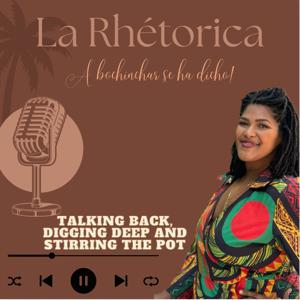
Rooted in an AfroLatina perspective, this podcast centers the voices, experiences, and brilliance of women of color in rhetoric and composition. Hosted by Amanda Patterson Partin, La Rhetórica…
Each episode opens space for nuanced dialogue, unapologetic storytelling, and scholarly reflection. Together, we examine how race, gender, and culture shape our presence in academic and professional spaces, and we ask the questions that often go unspoken: What counts as knowledge? Who gets to be called a rhetor? How do we show up fully, without shrinking or code-switching away the truth?
La Rhetórica is more than a podcast. It is a space to learn, unlearn, remember, and imagine. Pull up a chair. Bring your whole self. Let’s get into it. ¡A bochinchar se ha dicho!