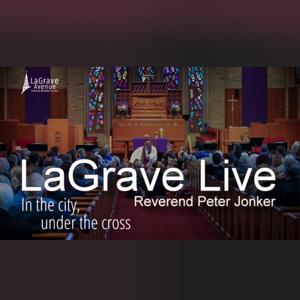
LaGrave Live
LIVE Morning Worship Service 09-06-2026
Now and Then
About The Service:
Rev. Steigenga will preach on Romans 8: 18-27, and his sermon is entitled “Now and Then.”
Order of Worship:
https://lagrave.org/wp-content/uploads/2026-9-6-AM-Order-of-Worship.pdf
About the Church:
We are a traditional CRC church in the middle of Downtown Grand Rapids, MI, worshipping at 8:40am, 11:00am, and 6:00pm. (10:00am and 6:00pm during the summer months)
We'd love to hear from you:
Connection: https://www.lagrave.org/contact
Let us pray for you:
Prayer: https://www.lagrave.org/prayerrequest/
Giving: https://www.elexiogiving.com/App/Giving/lagr107178
The August special offering is for Covenant House. Covenant House Michigan (CHMI) provides shelter and hope to young people aged 18-24 who are experiencing homelessness or victims of trafficking in Grand Rapids and Detroit. Their mission is to serve all youth who come to their doors with unconditional love, absolute respect, and relentless support.
Listen on the go:
Amazon Music: https://bit.ly/LGPodAmazonMusic
Apple Podcast: https://apple.co/3tuOdwQ
Google Podcast: https://bit.ly/LGPodGoogle
Soundcloud: / lagravecrc https://soundcloud.com/lagravecrc
Spotify: https://spoti.fi/3yXDFaT
Follow us!
Facebook: / lagravecrc https://www.facebook.com/lagravecrc
Instagram: / lagravecrc https://www.instagram.com/lagravecrc
Website: https://www.lagrave.org
#LaGrave #LaGraveCRC
Now and Then: Present Sufferings, Future Glory in Romans 8 with Reverend John Stegink
At LaGrave Avenue Christian Reformed Church, guest preacher Reverend John Stegink returns to the pulpit to preach on Romans 8:18-27, weighing the reality of present suffering against the certainty of future glory through stories of a detained Indonesian friend, a World War Two surgeon's letters home, and a chaplain's words of hope amid cancer treatment.
Opening Worship and a Fire Update
The service opens with an organ prelude and the cantor's sung call to worship, followed by the congregation singing the hymn Immortal, Invisible, God Only Wise. Pastor Chad welcomes everyone gathered in the sanctuary and watching online to LaGrave Avenue Christian Reformed Church, then welcomes Reverend John Stegink, one of the church's own, back to the pulpit for the morning. He reminds the congregation that this is the last Sunday of the single ten o'clock summer service, with the familiar 8:40 and 11:00 rhythm returning the following week, and that a ministry celebration will be held in the multipurpose room between services. He also gives an update on the building following the recent fire, telling worshippers that every part of it except the courtyard is safe to use, while the church still waits on reports from the fire department and structural engineers before the city can determine what comes next.
Confession, Assurance, and Prayers of the People
After the opening hymns, Pastor Chad leads the congregation into confession, framing it with Jesus' words from Matthew 11 inviting the weary and burdened to find rest. The congregation sings Come to the Savior Now and joins a responsive prayer confessing sin in thought, word, and deed, followed by words of assurance from Isaiah 53 and the hymn about blood that will never lose its power. Pastor Chad then leads a long pastoral prayer, naming members who need healing or comfort, families grieving recent deaths, and those turning ninety-one and ninety-two. He prays for caregivers, for people drifting from faith, for the coming Bible studies and small groups, and for the evening Vespers gathering. The prayer widens to conflict in the Middle East, Ukraine, Russia, Sudan, and Nigeria, the persecuted church, flooding in Nepal and China, missionaries Dave and Bianca Gifford in Mexico City, and renewal within the Christian Reformed Church.
Children's Message: What Is Real
Reverend Stegink invites the boys and girls forward for the children's message, joking that he is not Pastor Jonker's father, even though people sometimes mistake him for it, and warning that he will not be telling Frog and Toad stories. Holding up an apple, he asks the children how they know something is real, and they answer that they can see its color, touch it, and eat it, naming the senses that confirm what is physically present. He then asks whether they know of things that are real even though no one can touch, see, taste, hear, or smell them. One child offers love as an example, and Reverend Stegink agrees, adding air, thoughts, and silent prayer as other unseen realities. He connects this to the invisible God whom the congregation just sang about, and closes by having the children exchange the blessing The Lord be with you and And also with you before they return to their seats.
Scripture Reading and Three Blessings in Romans 8
Reverend Stegink reads Romans 8:18-27, Paul's passage on present suffering, the groaning of creation, and the Spirit's intercession, then begins his sermon by quoting the old hymn Count Your Many Blessings before turning to the text. Rather than starting with suffering, he first names three blessings drawn from earlier in the chapter. The first is that there is now no condemnation for those in Christ, because Jesus carried that condemnation to the cross. The second is that the Holy Spirit lives within believers as God's own presence and guarantee of a future. The third is that believers are children and heirs of God, not merely receiving God's gifts but inheriting God himself, a truth Reverend Stegink illustrates through the tribe of Levi, who received no land in Canaan because the Lord himself was their inheritance. These three blessings, he says, give present sufferings their proper context before the sermon turns to examine them directly.
Present Sufferings: Persecution and Compassion
Reverend Stegink turns to present sufferings, noting that Christians face persecution today in places like Nigeria, North Korea, China, and Pakistan. He shares the story of an Indonesian friend held in a detention center in Battle Creek for fifteen months while seeking asylum, who recently learned that a deported friend was put to death by his own family after becoming a Christian. Closer to home, he describes Hope for Neighbors, a Grand Rapids group that visits, writes letters to, and provides for immigrants detained in a jail in Baldwin, Michigan, calling it a way of standing alongside the suffering in the spirit of Hebrews 10. He broadens the theme beyond persecution, naming grief, broken dreams, worry over children or parents with dementia, loneliness, and hidden shame present in nearly every pew. Drawing on Genesis 3 and Paul's language of creation groaning as in childbirth, he argues that floods and fires which ravage landscapes and burn churches show creation itself is in bondage to decay.
Hope Beyond the Shadowlands
Reverend Stegink calls this present existence shadowlands, borrowing C.S. Lewis's term for a world of spoiled goodness still waiting for its final redemption, and quotes theologian John Stott's line that believers are, for now, only half saved. He looks ahead to the apostle John's vision of God dwelling with his people and wiping every tear away, and describes worship itself as a place where the membrane between now and eternity sometimes grows thin. To picture the tension between present suffering and future hope, he tells the story of Dr. Richard Boelkins, a LaGrave member and World War Two surgeon who wrote 227 letters home to his wife Jean from the Normandy campaign, letters Jean preserved and their son Jim later published in the book Faith and Family in a Time of War. Reverend Stegink closes with a phrase a chaplain undergoing cancer treatment used to write at the end of his reports, borrowed from the poet George MacDonald: there's a great good coming, then prays that the congregation would receive patient eagerness and eager patience while it waits.