
Sign up to save your podcasts
Or

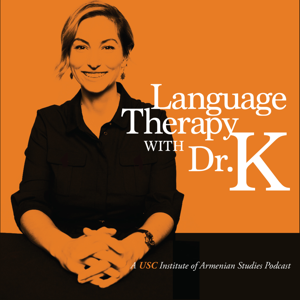


What kind of influence can a dominant language have on a minority language? In this episode, Dr. K sits with linguist Dr. Niamh Kelly from the American University of Beirut to discuss why knowledge of one language, such as Arabic or English, can influence the sound system of Western Armenian. They also deconstruct different language myths regarding phonetics, accents, and "perfect" speech.
For more, visit armenian.usc.edu.
Whether dancing at Armenian celebrations or watching Armenian dance companies perform on stage, it's evident that the practice of Armenian dance is rich and diverse. In this episode, Dr. K sits with PhD student and dance practitioner Natalie Kamajian to define different types of Armenian dance and discuss what the discourse behind them says about how Armenian identity is performed.
For more, visit armenian.usc.edu.
In this episode, Dr. K sits with renowned Armenian calligrapher Ruben Malayan, three weeks into the 2020 Artsakh War, to discuss the breadth and impact of his work, as it relates to Armenian culture and society. They also unpack the crucial role of arts and humanities in moments of rupture.
For more on Malayan's work, visit armeniancalligraphy.com and 15levels.com.
For more, visit armenian.usc.edu.
Vulgar vocabulary and cursing in a time of war? Hand-in-hand with an increased interest in learning and teaching Armenian? In this episode, Dr. K is joined by comedian Mary Basmadjian as they discuss her ability to break all kinds of gender and cultural norms, while simultaneously teaching the Armenian language through comedic skits such as "Vartoush Vocabulary."
For more, visit armenian.usc.edu.
In this episode of Language Therapy, Dr. K is joined by Khachatur Adumyan, one of Armenia's most sought-after interpreters, who has interpreted for every Armenian prime minister since independence. They talk about the linguistic, cognitive, and ethical demands of the job, the nuances of interpreting from and into Armenian, and the day-to-day realities of an interpreter, all in the context of the Artsakh war and the pandemic.
For more, visit armenian.usc.edu.
Who is a 1.5 generation immigrant? What is the connection between generation and language? What are the challenges of transmitting Armenian as a 1.5 generation parent? And what's with all the guilt and shame? Dr. K is joined by attorney and co-founder of ToTalk Armenian, Armine Bazikyan, as they discuss Armine's family's struggles with language transmission and ToTalk as a possible solution.
For more, visit armenian.usc.edu.
What is the connection between artificial intelligence, psychology, and language? Who/what is the world's first emotionally intelligent hospital robot and what's the connection to Armenia? Dr. K talks to Karen Khachikyan, CEO and co-founder of Expper Technologies, the company behind Robin the Robot, as they discuss Robin's emotional and linguistic capacities in helping children overcome their stress, isolation, and anxiety in a hospital setting. Dr. Shant Shekherdimian and Dr. Mineh Badmagharian also join the conversation.
For more, visit armenian.usc.edu.
What kinds of language policies do multilingual families enact when the language or languages in the home are not the same as the dominant language outside the home? What if each parent speaks a different language? What types of reactions and attitudes do families have to deal with when they set specific family strategies for language transmission? Dr. K is joined by Los Angeles Times journalist, Esmeralda Bermudez, in a deep conversation about language, identity, immigration, heritage, and the parenting choices she and her Armenian husband make in their multilingual family.
Read Bermudez's piece on raising a multilingual daughter here: https://lat.ms/31lXw4M.
For more, visit armenian.usc.edu.
From the publisher's feed

43,827 Listeners

37,575 Listeners

38,694 Listeners
28,903 Listeners

7,572 Listeners

111,831 Listeners

34 Listeners

24,526 Listeners

17 Listeners

18,895 Listeners

12,418 Listeners