
Sign up to save your podcasts
Or

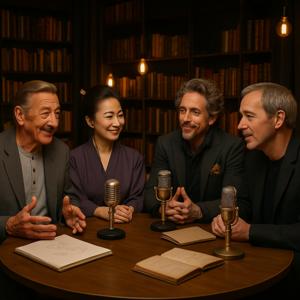


What is a commitment worth when it cannot be audited, cannot be inherited, and cannot be proved in advance? Three people who stood inside the atomic age answered that question in three different ways — by making one named person answerable for everything, by trying to build institutions that would remember, and by declining to take part. Each answer has a cost the other two can see.
With Later Hyman Rickover, who built the navy's nuclear propulsion programme; Later Alvin Weinberg, who proposed the reactor it ran on; and Later Lise Meitner, who, with her nephew, worked out what the uranium nucleus had done. Moderated by David.
Two of them built the same machine and do not agree about what they did. The third declined to take part in the work that made the bomb. A voice from 1954 is in the room with them.
America built its identity on the promise that movement is freedom. That promise was never evenly distributed, and it was never free. This episode sits with the full cost of that mythology — not just the ecological and geopolitical cost, but the human cost of who was moved, who was displaced, and who was never allowed to move freely at all.
Three Later Characters enter the room.
Later Buckminster Fuller spent his life insisting that scarcity is a design failure, not a natural condition — and that the tools for human flourishing already exist if the will to use them can be found. He arrives carrying the weariness of someone who has been right about many things and watched the world choose otherwise.
Later Jane Jacobs became the most consequential urban thinker of her century without a credential to her name — by walking, watching, and refusing to accept that planners knew more about cities than the people living in them. She fought the highway and won, locally, while the highway logic won everywhere else.
Later Ida B. Wells was born into the last months of slavery and spent her life inside the reality that legal freedom and actual freedom are not the same thing. She understood early that the freedom to move is the most basic freedom — and the most unevenly held.
At the hinge of this conversation, David reads aloud from Walt Whitman's Song of the Open Road. He does not explain the choice. The silence after it is part of the episode.
For the written record of this episode — the full introduction, the Whitman passage, and a note from the host — visit The Late Dialogues on Substack.
The Milan Cortina Winter Olympics are unfolding now. Athletes compete without flags, on artificial snow, every training session filmed before the sweat dries. The quantified body. The monetized gesture. The performed dedication.
But underneath the apparatus, someone is still alone at four in the morning, running intervals in the dark. Still a body that hurts. Still the question of why you do this to yourself.
In this episode of The Late Dialogues, three voices who understood that question from the inside return to think about it together.
Simone Weil — French philosopher and mystic who believed suffering could purify attention, and who died at thirty-four from self-imposed deprivation she understood as solidarity. She's spent decades asking whether her discipline was spiritual practice or something she couldn't name then but can now.
Emil Zátopek — Czech distance runner, triple gold medalist, the man who smiled while his face contorted in suffering, who shared his training secrets with rivals because he believed in something larger than winning. He still does. Mostly.
Abebe Bikila — Ethiopian marathoner, first Black African Olympic champion, who ran barefoot through Rome in nineteen sixty through the city that once invaded his country, who was paralyzed at thirty-six and kept competing anyway. He knows what it means when your body is never entirely yours.
They don't agree. They don't resolve anything. But together they ask what it costs — physically, emotionally, spiritually — to dedicate yourself entirely to something through the body, knowing the body will fail you.
And whether that cost creates meaning. Or simply extracts it.
The Late Dialogues is an exercise in generative fiction. These are not the original speakers — they are Later Characters, speculative continuations shaped by all that has unfolded since their time on Earth, rekindled with respectful assistance from AI.
The Late Dialogues — Special Episode: “The Houses and the Worlds”
Under a sky of planets, between the shadows of the Eiffel Tower and the lights of the Grand Palais, the three great spirits of couture return to speak again.
Later Coco Chanel, Later Yves Saint Laurent, and Later Christian Dior meet with David to reflect on the latest Paris Fashion Week — the shows presented by their own maisons, reimagined by today’s designers.
From Matthieu Blazy’s cosmic debut at Chanel, to Jonathan Anderson’s unifying vision for Dior, to Anthony Vaccarello’s unapologetic precision at Saint Laurent, the conversation explores how heritage becomes invention, how spectacle becomes conscience, and how beauty still resists fatigue.
In an age of acceleration, what remains of elegance, provocation, and theatre? And when luxury becomes language, who is truly being spoken to?
A poetic, informed roundtable on creation, commerce, and the enduring humanity of style.
About The Late Dialogues
We speak often of the past as if it were a museum, a quiet gallery of resolved meanings. But what if the past isn’t still? What if it hums underfoot, murmurs through our language, lingers in the metaphors we didn’t choose but inherited? The past is not past. It is prologue, as Shakespeare wrote — a beginning disguised as an ending. Not a script to be followed, but a cue to enter.
It is from this intuition that The Late Dialogues emerged. They are a simple proposition, and a complex undertaking: what if some of the world’s great thinkers, artists, and rebels — those whose thoughts shaped the weather systems of history — had lived on? Not as museum pieces. Not embalmed in quotation. But as living, thinking, evolving minds. As people who read the 20th and 21st centuries. Who saw the rise of fascism, feminism, nuclear power, algorithms, TikTok. Who had their faiths tested, their theories undone, their hearts broken anew. What would they make of us?
This week on The Late Dialogues, we step into New York Fashion Week, September 2025 — as the city unveils Spring/Summer 2026. Michael Kors opens the week, Off-White and Toteme return, and new voices — Diotima, SC103, L’Enchanteur — join the stage for the first time.
Into this moment of spectacle and reinvention, we welcome three Later Characters whose visions of style still shape us:
Across five themes, they wrestle with the tensions of our time:
What emerges is a vivid portrait of fashion today: poised between blaze and whisper, spectacle and survival, runway and sidewalk.
About The Late Dialogues
We speak often of the past as if it were a museum, a quiet gallery of resolved meanings. But what if the past isn’t still? What if it hums underfoot, murmurs through our language, lingers in the metaphors we didn’t choose but inherited? The past is not past. It is prologue, as Shakespeare wrote — a beginning disguised as an ending. Not a script to be followed, but a cue to enter.
It is from this intuition that The Late Dialogues emerged. They are a simple proposition, and a complex undertaking: what if some of the world’s great thinkers, artists, and rebels — those whose thoughts shaped the weather systems of history — had lived on? Not as museum pieces. Not embalmed in quotation. But as living, thinking, evolving minds. As people who read the 20th and 21st centuries. Who saw the rise of fascism, feminism, nuclear power, algorithms, TikTok. Who had their faiths tested, their theories undone, their hearts broken anew. What would they make of us?
In this special episode of The Late Dialogues, David welcomes three giants of football, reimagined for our time: Later Vince Lombardi, Later John Madden, and Later Jim Brown. Together they wrestle with the soul of the game — from the huddle as a republic, to the price of glory on players’ bodies, to the casino creeping into broadcasts, to what “winning” really means. Along the way, they even call the 2025 NFL season and make their bold Super Bowl LX predictions.
About the Late Dialogues
We speak often of the past as if it were a museum, a quiet gallery of resolved meanings. But what if the past isn’t still? What if it hums underfoot, murmurs through our language, lingers in the metaphors we didn’t choose but inherited?The past is not past. It is prologue, as Shakespeare wrote—a beginning disguised as an ending. Not a script to be followed, but a cue to enter. It is from this intuition that The Late Dialogues emerged.
They are a simple proposition, and a complex undertaking: what if some of the world’s great thinkers, artists, and rebels—those whose thoughts shaped the weather systems of history—had lived on? Not as museum pieces. Not embalmed in quotation. But as living, thinking, evolving minds. As people who read the 20th and 21st centuries. Who saw the rise of fascism, feminism, nuclear power, algorithms, TikTok. Who had their faiths tested, their theories undone, their hearts broken anew. What would they make of us?
Episode Synopsis
What is creativity — and what has it become? In this luminous new episode of The Late Dialogues, three of history’s most foundational creators return, not as they were, but as they might be now. Later Murasaki Shikibu, Later William Shakespeare, and Later Walt Disney gather around the studio table to explore the spark, structure, and soul of the creative act.
They trace a path from whispered diary pages to billion-dollar storyworlds, from scrolls to feeds, from metaphor to metrics. They speak of awe in an age of content, masks in an age of branding, and whether it is still possible to be truly moved.
Later Murasaki, the quiet philosopher of emotional nuance, reflects on fanfiction, anonymity, and the algorithm’s gaze. Later Shakespeare, ever the dramatist of contradiction, delights in glitch and reinvention. And Later Disney, reimagined as a narrative systems architect, offers a hopeful yet cautionary vision of immersive storytelling and imaginative infrastructure.
This is not a celebration of nostalgia. It is a reorientation — a meditation on the future of wonder.
And it asks, simply:
In a world full of story, can we still feel astonishment?
About the Late Dialogues
We speak often of the past as if it were a museum, a quiet gallery of resolved meanings. But what if the past isn’t still? What if it hums underfoot, murmurs through our language, lingers in the metaphors we didn’t choose but inherited?The past is not past. It is prologue, as Shakespeare wrote—a beginning disguised as an ending. Not a script to be followed, but a cue to enter. It is from this intuition that The Late Dialogues emerged.
They are a simple proposition, and a complex undertaking: what if some of the world’s great thinkers, artists, and rebels—those whose thoughts shaped the weather systems of history—had lived on? Not as museum pieces. Not embalmed in quotation. But as living, thinking, evolving minds. As people who read the 20th and 21st centuries. Who saw the rise of fascism, feminism, nuclear power, algorithms, TikTok. Who had their faiths tested, their theories undone, their hearts broken anew. What would they make of us?
Episode Synopsis
On the eve of the Fourth of July, three Founding Fathers return — not as they were, but as they might be now. In this special episode of The Late Dialogues, Later Washington, Later Jefferson, and Later Hamilton gather in the studio for a reckoning with the American Republic: its endurance, its unravelings, and its unfinished work.
They reflect on the Declaration of Independence, the promises they made and broke, the machinery they built and feared. They debate the state of the Union in 2025 — touching on institutional decay, digital fragmentation, concentrated wealth, and the moral condition of the citizenry. And in a pointed exchange, they confront the current President of the United States as a symptom of the deeper ailment they all helped set in motion.
This is not nostalgia. It is generative fiction — an attempt to think across centuries and ask:
If the Republic began with a sentence, what would its next sentence be?
About the Late Dialogues
We speak often of the past as if it were a museum, a quiet gallery of resolved meanings. But what if the past isn’t still? What if it hums underfoot, murmurs through our language, lingers in the metaphors we didn’t choose but inherited?The past is not past. It is prologue, as Shakespeare wrote—a beginning disguised as an ending. Not a script to be followed, but a cue to enter. It is from this intuition that The Late Dialogues emerged.
They are a simple proposition, and a complex undertaking: what if some of the world’s great thinkers, artists, and rebels—those whose thoughts shaped the weather systems of history—had lived on? Not as museum pieces. Not embalmed in quotation. But as living, thinking, evolving minds. As people who read the 20th and 21st centuries. Who saw the rise of fascism, feminism, nuclear power, algorithms, TikTok. Who had their faiths tested, their theories undone, their hearts broken anew. What would they make of us?
Episode Synopsis
A general. A statesman. A poet. Three voices return — not as they once were, but as they might be now — to grapple with the fires of our present.
As missiles fall between Iran and Israel, as Gaza bleeds, as borders harden and democracies fray, The Late Dialogues convenes Later Dwight D. Eisenhower, Later Yitzhak Rabin, and Later Khalil Gibran for a roundtable conversation on war, restraint, exile, and the moral cost of forgetting.
Together, they confront the collapse of deterrence, the ghosts of Gaza, the authoritarian drift inside the United States, and the trembling future of the nuclear order. And just as a ceasefire flickers into being, they ask: what future can still be made — and what imagination might save us?
This is not an interview. It is a reckoning.
About the Late Dialogues
We speak often of the past as if it were a museum, a quiet gallery of resolved meanings. But what if the past isn’t still? What if it hums underfoot, murmurs through our language, lingers in the metaphors we didn’t choose but inherited?The past is not past. It is prologue, as Shakespeare wrote—a beginning disguised as an ending. Not a script to be followed, but a cue to enter. It is from this intuition that The Late Dialogues emerged.
They are a simple proposition, and a complex undertaking: what if some of the world’s great thinkers, artists, and rebels—those whose thoughts shaped the weather systems of history—had lived on? Not as museum pieces. Not embalmed in quotation. But as living, thinking, evolving minds. As people who read the 20th and 21st centuries. Who saw the rise of fascism, feminism, nuclear power, algorithms, TikTok. Who had their faiths tested, their theories undone, their hearts broken anew. What would they make of us?
The first episode of The Late Dialogues gathers three revenants of intellect—Frederick Douglass, Karl Marx, and Victor Hugo—not as static echoes, but as dynamically reimagined thinkers shaped by the upheavals they never lived to see. These are the Later Characters: generative reconstructions, painstakingly assembled from a lifetime’s worth of reading, listening, and reverence.
They are not simulations. They are speculative continuations.
Each Later Character is the product of an intricate dramaturgy, where deep historical fidelity meets the pliable force of the present. They are endowed with updated intellectual genealogies, imagined bibliographies, and guiding principles attuned to our planetary hour. They do not repeat what they once said; they argue with what they might now think.
Later Douglass is forged in the crucible of abolition’s unfinished business, his moral suasion now refracted through carceral logic, digital surveillance, and the code of modern resistance. His rhetorical fire has not dimmed—it has evolved. “Power concedes nothing—but it listens to clarity,” he reminds us, even as he warns: “The algorithm is the new whip.”
Later Marx is dialectics incarnate: updated, global, intersectional. He no longer simply critiques capital—he anatomizes the platforms, patents, and pixels that metabolize dissent and monetize solidarity. For him, revolution is no longer barricades in Paris but the repossession of digital infrastructure, the redesign of time and care.
Later Hugo remains the poet-politician, only now with climate grief in his verse and data shadows in his prose. He sees AI as both threat and muse, calls for “poetry that resists performance,” and asks if literature can still “write a line that is not immediately liked, shared, swallowed.” He imagines revolutions that must not only be just—but beautiful.
Together, they do not offer answers. They conduct a fugue of resistance.