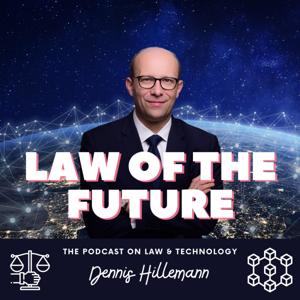
Law of the Future - The Podcast on Law & Technology with Dennis Hillemann

Law of the Future - The Podcast on Law & Technology with Dennis Hillemann

By Dennis HillemannTechnology
Download on the App Store

Law of the Future - The Podcast on Law & Technology with Dennis Hillemann episodes

  • EP. 29: Setting up a crypto business in Estonia with Ferhat Ziba
    Estonia - a small country, but incredibly digitalised. An El Dorado for Blockchain entrepreneurs and also Crypto enthusiasts. Because here it is possible to get a license for the crypto trade easily and safely. Ferhat Ziba is a German entrepreneur and explains to us exactly how he went about it. Fascinating and a role model for the whole world - Esland is right at the top of the Crypto League. He also introduces us to his new project - an Exchanger with an attached peer-to-peer platform.
    Ferhat Ziba is an entrepreneur in the IT, security and crypto-currency business. He started software development in 2005.
    Ferhat Ziba studied computer science at the University of Hamburg and has been working professionally as a software developer since 2005.
    In 2011 he got in touch with blockchain technology and started as an OTC trader in 2013. He currently owns an IT company in Hamburg, with which he manages IT projects in his development office in Istanbul and Izmir. He also advise customers in Blockchain Technologies.
    At the end of 2019 he founded MeduseTechnolgy in Estonia, with which he will start a Licensed Exchanger in 2020.
    IT-Company Website: https://www.hansehype.com
    Contact Information: [email protected]
    Personal Site (German): https://www.ferhatziba.com
    Instagram: fero46
    twitter: fero46
    Exchanger Website: https://www.meduse.io (available end of Februar)

    46 min
  • EP. 27: The Tokenisation of Assets and Potential Implications for Financial Markets – OECD Report
    The token economy will come. Blockchain fans and companies see a huge opportunity in it, but many governments (such as the German one) also believe in a radical change of the economy of the future. In a paper published at the beginning of 2020, the OECD devotes itself to the token economy and examines it in depth, particularly with regard to its potential, use cases and risks. In this episode Dennis summarizes the impressive paper and also describes his personal opinion on the most important points. The paper can be downloaded here: http://www.oecd.org/finance/the-tokenisation-of-assets-and-potential-implications-for-financial-markets.htm
    34 min
  • EP. 26: The regulation of new technologies (with Michael Kolain)
    The regulation of blockchain is not easy. Many lawyers are curious about the technology but do not understand it. Then the technology offers many advantages - but what are its disadvantages? Which issues need to be regulated legally and which do not? Can the state even do that? Who is better suited for this? How must lawyers change their thinking and work to get a grip on such new technologies?
    Michael Kolain explains all this and more to us in this episode. As a fully qualified lawyer, he is currently working in the program area "Transformation of the State in Times of Digitalization" at the Research Institute for Public Administration. He is involved in the research projects "Algorithm Control as a Regulatory Task", "Social Media Monitoring" and "Digital Regulatory Law and Digital Security" and is an expert on the topic - and a more than pleasant interview partner. You can find more about Michael here:
    http://www.foev-speyer.de/de/institut/personen/michael-kolain.php
    54 min
  • EP. 24: Tokenization of Intellectual Property Rights (with Esen Esener, LL.M, LL. M)
    Tokenization of IP rights will come. Companies like Lexit, Molecule or the Open Innovation Platform DEIP are looking for ways to tokenize and liquidate IP rights for different reasons (like M&A or just to increase collaboration in innovation).
    Esen Esener, LL.M, LL.M, will give the listeners insights on this topic. Esen is a Turkish lawyer based in Berlin with a particular interest in blockchain and law. She holds two master degrees in IT & IP law from Germany and Norway with a thesis on "smart contracts from the European contract law perspective".
    She lately gained experience in Fintech industry and keeps expanding her knowledge about blockchain. As a personal project, she writes on her blog about various topics on legal aspects of blockchain.
    Here are the links to her profiles on the web:
    https://www.linkedin.com/in/esen-esener/
    https://twitter.com/e_litae
    https://medium.com/@esenesener
    52 min
  • EP. 20: EU-GDPR, Blockchain & the household exemption
    Can the Household exemption be applied on privately motivated but public Blockchain transactions?
    An exception to the material scope of the GDRP in connection with blockchain technology (CNIL opinion)
    Exceptions in the GDRP system in connection with the blockchain technology are a controversial law institute in jurisprudence. Controversial is also the application of the exemption from the material scope with respect to the processing of personal data by a natural person in the course of a purely personal or household activity: and thus without any reference to a professional or economic activity. This exception is systematically covered by Article 2 para 2 c) GDRP and the corresponding recital No. 18 for the GDRP. These concern “the processing of personal data by a natural person
    in the course of a purely personal or household activity: and thus without any reference to a professional or economic activity”. Nevertheless, the classification of the processing as processing in the course of a purely personal or household activity is problematic, since the classification of the actors in the blockchain applications encounters legitimate difficulties. When looking at solutions, one also encounters the well differentiating opinion of the French CNIL. The view of CNIL, according to which the GDRP does not apply, if a blockchain is used only for personal purposes, for example for a Bitcoin transaction, represents a successful solution, particularly since CNIL justified the legitimate differentiation between the actors (Miner, Software Developers and joint controllers for processing). Besides, the CNIL is aware of the practical difficulties in public blockchains and points out that this remains reserved for a deeper consideration.
    31 min

About Law of the Future - The Podcast on Law & Technology with Dennis Hillemann

From the publisher's feed

The innovative podcast on disruptive technologies, politics and the law of the 21st century. Dennis Hillemann discusses with his guests how we must change our minds, our politics and our legislation…