
Sign up to save your podcasts
Or

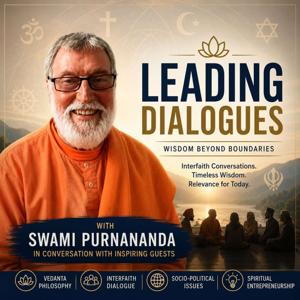


What does yoga really have to do with health? Is yoga simply a system of postures and exercise, or is it part of a much deeper understanding of the human being?
In this episode of Leading Dialogues, Sharanya interviews Swami Purnananda on yoga, Ayurveda, food, health, and the intimate relationship between body, mind, and spiritual life.
Swami Purnananda begins by challenging one of the most widespread modern assumptions about yoga: that yoga essentially means physical exercise. Instead, he returns to its philosophical meaning of union, placing asana, health and well-being within a much larger enquiry into who we are, what changes, and what remains unchanged. The conversation explores the Yogic distinction between Purusha and Prakriti, including the idea of an inner witnessing consciousness that observes the changing experiences of body and mind.
From there, the discussion moves into Ayurveda, the “science of life,” and the relationship between food, mind, and health. Swamiji and Sharanya consider the idea that physical nourishment and mental nourishment cannot really be separated: what we eat, what we think, what we see and hear, our emotional state, and the way we live all form part of one psychophysical system.
Among the topics explored are:
Yoga beyond asana: Yoga as a philosophy of union rather than simply a form of physical exercise.
Ayurveda and the science of living: Approaching health as part of a wider philosophy of life.
Purusha, Prakriti and the inner witness: What changes in us, and what remains constant.
Food and the mind: Physical food, mental “food” and even the modern idea of a digital diet.
Stress and digestion: Why the state of mind in which we eat may matter alongside what we eat.
Sattvic living: Food, thought, environment and the attempt to create greater balance in everyday life.
Exercise and movement: Yoga postures, flexibility, aerobic activity and the problems associated with increasingly sedentary lifestyles.
Ayurvedic and naturopathic approaches, including the episode's discussion of cold packs, steam, elimination and traditional ideas about supporting the body's natural processes.
Fasting and individual constitution: Why Swamiji argues against assuming that one health practice is appropriate for everyone.
Raising healthy children: Food habits, water, exercise, a calm home environment and learning to sit quietly.
Fresh, frozen and processed food, including a discussion of supermarket food, organic produce and modern convenience.
The body as an instrument of spiritual life: Why caring for the body ultimately serves, in Swamiji's view, a purpose deeper than physical health alone.
A recurring theme is that mind and body cannot be neatly separated. Toward the end of the conversation, Swamiji connects children's physical habits, a calm environment, and quiet reflection with the idea of the human being as a single psychophysical whole.
Ultimately, the conversation asks us to look beyond wellness as merely the absence of illness. What would it mean to care for the body, discipline the mind, and understand yoga as a means of discovering the deeper person within?
#Yoga #Ayurveda #Vedanta #SwamiPurnananda #HolisticHealth #YogaPhilosophy #MindBody #Wellbeing #LeadingDialogues
In this comprehensive episode of Leading Dialogues, Swami Purnananda is joined by His Grace, Archbishop Michael Jackson, who serves as the Archbishop of Dublin and Bishop of Glendalough in the Church of Ireland. Archbishop Michael Jackson is also the chairman of the Dublin City Interfaith Forum. Together, they explore the rich history, modern evolution, and radical future of interfaith dialogue in an increasingly secular and diverse Ireland.
Archbishop Jackson reflects on the 150-year legacy of the Church of Ireland as a "Church Without Borders," examining how shedding political ties allowed it to embrace true independence, global connections, and a "dialogue of life, ideas, and imagination." The conversation delves into the universal symbol of St. Patrick, why interfaith engagement strengthens Christian practice rather than diluting it, and the radical concept of "sanctification by use," explaining why iconic heritage spaces like Christ Church Cathedral have welcomed Sikh and multi-faith gatherings.
Moving into the realities of modern spiritual leadership, Archbishop Jackson breaks down his framework for lived spirituality through the 5 Marks of Mission (Teach, Tell, Tend, Transform, Treasure) and shares his personal spiritual recipe for making tough decisions under pressure. He opens up about calling out hidden sectarianism across Ireland, managing public media storms, and answering hostile feedback with grace, personal correspondence, and truth.
Finally, the conversation turns to the future of organized religion across Europe, offering a candid look at declining institutional power, economic realities, and why the future lies in "dynamic pockets" of authentic discipleship rather than rigid preservation of the past. Archbishop Jackson leaves us with a simple, profound formula for human connection in an age of uncertainty: "Know your neighbor, love your neighbor, let your neighbor know you, let your neighbor love you."
Podcast recorded on 24th July 2026.
Can a society move past centuries of religious division by simply changing how we talk to each other?
In this episode of Leading Dialogues, Swami Purnananda sits down with Adrian Cristea, the Executive Officer of the Dublin City Interfaith Forum (DCIF) and a representative of the Romanian Orthodox Church. Together, they explore Ireland's rapid transformation from a religiously homogeneous society into a thriving, complex tapestry of global faiths and secular worldviews.
Adrian pulls back the curtain on nearly 15 years of grassroots and civic work of DCIF, explaining why the secret to true community integration has nothing to do with debating complex theology and everything to do with building raw, human relationships. The conversation covers the massive post-communist resurgence and growth of the Romanian Orthodox Church on the island, how the forum partners with state entities to tackle modern systemic issues like racism and migrant integration, and how ancient traditions can heal modern scars.
We also get an exclusive look at the 2026 Annual Interfaith Pilgrimage, a symbolic trek along the Monaghan and Fermanagh border designed to transcend sectarianism and celebrate our shared humanity.
Dublin City Interfaith Forum Website: https://www.dcif.ie/
Can ancient spiritual truths reshape modern political and economic landscapes?
In this illuminating episode of the Leading Dialogues podcast, Swami Purnananda sits down with Sister Sheila Curran of the Congregation of the Sisters of Mercy. Together, they bridge the worlds of Eastern metaphysics, Christian mysticism, and radical social activism to examine how spirituality can express itself through structural justice and human rights.
Sister Sheila details her extensive background with Social Justice Ireland and her time working alongside liberation theologians like Gustavo Gutiérrez in Peru. The conversation traces the revolutionary history of Ireland's "Walking Nuns," who broke traditional cloister walls to serve the poor, and draws striking parallels to the egalitarian spiritual movements led by Swami Vivekananda and Sister Nivedita in India.
Turn your attention to the pressing crises of the modern world as the discussion tackles the moral failures of the housing crisis, how government negligence fuels anti-immigrant scapegoating, and the delicate peace-building lessons carved out of the Northern Ireland Troubles. Finally, explore a profound meditation on "internal borders," the deep-seated prejudices of the human heart, and discover how both the Vedantic vision of universal oneness and Christ’s "Kingdom of Heaven within" provide the ultimate remedy for a fractured society.
What happens to the human soul when the physical brain begins to unravel? Is a person their diagnosis, their memories, and their ego—or is there a silent, untouched awareness sitting behind the hardware of the mind?
In this groundbreaking episode, Swami Purnananda, a Vedantic Monk, sits down with Dr. Yasoda-Mohan for a profound dialogue at the confluence of modern neuroscience and ancient Vedantic philosophy. Moving far beyond the rigid constraints of 17th-century materialism, they explore dementia, Alzheimer’s, and Parkinson’s disease not just as tragic biological organ failures, but through a deeply spiritual, holistic lens.
Together, they bridge the gap between hard clinical realities - like the vivid dreams of Lewy Body dementia - and the ultimate timeless truth: that while the physical lightbulb may flicker and fade, the foundational electricity of pure cosmic consciousness remains entirely flawless, whole, and beautiful.
If you are a caregiver, a medical researcher, a seeker of truth, or someone navigating the heavy waters of cognitive decline, this conversation is an invitation to step away from the panic of trying to "fix" and step into the radical, compassionate space of holding presence.
📌 Key Topics Explored in This Episode:
The Willpower Fallacy: Why behavior in dementia is a structural organ failure (like a heart pump), entirely divorced from a patient's character or willpower.
The Splitting Lens: How space, time, and dimensional deficiency fracture our perception of a single, unified cosmic totality.
The Three States of Consciousness: Exploring the waking state (Vishwa), the dream state (Hiranyagarbha), and the deep sleep of pure, unbothered peace (Sat-Chit-Ananda).
Decolonizing Medicine: Merging modern Western allopathic care with thousands of years of indigenous knowledge systems, from the Amazon rainforest to Ayurveda.
Naturopathic Rapture: Shifting medicine from "diagnosing inherent brokenness" to identifying and removing lifestyle obstacles so the body’s natural harmony can thrive.
"Our different ways of approaching God are found in this silence."
What happens when a Jesuit priest and a Vedantic monk sit down to discuss faith, justice, and the ultimate mystery of the divine? In this episode of the Leading Dialogues Podcast, Father Edmond Grace (Jesuit Center for Faith and Justice) joins the conversation with Swami Purnananda to explore the radical history of East-West spiritual dialogue.
Together, they dive into the liberating, heart-centered work of Anthony de Mello, look at historical pioneers who dared to bridge European and Asian spiritualities, and explore the staggering theological parallels between the Christian Trinity and the Vedantic realisation of Sat-Chit-Ananda (Existence, Consciousness, Bliss). They also pivot to the worldly plane to unpack the modern crisis of democracy, the human psychological need for "public happiness" and teaching the value of stillness to primary school children.
A Vedanta Monk in Conversation with a Zen Buddhist Priest
Building a Business Without Losing Your Peace
From the publisher's feed
Wisdom beyond boundaries. Interfaith conversations, timeless wisdom. Relevance for today.