
Sign up to save your podcasts
Or

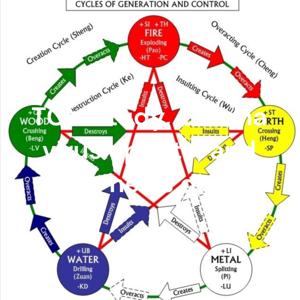


The Liver stores Blood and is responsible for the smooth movement of Qi.
a)Pattern of Constrained Liver Qi (gang-qi-yue-jie:肝気鬱血)
b)Pattern of Deficient Liver Blood (gan-sue-xu:肝血虚)
c)Pattern of Liver Fire Blazing Upward(gan-hup-shang-yan:肝火上炎)
d)Pattern of Deficient Liver Yin(gan-yin-xu:肝陰虚)
e) Pattern of Arrogant Liver Yang Ascending (gang-yang-shang-kang:肝陽上亢)
f)Pattern of Liver Wind MovingInternally (gang-feng-nei-dong:肝風内動)
g)Pattern of Cold Stagnating in the Liver Meridian(han-zhi-gan-mai:寒滞肝脈)
Chinese medicine the web that has no weaver
page 247-253
Patterns of disharmony
Spleen Disharmonies
Spleen rukes transmutation and is the essential focus for the transformative dynamic of Qi in human life.
a) Patterns of Deficient Spleen Qi (pi-qi- xu:脾気虚)
b)Deficient Spleen Yang (pi-yang-xu:脾陽虚)
c) Patterns of Spleen Qi Sinking (pi-qi-xia- xian:脾気下陥)
d)Patterns of Spleen Unable to Govern the Blood (pi-bu-zong-xue:脾不統血)
e)Patterns of Distressing the Spleen (chi-kun-pi:湿困脾)
f)External Dampness Obstructing (wai-shi-zu:外湿湿)
g)Damp Heat Collecting in the Spleen (pi-yun-shi-re:脾蕴湿熱)
h)Patterns of Mucus (tan-zheng痰証)
Chinese medicine
the web that has no weaver
page 244-246
East & West Reconsidered
Chinese medicine the web that has no weaver
page 239-244
Chapter 8
the pattern of the human landscape - the details of the clinical scene
Patterns of Qi and Deficient Yang, Patterns of Blood and Deficient Yin
Patterns of Deficient Qi (qi-xu-zheng:気虚証)
Deficient Yang(Yang-xu-zheng:陽虚証)
Patterns of Stagnant Qi (qi-zhi-zheng:気滞証)
Patterns of Deficient Blood (xue-xu-zheng :血虚証)
Deficient Yin (Ying-xu-xheng:陰虚証)
Patterns of Congealed Blood(due-yu-zheng:血瘀証)
Patterns of Hot Blood(due-re-zheng:血熱証)
The patterns of Excess/Heat (shi-re-zheng : 実熱証)
signs : Excess (yang) + Heat (yang)
movement : forceful + fast
pain : intensified by pressure = relieved by cold
tongue : thick moss + red with yellow moss
pulse : full and strong + rapid
The pattern of Deficiency/Heat (xu-re-zheng:虚熱証)
signs : Deficiency(yin ) + Heat (yang)
movement : weak and fragile but fast
pain : relieved by pressure but relieved by cold
tongue : little or no coating but red
pulse : thin but rapid
The pattern of Excess/ Cold (shi-han-zheng: 実寒証)
signs : Excess(yang) + cold (yin)
movement : forceful but slow
pain : unrelieved bye pressure but responds to heat
tongue : thick moss but pale
pulse : tight , work, full, or otherwise strong but slow
The pattern of Deficiency/Cold(xu-han-zheng:虚寒証)
signs : Deficiency (yin) + Cold(yin)
movement : frail/ weak + slow
pain : relieved by pressure + responds to heat
tongue : little or no moss + pale
pulse : empty, thin or otherwise weak + slow
Chinese medicine The web that has no weaver
page 231-234
Patterns of True Heat / Illusionary Cold (zhen-re-jia-han zheng:真熱仮寒証)
Yin very reduced but forced to the extremeties by greatly increased Yang
True Cold/ Illusionary Heat(zhen-han-jia-re-zheng:真寒仮熱証)
Yang floats to the surface
Patterns of Internal / External, Deficient/ Excess , Cold / Hot
Chinese medicine the web that has no weaver
page 217-223
the wight principal patterns are composed of four pairs of polar opposites:|
Interior (li-zheng:裏証 )/ Exterior (biao-zheng:表証)
Deficiency (xu-zheng:虚証)/ Excess(shi-zheng:実証 )
Cold (han-zheng;寒証 )/ Hot(re-zheng:熱証)
Patterns of Yin(陰証) / Yang (陽証)
Chinese medicine
the web that has no weaver
page 215-217
Chapter 7
The eight principal patterns :
The faces of yin and yang
the pattern's basic texture and composition
Chinese medicine the web that has no weaver
page 203-210
18. moderate pulse(huan mai: 緩脈)
other (less important ) pulses
19.flooding pulse(hong mai: 洪脈)
熱邪亢盛
20. minute pulse (wei mai : 微脈)
陰陽気血諸虚・陽虚の危篤な症候
21. frail pulse(ruo mai :弱脈)
気血不足
22. soggy pulse(ru mai:濡脈)
虚・湿
23.leather pulse(ge mai :革脈)
精血虚寒
24. hidden pulse(fu mai : 伏脈)
邪閉厥証・激痛
25. confined pulse(lao mai : 牢脈)
陰寒内実・脱腸
26. spinning bean (moving) pulse(dong mai :動脈)
27.hollow pulse (kong mai :芤脈)
失血・陰損傷
28.scattered pulse(san mai: 散脈)
元気離散
page 194-202
touching examination (qie-zhen : 切診)
pulse taking (脈診)
type of pulse
Depth
1.floating pulse (fu mai : 浮脈)
表証、陰虚証
2.sinking pulse / deep pulse (chen may :沈脈 )
陽実、陰虚証 裏証(内風)
Speed
3.slow pulse (chi mai: 遅脈)
風邪、寒証、
4.rapid pulse (shu mai: 数脈)
熱証、
Widh
5. thin pulse (xi mai: 細脈)
気血両虚・諸虚・労損・湿
6.big pulse (da mai : 脈)
Strength
7.empty pulse (xu mai : 虚脈)
虚証・気血両虚
8.full pulse (shi mai :実脈)
実証
9.slippery pulse (hua mai : 滑脈)
痰飲・食滞・実熱・妊娠
10.choppy pulse(se mai :渋脈)
気滞血瘀・精傷・血少
11.wiry pulse (xuan mai: 弦脈)
肝胆疾患・痛証・痰飲
12. tight pulse(緊脈)
実・寒・食滞・陰中の陽
Length
13.short pulse(短脈)
有力:気鬱
無力:気損
14.long pulse(長脈)
陽気有余・熱証
Rhythm
15.knotted pulse(jie mai : 結脈)
陰盛気結・寒痰・血瘀
16.hurried pulse(cu mai :促脈)
陽盛実熱・気滞血瘀
17. intermitted pulse(dai mai:疾脈 )
陽極まり陰が尽きる・元気脱
From the publisher's feed