
Sign up to save your podcasts
Or



Zang Fu, the Organ Systems of Traditional Chinese Medicine: Functions, Interrelationships and Patterns of Disharmony in Theory and Practice
Author :Jeremy Ross
Page 183-187
Cpater. 15-1
Emotions
The Emotions and Behaviour
Classifications of the Emotions
The Seven Emotions : Qi Qing (七情)
1. Xi (喜) Joy happiness, gaiety, excitement, pleasure
2. Nu (怒) Anger, irritation
3. Si (思) meditation, contemplation, pensiveness
4. You (憂) anxiety, sorrow
5. Kong (恐) fear, extreme anxiety
6. Jing (驚) sudden intense fear, fright
7. Bei (悲) grief, affliction
The Five Feeling : Wu Zhi(五志)
1. Xi (喜)-Xin (Heart)
2. Nu (怒) -Gan(Liver)
3. Si (思)-Pi (Spleen)
4. You (憂) -Fei (Lungs)
5. Kong (恐) - Shen (Kidney)
The Five Feelings and the Five Zang
Fear and Shen
Anger and Gan
Joy and Xin
Pensiveness and Pi
Grief and Fei
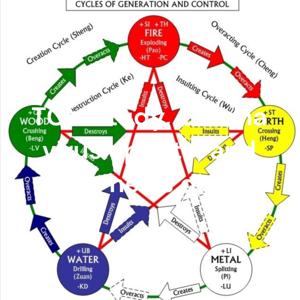
The Five Feelings and the Five Phases
Emotions and Yin Yang
....................................
Reading and learning Texts about Traditional Chinese Medicine.
The objective is to share great wisdom of Traditional Chinese Medicine, Ayurveda, and any kind of Alternative Medicine by posting my recording while I am reading English books at laud.
It is my English learning and Natural medicine studying purpose.
Hope those recordings help somebody learn and satisfy one's interests.
Enjoy!
Disclaimer:
This video does not contain medical advice. All content is intended for informational purposes only and is not intended to substitute for medical advice, diagnosis, or treatment from your physician or other healthcare provider. Please consult your physician for personalized medical advice and for any questions regarding a medical condition.
Tag
Traditional Chinese Medicine, Alternative Medicine, Natural Medicine, Holistic Health, Wellbeing
Zang Fu,
the Organ Systems of Traditional Chinese Medicine: Functions, Interrelationships and Patterns of Disharmony in Theory and Practice
Author :Jeremy Ross
Page 178-182
Chapter 14-2
Zang Fu
Zang fu Pairs
Zang Fu and the Origins of Disease
Stagnation
Phlegm
Internal Wind
Summary
Reading and learning Texts about Traditional Chinese Medicine.
The objective is to share great wisdom of Traditional Chinese Medicine, Ayurveda, and any kind of Alternative Medicine by posting my recording while I am reading English books at laud.
It is my English learning and Natural medicine studying purpose.
Hope those recordings help somebody learn and satisfy one's interests.
Enjoy!
Disclaimer:
This video does not contain medical advice. All content is intended for informational purposes only and is not intended to substitute for medical advice, diagnosis, or treatment from your physician or other healthcare provider. Please consult your physician for personalized medical advice and for any questions regarding a medical condition.
Tag
Traditional Chinese Medicine, Alternative Medicine, Natural Medicine, Holistic Health, Wellbeing
Zang Fu, the Organ Systems of Traditional Chinese Medicine: Functions, Interrelationships and Patterns of Disharmony in Theory and Practice
Author :Jeremy Ross
Page 167-178
Part 3
Interrelationships
Chapter14-1
Zang Fu Interrelationships
Yin Yang
Substances
Pathology of the Substances
Jing Luo
Tissues
Zang Fu
The Organ Systems of Traditional Chinese Medicine: Functions, Interrelationships and Patterns of Disharmony in Theory and Practice
Author :Jeremy Ross
Page 161-166
Chapter 13 Review of the Five Zang
Functions
Main Functions of the Five Zang
Shen (Kidney 腎)
Sores Jing
Foundation of Yin & Yang
Pi (Spleen 脾)
Rules Transportation & Transformation
Gan (Liver 肝)
Rules Free-flowing of Qi
Stores Xue
Xin (Heart 心)
Stores Shen
Rules Xue & Xue Mai
Fei (Lungs 肺)
Rules Qi & Respiration
Governs Dispersing &Descending
Interrelationships of the Main Zang Functions
Origins of Patterns of Disharmony
Patterns of Disharmony of the Five Zang
Shen
Deficient Shen Jing
Deficient Shen Yang
Shen Qi not Firm
Shen Fails to Recieve Qi
Water Overflowing
Deficient Shen Yin
Pi
Deficient Pi Qi
Deficient Pi Yang
Inability of Pi to Govern Xue
Sinking of Pi Qi
Invasion of Pi by Cold & Damp
Damp Heat Accumulates in Pi
Gan
Depression of Gan Qi
Deficient Gan Xue
Hyperactive Gan Yang
Blazing Gan Fire
Stirring of Gan Wind
Damp Heat in Gan & Dan
Stagnation of Cold in Gan Jing Luo
Xin
Deficient Xin Qi
Deficient Xin Yang
Collapse of Xin Yang
Stagnant Xin Xue
Deficient Xin Yin
Blazing Xin Fire
Phlegm Fire Agitating Xin
Cold Phlegm Misting Xin
Fei
Deficient Fei Qi
Deficient Fei Yin
Invasion of Fei by Wind
Retention of Phlegm in Fei
Zang Fu Chapter 12
Xin Bao (Pericardium : 心包) and San Jiao (Triple Burner:三焦)
Xin Bao (心包)
Functions
Patterns of Disharmony
San Jiao (三焦)
The four main conception of San Jiao
2. San Jiao as the Fu system
3. San Jiao as the Jing Luo
Distribution
Signs
4. San JIao as the San Jiao points
Treatment of San Jiao Disharmonies
Summary
Zang Fu
Chapter 11-2 Da Chang (大腸)
Functions
Patterns of Disharmony
Summary
Zang Fu
Chapter 11-1
Fei (Lungs) and Da Chang (Large Intestine)
Fei
Functions
Patterns of Disharmony
Summary
Zang Fu Chapter 10-2
Xin and Xiao Chang (Heart and Small Intestine)
Xiao Chang (small intestine)
Functions
Patterns of Disharmony
- Deficient Cold in Xiao Chang
- Stagnant Qi of Xiao Chang
a) Obstructed Qi of Xiao Chang
b) Excess Heat in Xiao Chang
Zang Fu Chapter 10-1
Xin (Heart) and Xiao Chang(Small Intestine)
Xin
Functions
1. Rules Xue and Xue Mai
2. Stores Shen
3. Opens into the Tongue: Manifests in the Face
Patterns of Disharmony
Yang Deficiency:
- Deficient Xin Qi
- Deficient Xin Yang
- Stagnant Xin Xue
- Cold Phlegm Misting Xin
Yin Deficiency:
- Deficient Xin Xue
- Deficient Xin Yin
- Blazing Xin Fire
- Phlegm Fire Agitating Xin
Summary
Zang Fu Chapter 9-4
(Gall Bladder 胆)
Functions
Patterns of Disharmony
From the publisher's feed