
Sign up to save your podcasts
Or



For more information email [email protected]
Hosted on Acast. See acast.com/privacy for more information.
From a decade of men-only bars and newsroom sexism, Christa Ackroyd fought her way to the front line of British journalism.
In this episode, Dermot Murnaghan sits down with pioneering journalist and broadcaster Christa Ackroyd for a deeply personal and wide-ranging conversation about local journalism, resilience, and the role of women in news.
Christa reflects on her trailblazing career in regional television, including two decades dominating the airwaves across Yorkshire on Calendar and Look North. She shares the emotional story of reporting the Yorkshire Ripper murders at just 19 years old, her battles against misogyny in the newsroom, and how the Brontë sisters shaped her drive to defy expectations.
Christa also reveals:
For more information email [email protected]
Hosted on Acast. See acast.com/privacy for more information.
In this episode, Dermot Murnaghan sits down with journalist, author and broadcaster Gavin Esler for a wide-ranging conversation that spans Northern Ireland, the White House, and a memorable visit to Dolly Parton’s home.
Gavin opens up about his early career during the Troubles, his run-ins with BBC bureaucracy, and the journalism that helped free innocent men wrongly imprisoned after IRA bombings. He reflects on his years in the United States reporting on Bill Clinton and Barack Obama, his time anchoring Newsnight during its heyday, and how both the media landscape and political accountability have changed.
Gavin also reveals:
For more information email [email protected]
Hosted on Acast. See acast.com/privacy for more information.
In this episode, Dermot Murnaghan talks to broadcaster Nick Owen about a career that began in local newspapers and led to national fame—culminating in his role at the heart of breakfast television during the 1980s.
Nick shares how he helped rescue a failing TV-am, the unexpected promotion that made him front-page news, and what he learned working alongside Anne Diamond.
He also speaks openly about his prostate cancer diagnosis, the surgery that followed, and why he’s now backing calls for a national screening programme.
Nick also reveals:
A story of a life in news and sport—and a fight to help save men’s lives.
Hosted on Acast. See acast.com/privacy for more information.
In this episode, Dermot Murnaghan is joined by broadcasting legend Anne Diamond OBE, for a journey through journalism, personal loss, and untold wartime history.
From turning around TV-am to uncovering her father’s secret role in inventing radar, Anne reflects on a career built on curiosity, compassion, and determination.
She opens up about the behind-the-scenes battles at TV-am, being tabloid fodder in the '80s, and how tragedy spurred her to launch a public health campaign that saved tens of thousands of babies' lives.
Anne also reveals:
A broadcaster who defined morning television — and turned personal experience into lasting change for families nationwide.
Hosted on Acast. See acast.com/privacy for more information.
In this episode, Sir Trevor McDonald joins Dermot Murnaghan to reflect on a broadcasting career that spanned generations.
From his early days in Trinidad to fronting News at Ten, he recalls the clashes and confidences that shaped a lifetime in journalism: arguing with Margaret Thatcher over Nelson Mandela, walking silently through Saddam Hussein’s palace, facing down George W. Bush in the Oval Office, and listening to the quiet wisdom of a newly freed Mandela.
In this episode, Trevor explains:
A portrait of a journalist whose voice became part of national life, and the reason Britain tuned in at ten.
Hosted on Acast. See acast.com/privacy for more information.
In this episode, Jonathan Dimbleby joins Dermot Murnaghan to reflect on a career defined by the power of serious journalism. From the golden age of current affairs television to the frontlines of forgotten conflicts, Dimbleby was there when journalism reached millions and meant something.
He looks back on the moments that shaped him: the famine footage he had to smuggle out of Ethiopia, the quiet clarity of interviewing a reluctant Prince of Wales, and the long-form political encounters that held leaders to account before time limits and soundbites took over.
In this episode, Jonathan explains:
A reminder of a time when broadcast journalism had the time, the courage and an audience that cared.
Hosted on Acast. See acast.com/privacy for more information.
Joanna Gosling spent more than 30 years reporting the biggest stories of our time—but it was the quiet, human moments that finally got to her.
In this episode, Joanna joins Dermot Murnaghan to reflect on the emotional toll of live news, the stories that stayed with her, and what it means when the person behind the headlines can no longer stay detached.
From her first newsroom job with no experience to becoming one of the BBC’s most recognisable faces, Joanna shares how she built a career without shortcuts—and what finally made her walk away during the BBC’s painful news channel merger.
In this episode, Joanna explains:
• How she got her start in radio with no experience, no contacts, and a lot of persistence
• Why she couldn’t hold it together when Nazanin Zaghari-Ratcliffe was finally released
• The pressure female broadcasters still face over appearance
Hosted on Acast. See acast.com/privacy for more information.
Natasha Kaplinsky started her media career in the typing pool, and became one of Britain’s most recognisable broadcasters.
In this deeply personal and candid episode, Natasha sits down with Dermot Murnaghan to revisit the defining moments of her career.
This episode is packed with behind-the-scenes moments, unfiltered insight, and a powerful reminder of the human side of public life.
Hosted on Acast. See acast.com/privacy for more information.
He’s faced down Russian special forces, slipped into Chechnya disguised as a refugee, and shared a room with Nelson Mandela just days after his release. From the fall of the Berlin Wall to the frontlines of Iraq, Jonathan Charles has seen history unfold—often from just feet away.
In this gripping episode, the legendary foreign correspondent reveals:
• The moment Putin emerged—and the chilling change it signalled
• Why missing the fall of the Berlin Wall by hours still haunts him
• What it’s really like to report in a firefight—and the moment he knew it was time to stop
• How meeting Mandela overturned all his assumptions
An honest look at what it truly means to witness history up close.
Hosted on Acast. See acast.com/privacy for more information.
From the publisher's feed
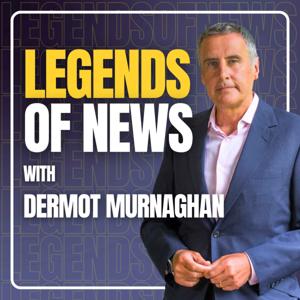
Legends of News is a gripping, deeply personal podcast hosted by award-winning broadcaster Dermot Murnaghan, exploring the golden era of television news through the voices of those who shaped…
With over four decades in the newsroom himself, Dermot invites fellow household names to reveal what it was really like in front of the camera when the world changed in real time.
Through candid conversations, listeners are granted a front-row seat to history: from breaking global events to chaotic newsrooms, unforgettable interviews with world leaders, and the occasional live blooper.
As history echoes through current events, these news giants reflect on how the past informs the present—and share where life has taken them now.
Legends of News is a warm, revealing, and inspiring chronicle of the stories that must not be forgotten
Hosted on Acast. See acast.com/privacy for more information.