
Sign up to save your podcasts
Or

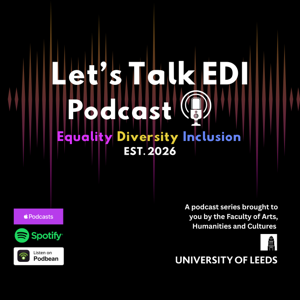


Let’s Talk EDI is a new podcast series brought to you by the Faculty of Arts, Humanities and Cultures at the University of Leeds, to provoke conversation, reflection and explore the experiences of staff and students within our Faculty.
This episode focuses on exploring invisible work within the PGR community. It surfaces day‑to‑day experiences, validates the contributions that can go unseen, and create space to reflect on how invisible work shows up differently for different PGRs. The conversation will also signpost to existing resources, support good practice, and look toward developing future interventions, helping to turn recognition into action.
Host Bio:
Kashmir Kaur (SFHEA) is an Associate Professor of English for Academic Purposes at the University of Leeds, where she leads in-sessional provision across Earth and Environment and Transport. She collaborates on an international COIL project integrating AI into language education. Her research explores decoloniality, language, power and epistemic justice in academic communication, and she has delivered invited talks across the UK, Europe and the United States. She is also the creator and host of the One Language, Many Silences podcast, which explores language, power, identity and academic life through conversations with scholars and practitioners.
Panel Bios:
Ola Fagbohun is a first-year postgraduate researcher in the School of Performance and Cultural Industries and runs a Sheffield-based social enterprise exploring health equity in menopause and ageing amongst people often marginalised by the health system. Her research and practice focus on valuing diverse knowledge systems, asking whose knowledge and experience are valued, and why, and how different ways of knowing, being and doing can challenge dominant understandings of menopause and ageing. Her PhD brings decolonising, participatory and creative health methods together to co-produce a framework with Nigerian women in the UK that reimagines menopause and ageing through cultural heritage and identity, making space for knowledge and experiences that conventional health research can overlook and contributing to more equitable approaches to health and wellbeing.
Teba Natasha is a PhD researcher in Linguistics at the University of Leeds, specialising in corpus linguistics and translation studies. Her research explores Arabic–English translation in Iraqi legal and peacebuilding contexts. Alongside her research, she has experience in university teaching, professional translation, and working with international organisations in Iraq.
Technical Support:
Thanks to Susan Preston, Faculty EDI Project Officer, for their technical support, recording and editing this podcast.
Let’s Talk EDI is a new podcast series brought to you by the Faculty of Arts, Humanities and Cultures at the University of Leeds, to provoke conversation, reflection and explore the experiences of staff and students within our Faculty.
This episode focuses on exploring invisible work within the staff community. The conversation examines who carries this work, why it can be difficult to measure, and how issues of identity, trust, wellbeing and institutional culture shape its visibility. Contributors share personal stories of supporting students and colleagues, navigating recognition and promotion systems, and finding ways to make important contributions more visible and valued. The episode also reflects on practical strategies for recognising invisible work while respecting that not everyone wishes to be visible themselves.
A thoughtful discussion about care, collaboration, recognition and the people whose efforts often make success possible behind the scenes.
Host Bio:
Beth Johnson is Director of Equity, Diversity and Inclusive Excellence for the Faculty of Arts, Humanities and Cultures at the University of Leeds, and Professor of Television and Media Studies. Her work brings together academic leadership and research, with a particular focus on social class, representation, production and creating more inclusive cultures and practices.
Panel Bios:
Mary Glasper is the Lead Technician for Fashion, Textiles and Colour in the School of Design. She co-manages Design’s technical team and provides support to students, researchers, and academic staff in teaching and research activities.
Prof Abigail Harrison-Moore is a Professor of Art History and Museum Studies at the University of Leeds, Abigail’s research focuses on c19th and early c20th art and design history. Her monograph, Fraud, Fakery and False Business (Continuum, 2011) explored the antiques market in 1920’s England. Currently she leads an international project on gender and the histories of energy (In a New Light; Histories of Women and Energy (MQUP, 2021)). She is a campaigner for arts education, helped develop the curriculum in her subject areas and has written and spoken widely on the educational challenges for young people in the UK. She developed and leads a range of projects for teachers and pupils, including Art Teachers Connect; the Discover ARTiculation Challenge and Discovery Days, and a national EPQ programme. She combines her research and practice in Whose Power? a participatory research project working with 14-24 year olds to co-produce diverse histories of energy in museums (https://whosepower.podbean.com/).
Technical Support:
Thanks to Susan Preston, Faculty EDI Project Officer, for their technical support, recording and editing this podcast.
From the publisher's feed
Let’s Talk EDI is a podcast from the Faculty of Arts, Humanities and Cultures, exploring equality, diversity and inclusion through open conversation and personal stories. Each episode centres the lived experiences of staff and students, creating space to reflect on the challenges and opportunities that shape our working and learning environments.
The podcast begins with a mini-series on 'Invisible Work', examining the often unseen labour - including emotional, pastoral and EDI-related work - that underpins our community, and how this is experienced across different groups.