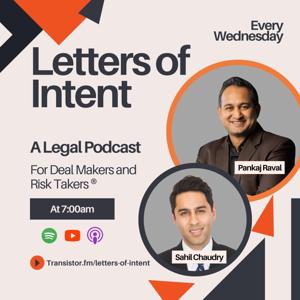
Letters of Intent

Letters of Intent

By Pankaj RavalBusinessEntrepreneurship
Download on the App Store

Letters of Intent episodes

  • The 100 to 100 Campaign: Carbon Law Group's New Initiative

    Carbon Law Group is on a mission: to help 100 entrepreneurs and growing businesses reach the $100 million mark. Whether that means a $100 million exit, reaching a $100 million valuation, or generating $100 million in revenue, Pankaj Raval and Sahil Chaudry are dedicating this episode to unveiling the firm's ambitious new initiative.

    In this episode of Letters of Intent, Pankaj and Sahil discuss the legal barriers that often prevent small businesses from reaching "escape velocity." They break down why airtight contracts and rigorous controls are the non-negotiables of scaling. They also pull back the curtain on how Carbon Law Group is heavily investing in AI tools (like Lexis AI and Claude) to provide the strategic firepower of a 10-person legal team with unprecedented economic efficiency.

    Takeaways

    • The 100 to 100 Mission: Carbon Law Group is actively looking for hungry, coachable founders of growing businesses currently valued between $1M and $10M who want to scale to $100 million.
    • Contracts and Controls: To scale successfully, you need the proper legal infrastructure. This means having bulletproof Master Service Agreements (MSAs), Statements of Work (SOWs), and registered Intellectual Property to ensure you don't accumulate deal-killing liabilities as you grow.
    • AI is a Tool, Not a Lawyer: While tools like ChatGPT are incredibly powerful, they cannot replace a lawyer's trained ability to spot hidden risks, navigate complex human personalities in a negotiation, and map legal strategies to real-world business goals.
    • The Economic Efficiency of AI: By investing heavily in R&D and tools like Lexis AI, Claude, and Prompteteer, Carbon Law Group eliminates the bloated billing of traditional big law firms, doing the work of 10 lawyers with a highly efficient, technology-enabled team.
    • Entrepreneur-to-Entrepreneur: The best legal advice doesn't come from an academic vacuum. Pankaj and Sahil leverage their own experiences of managing employees and meeting sales targets to provide pragmatic, actionable counsel.

    Soundbites

    • "We want to make sure that you have the legal backbone and legal backing to make the right decisions, eliminate risk and get to that hundred million."
    • "You got to have great contracts, and you got to have great controls scaling your business."
    • "Honestly, if you have Chat GPT and you feel like that's your best lawyer, good luck. But the reality is, there's a lot more that goes into it than just what the AI can tell you."
    • "What would take 10 lawyers maybe three years ago, we can do with two to three."
    • "We know what it feels like to set targets and set sales targets and have to come up with the money to meet your expenses every month while chasing that big exit."

    Keywords

    SpaceX, xAI, Elon Musk, Section 368, Tax-Free Reorganization, Mergers and Acquisitions, Entire Fairness Rule, Corporate Governance, Fiduciary Duty, Pre-IPO Cleanup, Small Business Strategy, Carbon Law Group 

    🔗 Learn More

    Website: carbonlg.com

    Connect with Pankaj: https://www.linkedin.com/in/pankaj-raval/

    Connect with Sahil: https://www.linkedin.com/in/sahil-chaudry-6047305/


    Click Here To Schedule A Call With Us

    16 min
  • The $1.25 Trillion Gymnastics: Why Elon Musk Merged SpaceX and xAI

    When Elon Musk merged SpaceX and xAI into a reported $1.25 trillion enterprise, the headlines focused on rockets and artificial intelligence. But underneath the surface, this deal was a masterclass in corporate governance, valuation engineering, and tax structuring. In this episode of Letters of Intent, Pankaj Raval and Sahil Chaudhary break down the legal and financial mechanics behind the massive all-stock transaction.

    They explore how Section 368 of the Internal Revenue Code allows for tax-free reorganizations, why using stock as currency prevents immediate tax drags, and the intense fiduciary scrutiny (Delaware's "Entire Fairness Rule") that applies when a founder negotiates with themselves. Whether you are dealing with billions of dollars or running a growing small to mid-sized business, this episode reveals how to effectively consolidate entities and prepare for future financing.

    Takeaways

    • Beware "Related Party" Valuations: When a transaction is an all-stock exchange between two entities controlled by the same person, internal valuations (like xAI's reported $250 billion) should be viewed with skepticism.
    • Section 368 Reorganizations: By structuring an acquisition as a "Type B" stock-for-stock exchange, companies can treat their stock as currency, allowing shareholders to merge entities without recognizing immediate capital gains taxes.
    • The Pre-IPO Cleanup: This strategy isn't just for tech titans. Founders of small to mid-sized businesses frequently use tax-free reorganizations to cleanly consolidate separate IP holding companies and operating entities before raising capital or selling.
    • The Entire Fairness Rule: If you are a controlling shareholder on both sides of a merger, Delaware law holds you to a high fiduciary standard. You must prove both the process and the price were completely fair to minority shareholders to avoid self-dealing liabilities.
    • Documentation is Everything: To secure tax-free status from the IRS and satisfy fiduciary duties, complex reorganizations require immaculate documentation—from board approvals and stockholder consent to independent legal review.


    Soundbites

    • "Grain of salt, especially whenever you hear all stock transaction, your corporate antenna should go up."
    • "So the same way you can trade currencies, you can trade stock. And so you don't actually need cash to make an acquisition."
    • "In a Delaware law, when a controlling shareholder causes a company to acquire another entity he also controls, the courts will apply something called the entire fairness rule."
    • "This is incredibly common in pre-IPO cleanups and in private equity roll-ups."
    • "The moral of the story is that when you negotiate with yourself... governance, valuation, discipline, and tax structuring must align."


    Keywords

    SpaceX, xAI, Elon Musk, Section 368, Tax-Free Reorganization, Mergers and Acquisitions, Entire Fairness Rule, Corporate Governance, Fiduciary Duty, Pre-IPO Cleanup, Small Business Strategy, Carbon Law Group 

    🔗 Learn More

    Website: carbonlg.com

    Connect with Pankaj: https://www.linkedin.com/in/pankaj-raval/

    Connect with Sahil: https://www.linkedin.com/in/sahil-chaudry-6047305/


    Click Here To Schedule A Call With Us

    11 min
  • Bad Bunny's IP Masterclass

    When Bad Bunny took the stage for the Super Bowl halftime show, he put on an incredible display of Puerto Rican culture, musical talent, and local pride. But underneath the lights and the music was a massive, highly strategic business transaction. In this special episode of Letters of Intent, Pankaj Raval and Sahil Chaudhary put on their "deal lawyer glasses" to break down the mechanics behind the world's most-watched performance.

    They explore the paradox of why mega-stars perform at the Super Bowl for free, breaking down the concepts of value arbitrage and the attention economy. They also deconstruct the complex web of intellectual property rights, explaining how broadcast rights, sync rights, and creative control are negotiated. Finally, Pankaj and Sahil discuss the cultural significance of the performance, highlighting how small businesses and diverse communities are the true engine of the American Dream.

    Takeaways

    • Value Arbitrage: The Super Bowl halftime show is the ultimate example of giving up short-term cash for long-term amplification. Headliners trade a direct performance fee for an audience of 128+ million, resulting in massive spikes in streaming and touring revenue.
    • It's an IP Deal, Not a Service Contract: An artist isn't just providing a service; they are negotiating a complex bundle of intellectual property rights. Knowing how to leverage Name, Image, and Likeness (NIL), sync rights, and public performance rights is crucial.
    • The Importance of Creative Control: By retaining creative control, Bad Bunny was able to center Puerto Rican history, highlight power outages, and elevate local small businesses on a global platform.
    • The American Dream is Built on Small Businesses: Showcasing local barbershops and boxing gyms reinforced the reality that growing businesses are the cultural and economic lifeblood of our communities.


    Soundbites

    • "This is really a kind of value arbitrage where the artist is giving up short-term cash for a much longer term play and that play is amplification."
    • "This is less like a contract for services and this is more of an IP deal."
    • "The fact that these small businesses support their families, support others building businesses is really just paramount to what our American dream is all about."
    • "Not only is it local, he's talked about a lot of small businesses, but he's also brought the global mindset to the local."


    Keywords

    Carbon Law Group, Intellectual Property, Business Strategy, Small Business, Attention Economy


    Resources Mentioned

    • Concepts: Value Arbitrage, Attention Economy, Intellectual Property (Sync Rights, Master Recording Rights, Name Image & Likeness), Broadcast Rights.
    12 min
  • Commercial Leasing 101: SNDAs, TIs, and Personal Guarantees

    Most business owners look at a commercial lease and see rent and square footage. Robby Pinnamaneni sees a credit instrument that can make or break your company. In this episode of Letters of Intent, Pankaj and Sahil sit down with Robby, a seasoned real estate attorney and founder of The Leasing Lawyers, to dismantle the myths of commercial leasing.

    They discuss why the term "boilerplate" is a trap used to rush bad deals, why Tenant Improvement (TI) allowances are actually high-risk loans, and why the 2026 debt maturity wall means you need to audit your landlord's finances before you sign. Plus, Robby shares a sophisticated strategy for investors to acquire distressed properties for cents on the dollar using "mezzanine debt."

    Takeaways

    • Lease = Loan: A commercial lease is a credit instrument. You are taking on a massive financial obligation. Treat the negotiation with the same seriousness you would a bank loan.
    • The SNDA Essential: If your landlord defaults on their mortgage, the bank can kick you out—unless you have a Subordination, Non-Disturbance, and Attornment (SNDA) agreement. In 2026's distressed market, this is non-negotiable.
    • Diligence Both Ways: Stop trying to impress the landlord. In a market with high vacancy and distressed debt, you need to audit their balance sheet. Can they afford to fix the HVAC? are they about to be foreclosed on?
    • The "Boilerplate" Trap: Brokers often label risky clauses as "standard" or "boilerplate" to close deals fast. Never accept "it's market" as a valid legal explanation.
    • Mezzanine Debt Strategy: Robby explains how savvy investors are buying mezzanine debt to foreclose on the entity owning a property (UCC foreclosure) in 60-90 days, bypassing the year-long judicial foreclosure process.


    Soundbites

    • "A lot of times people think the landlord's being generous with Tenant Improvements. They're not. It's effectively a loan."
    • "I hate the term 'boilerplate.' Brokers use it to instill a mantra so they can close the deal and get their commission."
    • "It's no longer a beauty contest of the tenant trying to impress the landlord. The landlord also has to impress the tenant."
    • "If you don't have an SNDA and the landlord defaults, the lender can just kick you out. Your goodwill, your build-out, it all goes out the window."
    • "You gotta start thinking optionality. What if I want to sell? What if I need less space? The lease governs your exit."


    Keywords

    Commercial Real Estate, Leasing, Robby Pinnamaneni, Tenant Rights, SNDA, Mezzanine Debt, Distressed Real Estate, Business Law, Entrepreneurship, Due Diligence, Carbon Law Group


    Guest: Robby Pinnamaneni (The Leasing Lawyers)

    • Website: TheLeasingLawyers.com
    • Instagram: @theleasinglawyers_


    🔗 Learn More

    Website: carbonlg.com

    Connect with Pankaj: https://www.linkedin.com/in/pankaj-raval/

    Connect with Sahil: https://www.linkedin.com/in/sahil-chaudry-6047305/


    Click Here To Schedule A Call With Us

    27 min
  • SPECIAL EPISODE - IP-Maxxing: The Trademark Potential of the Looksmaxxing Trend

    Pankaj and Sahil dive into the viral internet subculture of "looksmaxxing" and its leading influencer, Clavicular. While the trend prioritizes extreme physical appearance over everything else, there's a massive, overlooked business angle: Intellectual Property. They investigate whether the term "looksmaxxing" is trademarked, uncover an abandoned filing, and explain why the next generation of creators and small businesses must "IP-maxx" to protect their brands and assets before they get "frame-mogged" by competitors.

    Takeaways

    • The Creator Economy is Serious Business: Viral internet figures are building massive personal brands that function like modern small businesses. Securing the intellectual property behind these brands is crucial.
    • The Trademark Void: Despite the massive popularity of "looksmaxxing," the trademark remains largely unclaimed for key categories (like cosmetics or grooming), leaving a huge monetization opportunity on the table.
    • Sword vs. Shield: Relying solely on common law trademark rights (using the name in commerce) is just a "shield." A federal trademark registration acts as a "sword," giving you nationwide protection and the power to enforce your rights in federal court.
    • IP-Maxx Your Brand: If you're building a brand—even an unconventional internet persona—secure your intellectual property and corporate governance early. Don't wait until someone else capitalizes on your viral success.


    Soundbites

    • "These are the next generation of entrepreneurs, these creators who are building personal brands, and they're going to have assets... that can be licensed."
    • "It is a sword and a shield because the trademark is both defensive and offensive. You have the right to file lawsuits... that you wouldn't have without a federal trademark."
    • "Always better to have a trademark than not to have a trademark."
    • "I think it's fair to say if you want to IP-maxx and you don't want to get frame-mogged by some other IP attorney, you need to call Carbon Law Group."


    Keywords 
    Intellectual Property, Trademark Law, Looksmaxxing, Creator Economy, Personal Branding, Clavicular, Small Businesses, Brand Licensing, Carbon Law Group

    🔗 Learn More

    Website: carbonlg.com

    Connect with Pankaj: https://www.linkedin.com/in/pankaj-raval/

    Connect with Sahil: https://www.linkedin.com/in/sahil-chaudry-6047305/


    Click Here To Schedule A Call With Us

    11 min
  • Rainmaking for Lawyers: Building Transferable Value Beyond the Founder

    For many lawyers and professional service providers, the "exit plan" is simply to die at their desk. But building a practice that relies 100% on you isn't a business—it's a job. In this episode of Letters of Intent, Pankaj and Sahil sit down with Gideon Grunfeld, founder of Rainmaking For Lawyers, to discuss the complex psychology and mechanics of succession planning.

    They explore why "goodwill" is often worthless in a sale, how to build transferable value through SOPs (Standard Operating Procedures), and why the legal industry is shifting away from the "Mom & Pop" model toward Private Equity-backed structures. If you want your life's work to outlast you, this conversation is the blueprint.

    Takeaways

    • The Identity Trap: The biggest barrier to succession planning isn't financial—it's psychological. Founders fear becoming irrelevant. Gideon explains that stepping back isn't an "on-off switch," but a transition where you can still add value.
    • Systems > Charisma: Buyers do not pay for your personality. They pay for systems, databases, and Standard Operating Procedures (SOPs) that ensure revenue continues when you leave.
    • The Power of the LOI: A Letter of Intent is critical in succession deals. It signifies the shift from "dating" to "moving in together," allowing you to share sensitive data (like client lists) for due diligence while protecting confidentiality.
    • Don't Be an "Article II" Lawyer: Defining your expertise too narrowly makes your business fragile. You must define yourself by the problems you solve for clients, not the specific code section you litigate.
    • The MSO Revolution: Private Equity is entering the legal space through Management Service Organizations (MSOs). This shift means the future of law belongs to scaled, professionally managed firms, not isolated solo practitioners.


    Soundbites

    • "Succession planning is only relevant if you've gotten something big enough... that it's not dependent on you doing exactly the same thing you've done for the last 30 years."
    • "If the entire firm is just you and your name and your charisma... The answer is I'm going to pay you 10% because I don't think I could remotely replicate what you do."
    • "Unemployed people don't have a ton of money. No work equals no money."
    • "My dream is to die at my desk and to hit my head on the treatise I'm reading. I've heard that a million times."
    • "We're no longer a mom and pop business economy... The days of being like a young solo and thinking you're gonna replicate what the prior generation did is vanishingly unlikely."


    Keywords

    Succession Planning, Law Firm Valuation, Exit Strategy, Gideon Grunfeld, MSO, Private Equity in Law, Standard Operating Procedures, Business Growth, Carbon Law Group

    Guest: Gideon Grunfeld (Rainmaking For Lawyers)

    • Website: rainmakingforlawyers.com
    • LinkedIn: Gideon Grunfeld


    🔗 Learn More

    Website: carbonlg.com

    Connect with Pankaj: https://www.linkedin.com/in/pankaj-raval/

    Connect with Sahil: https://www.linkedin.com/in/sahil-chaudry-6047305/


    Click Here To Schedule A Call With Us

    49 min
  • Legal Roleplay: LLC, C-Corp, or S-Corp?

    Choosing the right legal entity isn't just about paperwork, but it's also about defining the future of your business. In this special "Roleplay" episode of Letters of Intent, Pankaj Raval and Sahil Chaudry simulate a real client consultation to demystify the complex world of entity selection.

    Pankaj plays the role of a physician launching a high-growth sober living company, while Sahil plays the corporate attorney guiding him through the maze. They break down the critical differences between LLCs, C-Corps, and S-Corps, explaining why "Phantom Income" can ruin an LLC owner's year, how the MSO structure allows for investment in healthcare, and why C-Corps are the only real choice for venture-backed scale.

    Takeaways

    • The MSO Solution: Non-doctors generally cannot own medical practices. To scale a healthcare business with outside capital, you often need a Management Services Organization (MSO) to separate the business operations from the clinical work.
    • Phantom Income: In an LLC (pass-through entity), you are taxed on the profit allocated to you, even if that money stays in the business account. This "Phantom Income" can create a tax bill with no cash to pay it.
    • C-Corps for Growth: If you plan to raise venture capital, issue stock options to employees, or reinvest earnings heavily, a C-Corp is usually the superior choice despite "double taxation."
    • The QSBS Goldmine: Founders of C-Corps in qualified industries (not professional services) who hold stock for 5+ years may be eligible to exclude up to 100% of their capital gains upon sale under Section 1202.
    • S-Corp Strategy: For profitable small businesses and professional service providers not seeking venture capital, an S-Corp election can save thousands in self-employment taxes once income exceeds ~$150k.

    Soundbites

    • "This is not an OnlyFans channel. We are going to be doing some legal role playing."
    • "An LLC is a pass-through entity... the IRS is going to tax you on your profit, whether or not you take it. That's called phantom income."
    • "Think of Kafka as the plumbing. Wait, wrong episode. Think of the C-Corp as the vehicle for the big juicy exit."
    • "If you're screwing the IRS, maybe I'm going to get screwed too... wait, that's valuation. Here it's: If you aren't expecting regular distributions, go with a C-Corp."
    • "With an S-Corp, you pay employment taxes on your salary, but the benefit is that any distributions beyond that are free of self-employment tax."

    Keywords

    Entity Selection, C-Corp vs LLC, S-Corp, Management Services Organization, MSO, QSBS, Venture Capital, Corporate Governance, Phantom Income, Business Law, Carbon Law Group

    🔗 Learn More

    Website: carbonlg.com

    Connect with Pankaj: https://www.linkedin.com/in/pankaj-raval/

    Connect with Sahil: https://www.linkedin.com/in/sahil-chaudry-6047305/


    Click Here To Schedule A Call With Us

    19 min
  • Why Your Founder-Led Sales Strategy is Doomed to Fail

    "Sales" is often a dirty word for founders, associated with aggressive tactics and "Wolf of Wall Street" energy. But for Enrico Parodi, sales is simply engineering applied to human relationships. In this episode of Letters of Intent, Pankaj and Sahil sit down with Enrico, an outsourced Vice President of Sales who helps small to mid-sized businesses build scalable, repeatable revenue engines.

    They discuss the critical transition from founder-led sales to a professional sales team, why most companies hire the wrong type of sales leader (a "driver" instead of a "builder"), and the "Ego vs. Pain" threshold every entrepreneur must cross before they can truly scale.

    Takeaways

    • Ego vs. Pain: Founders often struggle to let go of sales because they believe they are the only ones who can do it. Enrico argues that until the "pain" of stalled growth outweighs the founder's "ego," they won't seek the help they need.
    • Builders vs. Drivers: There are two types of sales leaders. "Drivers" know how to operate an existing system. "Builders" know how to construct the car from scratch. Most small businesses hire drivers when they actually need builders.
    • The Ideal Client Profile (ICP): In B2B sales, you cannot target the masses. You must define exactly who you serve, or you will dilute your value proposition and kill your profitability.
    • Engineering Mindset: Sales requires structure. Without a defined process (CRM, routine, pipeline management), you cannot scale beyond the founder's personal effort.
    • Responsiveness: In a noisy market, the simplest competitive advantage is reliability. Doing what you say you will do, when you say you will do it, eliminates the need to "sell" yourself.


    Soundbites

    • "If the ego is there, they have not had enough pain."
    • "It's like a car race, there are people that drive and people that build the cars. The people that build the cars are very few."
    • "If you don't give them a routine, they are lost... if you are not structured, you don't scale."
    • "If you take a Lamborghini [it is different] than a Fiat 500, right? But the pieces are the same... you have wheels, you have a steering wheel, you have an engine."
    • "If you are in a getting-only mentality, they sniff it from 10 miles."


    Keywords

    Sales Strategy, Fractional VP of Sales, B2B Sales, Business Growth, Ideal Client Profile, Sales Management, Corporate Governance, Entrepreneurship, Carbon Law Group

    Guest: Enrico Parodi (Sales Xceleration)

    • Email: [email protected]
    • LinkedIn: Enrico Parodi
    • Website: https://salesxceleration.com/advisors/enrico-parodi/


    🔗 Learn More

    Website: carbonlg.com

    Connect with Pankaj: https://www.linkedin.com/in/pankaj-raval/

    Connect with Sahil: https://www.linkedin.com/in/sahil-chaudry-6047305/


    Click Here To Schedule A Call With Us

    32 min
  • Why Your AI Screenplay Can’t Be Copyrighted (And Is "Dirty" Data)

    It sounds glamorous, but entertainment law is not for the faint of heart. In this episode of Letters of Intent, Pankaj and Sahil sit down with Nadia Davari, a veteran entertainment attorney and film producer.

    They pull back the curtain on the industry, discussing why the "golden age" of independent film financing is fading, the stark difference between negotiating with a studio vs. an indie producer, and the massive legal risks of using AI in the creative process. If you are a creator thinking about using ChatGPT to write your script or your contracts, you need to listen to this warning first.

    Takeaways

    • AI & Copyright: You cannot copyright work created by non-humans. If you use AI to write your screenplay, you may own nothing. It is considered public domain or "dirty data."
    • The ChatGPT Trap: Clients often try to save money by using AI to draft legal documents (like operating agreements). Nadia explains why this results in "gibberish" that costs more to fix than to draft from scratch.
    • Industry Reality Check: Entertainment law isn't all red carpets. It often involves low starting pay, volatile projects, and deals that fall through at the last minute.
    • Negotiation Strategy: When negotiating with a studio, you can be aggressive. When negotiating with an independent producer, you must understand there is a hard cap on money. Know who you are fighting.
    • The Death of Pre-Sales: The old model of funding films through international pre-sales and DVD revenue is dying, making it harder for independent filmmakers to predict revenue.
    • AI in Law: While tools like Lexis AI and Spellbook are useful for professionals, "cowboy" use of ChatGPT by laypeople creates legal nightmares.


    Soundbites

    • "Entertainment law is definitely not for the weak of heart. It's really a whole other business."
    • "He said, 'I'm using AI.' I said, 'Do you realize that none of that is private information anymore? Do you know that you can't copyright it?'"
    • "I put this into Chat GPT and these are the answers... some of the answers from AI was such gibberish."
    • "Please don't give us the nightmare of your Chat GPT work. It's easier for us to redraft an entire agreement."
    • "You have to have an eye out to the end of the process... Where are you going to go? Who's going to watch this?"


    Keywords

    Entertainment Law, AI Copyright, ChatGPT, Film Financing, Independent Film, Intellectual Property, Hollywood, Negotiation Strategy, Screenwriting, Legal Tech, Carbon Law Group

    Guest: Nadia Davari (Law Offices of Nadia Davari)

    • Website: nadiadavari.com / davarilaw.net
    • Instagram: @nadiadavari 


    🔗 Learn More

    Website: carbonlg.com

    Connect with Pankaj: https://www.linkedin.com/in/pankaj-raval/

    Connect with Sahil: https://www.linkedin.com/in/sahil-chaudry-6047305/


    Click Here To Schedule A Call With Us

    40 min
  • Why Your Business Is Worth Less Than You Think (And How to Fix It)

    "Price is what you pay. Value is what you get." But how do you determine that value? In this masterclass episode of Letters of Intent, Pankaj and Sahil are joined by Stephen Bethel, a veteran business appraiser and broker with decades of experience.

    They dive deep into the art and science of valuation, exposing the biggest mistakes founders make (like treating their business as a "personal ATM"), why "unsexy" industries like porta-potties are often better investments than tech unicorns, and why the commercial real estate market might be facing a 30% correction. If you plan to sell your business one day, this conversation will tell you exactly how to get it "wedding ready."

    Takeaways

    • Don't Be a Personal ATM: If you run personal expenses through your business to lower taxes, don't expect a high valuation when you sell. Buyers won't pay for "add-backs" they can't verify.
    • Recast Your Financials: Before selling, hire a CPA to "recast" your financials. Presenting clean, adjusted numbers on letterhead builds trust and value.
    • The "Dirty" Business Advantage: Simple, unsexy businesses (pallet companies, car washes, solid waste) often trade at better multiples and have more stable cash flow than flashy tech startups.
    • Real Estate Trap: If you own the building your business operates in and don't pay yourself market rent, your EBITDA is artificially high. A buyer who has to pay rent will value your business much lower.
    • Commercial Real Estate Warning: Stephen predicts a potential 25-30% drop in commercial real estate prices over the next 18-24 months due to negative absorption and high interest rates.
    • Get "Wedding Ready": Selling a business is like getting married or selling a car. You need to clean it up, organize your contracts, and make sure the "restroom isn't a dump"—because buyers judge the unseen by the seen.


    Soundbites

    • "If you're screwing the IRS, maybe I'm going to get screwed too."
    • "Simpler the business and the dirtier the business, the better it is."
    • "Everyone thinks their house is worth a whole bunch... My business is different... you're like, yeah, well, maybe not."
    • "I've seen a lot of software companies go nowhere... I haven't made money in four years, we're going to break even in two."
    • "It's kind of like getting in shape to go get married... you gotta look good."
    • "Everyone looks at it as basically a private ATM... but on the flip side, I also want my cake and eat it too."


    Keywords

    Business Valuation, Stephen Bethel, M&A, Commercial Real Estate, EBITDA, Exit Strategy, Small Business, Entrepreneurship, Due Diligence, Financial Planning, Carbon Law Group


    Guest
    Stephen Bethel (Frazier Capital)

    • Socials: https://www.linkedin.com/in/stephen-bethel-a78a20105/
    • Phone: 213-439-9956, extension 102


    🔗 Learn More

    Website: carbonlg.com

    Connect with Pankaj: https://www.linkedin.com/in/pankaj-raval/

    Connect with Sahil: https://www.linkedin.com/in/sahil-chaudry-6047305/

    Trademark Watch Service: https://carbonlg.com/introducing-carbon-laws-new-trademark-watch-service/


    Click Here To Schedule A Call With Us


    28 min

About Letters of Intent

From the publisher's feed

Conversations with business leaders and changemakers on how they built their business and what keeps them going.