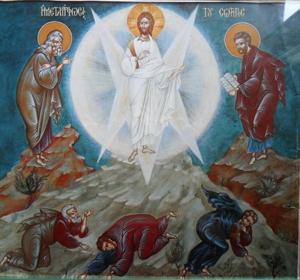
Life Transfigured - The Podcast

Life Transfigured - The Podcast

By Justin MillerTechnology
Download on the App Store

Life Transfigured - The Podcast episodes

  • 2020 Divine Liturgy 5
    October 4, 2020
    Divine Liturgy Series, Number 5
    By Fr. Alex Miller
     
    Genesis 1:26-31, Genesis 2
     
    At the beginning of the liturgical new year I began this series of homilies on the divine liturgy by looking at the foundation of who God is and who we are because of him.
     
    We have been working our way through the Genesis account of creation and today we come to the sixth day and the pinnacle and completion of all that God created.
     
    The account of the creation of Adam brings to a conclusion this chronological narrative of how God created all that exists.
     
    The account is immediately followed by a separate explanation of creation that is complementary to it.
     
    Critics of the literal creation story say that these two accounts contradict each other and therefore show that they cannot be trustworthy.
     
    However when understood beneath the lens of scholastic scholarship and the writings of the holy fathers we see that these two accounts are completely compatible and complementary to each other.
     
    So let’s look at the conclusion of the chronological narrative and then move on to the  complementary narrative.
     
    By way of review here are the six days of creation:
     
    Day 1 The heavens and the earth, light, and the invisible angelic world
     
    Day 2 The separation of the waters above the heavens from the waters below the heavens(heavens, firmament, sky, atmosphere)
     
    Day 3 Separation  of the water from the dry land and the bringing forth of vegetation from the dry land.
     
    Day 4 The sun the moon and the stars
     
    Day 5 Fish in the sea and birds in the air
     
    Day 6 Land animals and the creation of man
     
    Then God said let us make man in our image.
     
    In this final day of creation and in this narrative God tells us three specific things about man:
     
    first of all,  that he is created in the image of God 
     
    secondly,  that he was created male and female and
     
     thirdly, that he is created to have dominion over all creation.
     
    The final verses of chapter 1 establishes  the fact that all of the vegetation growing on the earth was given for food for man and for all living things and that it was very good.
     
    Chapter 2 of Genesis begins with a description of the seventh day, the day of rest. 
     
    And then begins a separate narrative of creation that is not chronological but is more of an overall summary of creation with emphasis on the creation of man and a description of the garden of Eden.
     
    Here the emphasis is not so much on chronology but rather on purpose and function.
     
     
    Chapter 2 gives us greater detail about the creation of man. The first man Adam was formed from the dust of the earth and “God breathed in his face the breath of life and man became a living soul.”
     
    Then we have a fairly detailed description of a specific part of creation known as the garden of Eden where man would be placed. In this description are listed some rivers that flow from the garden and some of the rivers have names that continue today in contemporary geography, Tigris and Euphrates.
     
    We are told that God placed man in the garden to tend it and we find the admonition to partake of everything in the garden except for one tree, the  tree of the knowledge of good and evil.
     
    Then God said something very important about the nature of man, he said “it is not good for man to be alone. I will make him a helper comparable to him.”
     
    This is where we need to be very careful in how we read this text. The next verse says also God formed out of the ground all the wild animals of the field all the birds of heaven and brought them to Adam to see what he would call them.
     
    Critics read this verse without precision and interpret it  to mean that God created Adam and then created all the animals.
     
    But that is not what it says.
     
    The text is not speaking chronologically but rather generally about creation.
    It explains that in addition to the creation of Adam, God had  also created the birds and all of the land animals, and he brought them to Adam to see what he would name them.
     
    In other w

    13 min
  • 2020 Divine Liturgy 4
    This is the fourth sermon in a series of homilies on the Divine Liturgy.
    By Fr. Alex Miller
     
    We have begun this series by looking in depth and who God is and who we are because of him.
     
    As an introduction to this subject we are specifically looking at the first six days of creation.
     
    To review we have stated that on the first day  God created out of nothing the heavens and the earth, light and the invisible angelic world.
     
    On the second day he separated the waters above the sky from the waters below the sky.
     
    Today we look at the third day of creation.
     
    On the third day of creation God separated the water from the dry land and caused the land to bring forth all forms of vegetation.
     
    The fathers of the church write about this extensively and state that this explosion of vegetation occurred instantaneously not over a long period of time as it is supposed by the theory of evolution.
     
    Also they state that every plant and green vegetation that grew up had within itself its own seed according to its kind.
     
    This again is contrary to the theory of evolution which claims that complex things develop from more simple things and this development takes place over millions of years.
     
    Again we see the beauty the logic and rationality of God in the way that he is putting creation together beginning with water, then separating the land, then producing vegetation growing on the land which would become a beautiful garden and habitation for all the animals and ultimately for mankind.
     
    On the fourth day of creation God created the sun and the moon and the stars and set them in the heavens and set them in motion in a predictable and consistent pattern of movement. The sun immediately initiated the process of photosynthesis to allow for the growth and nurture of all of the plants and vegetation growing on the earth.
     
    On the fifth day the Lord caused the sky to be filled with all kinds of birds and the oceans to be filled with all kinds of fish and swimming things each of them created according to their kind.
     
    With everything set in place for the sustenance of human of life: water,  land, sky, and sun, birds filling the sky and fish filling the sea, on the sixth day God created all the land animals each of them according to their kind, male and female he created them.
     
    This again is totally incompatible with the fairytale of evolution. All species were created in a single moment of divine inspiration and each species was created mature and carrying within itself the means to reproduce according to its kind.
     
    All of this was done in a rational logical intelligent order to prepare the world for one last crowning moment of creation: “let us make man in our image.”
     
    Next week we will conclude our discussion of creation with a detailed look at the crowning event of this narrative: the creation of Adam and Eve.
    16 min
  • 2020 Divine Liturgy 3
    September 20, 2020
    Divine Liturgy Series, Number 3
     
    Genesis 1:6-8
     
    This is the third sermon in a series of homilies on the divine liturgy.
     
    We have begun our study by looking at the first chapter of Genesis to know clearly who God is and how he has created us and the world in which we live.
     
    We have begun this way because it is essential in worship to know who you are worshiping and who you are because of your creator.
     
    The nature of the one you are worshiping shapes the way you worship and the action of the worshiper is shaped by one’s self awareness.
     
    In the first two sermons we looked at the nature of God and we looked at the first day of creation.
     
    Today we will address the second day of creation which often is overlooked and misunderstood.
     
    In fact it is safe to say that the meaning of the second day of creation is so obscure that it is mostly ignored.
     
    “Then God said let there be a firmament in the midst of the water let it divide the water from the water and it was so. Thus God made the firmament and God divided the water under the firmament from the water above the firmament so God called the firmament heaven and God saw that it was good and there was evening and morning the second day.”
     
    It appears that after the first day of creation all that existed was basically disorganized water.
     
    So on the second day of creation God begins to bring order to the created world and begins to organize and set up the water system that would eventually be one of the primary sustainers of creation.
     
    We now have three components of the material world: we have the water below the firmament, the water above the firmament, and we have the firmament itself.
     
    The water below the firmament is basically the sphere of what we call earth completely covered with water,  we have space or sky surrounding that sphere and then we have water above the sky whose nature is not completely understood.
     
    Scientifically we understand now that the world is set up with a water system and interaction between the water that exists on the earth and the water or humidity that is in the atmosphere or above the atmosphere.
     
    We Know that this system is very sophisticated and very intelligently designed to keep the world relatively stable in terms of temperature and environment.
     
    Firmament represents what we call the sky or atmosphere or space.
     
    It’s possible that before the great flood the the waters above the firmament or sky existed in the form of some type of canopy or greenhouse cover extremely dense with moisture and which allowed light from above but kept out some of the more harmful radiation of the sun which would be created later.
     
    (In the description of the great flood we read about catastrophic changes to this water system, both the waters below the firmament and the waters above the firmament. We will not say more about that at this time but will address it in greater detail when we discuss the fall of mankind and the great flood.)
     
    The reality is that we do not know the exact nature of the firmament and the waters above the firmament in the beginning but we do know that the fathers of the church interpreted it so that this is exactly what happened on the second day and that it was the second step in the creation and the ordering of a sustainable and nurturing world.
     
    We see that God in a very intelligent and ordered way step-by-step is preparing creation for the inhabitation of some special form of life, that is humanity.
     
    Going back to the first few verses of Genesis we see the action and involvement of the holy trinity,  the Father speaks,  the Son creates and the Holy Spirit hovers over the water.
     
    God is Trinity and we must worship him as Trinity otherwise we are not really worshiping him at all. This is the foundational point of the divine liturgy which we are going to be studying throughout this liturgical year, God as Trinity and humanity in the image of God.
     
    The second day is an affirmation of this one basic premise:
    Creat
    13 min
  • 2020 Divine Liturgy 2
    September 13, 2020
    Divine Liturgy Series, Number 2
    By Fr. Alex Miller
    Genesis 1: 1-31
     
    This is the second in a series of sermons on the divine liturgy of the holy orthodox church.
     
    Before getting into the liturgy itself this year I feel it’s important to establish the foundation of who is the subject of this worship, what is his nature, and who we are because of him.
     
    To do so we must begin in the beginning with God as creator and so today’s sermon is really going to be a Bible study of the first chapter of Genesis.
     
    The first 11 chapters of Genesis are what I like to refer to as reverse prophecy.
     
    This section of the Bible is unique in that it is telling us things that only God is eyewitness to. These events, especially the acts of creation, the six days of creation were observed only by God himself and through divine revelation this knowledge was imparted to Moses.
     
    The nearly universal consensus of the church down through the centuries has been that this account of creation is to be taken literally and not metaphorically or mythologically.
     
    The holy fathers of the early New Testament church from the second third fourth century and so on to this day have testified to this.
     
    It was only with the introduction of evolution by Charles Darwin that parts of Christendom began to doubt the authenticity of the creation narrative.
     
    It is important to note that Charles Darwin and his colleagues were motivated by the hatred for God, racism and for a hatred of any limitations on the sexual appetite. This is also true of Margaret Sanger the founder of Planned Parenthood.
    She especially was intent upon the extermination of black people and to this day planned parenthood continues it’s genocide upon the African-American population.
     
    The theory of evolution is a man-made fairytale. Not only is it totally contradictory to holy scripture it is unsupported by modern science and it has been proven to be a total impossibility.
     
    My children in Christ therefore let us approach the book of Genesis with total faith and trust in the reliability and the accuracy of this account of the beginnings of our world.
     
    In the beginning God created the heavens and the earth and the earth was formless and void.
     
    In the beginning God. That is all that existed and even the word exist does not explain God. All we can say is that God has been, is, and will ever be, three divine persons, father son and holy spirit perfectly united in one nature.
     
    God brought the world into existence out of nothing, ex nihilo.
     
    This is the only explanation for what we see. If you press an evolutionist to explain the source of the “primordial slime” they cannot. Though many of them will say “well it came from another planet.” In other words they just kick the can down the road.
     
    On day one of creation God brought the world into existence and it was invisible and unfinished, formless and void, and covered with darkness. “The Spirit of God was hovering over the face of the water.”
     
    On the first day after bringing the world into existence God said “let there be light.”
     
    In these first few verses we see the reality of the holy Trinity: the Father speaks, the Holy Spirit hovers, the Son, in response to the Father, creates.
     
    The holy fathers of the orthodox church teach that on this first day in addition to creating the world and illuming the world with light God also created the angelic world, the invisible world. This is suggested by various scriptures of the Old and New Testament.
     
    Many of the holy father’s have grappled with the question of the nature of the light which was present on the first day. They all agree that it was something different from the sun and the moon and the stars which were created on the fourth day.
     
    Many modern Christians have confused these two sources of light or have suggested that is just a mistake in the text or that it really doesn’t matter but it is clear from the patristic record the holy church took this question very seriously and too
    18 min

About Life Transfigured - The Podcast

From the publisher's feed

Sermons and other messages of Rev. Alex Miller, pastor of Holy Transfiguration Church in Crawfordsville, Indiana