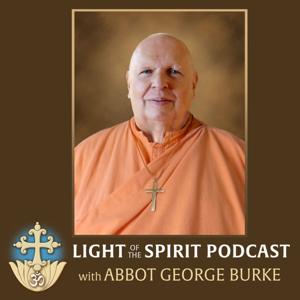
Light of the Spirit Podcast

Light of the Spirit Podcast

By Abbot George Burke (Swami Nirmalananda Giri)Religion & SpiritualityChristianitySpiritualityHinduism
Download on the App Store

Light of the Spirit Podcast episodes

  • I Meet Swami Sivananda of Rishikesh
    I met God in flesh both in America and India in the form of great yogis and devotees. Transformed by yoga and devotion they were embodiments of higher consciousness. One time my friend Hari Datta Vasudev was telling me about some of the holy ones he had met during his life. After one account he paused and then looked at me very intently. “They are the glory of India!” he told me. I agree and would like to tell you of the glory of India I encountered, the glory of God revealed in humanity.

    The greatest of these was Swami Sivananda of Rishikesh, a holy city in the Himalayan foothills about twenty miles north of Hardwar, another most sacred place. Truly in a class by himself, Sivananda was the Lord of life and death, holding the keys of immortality. Although I could describe the other holy ones to some degree, Sivanandaji was beyond description or classification. He loved and we loved in return. I do not think even his closest disciples could say any more.
    I met many great yogis in India but among them Sivananda was unique. The other yogis, great as they were, yet produced in me an external awareness, the awareness of their vibration, their very high energy. Now that awareness was certainly beneficial, but in a lesser degree, because it was outwardly turned and reality is inside. Sivananda was glorious and a wonder beyond telling, as was always evident. Yet, I found that the moment I entered his presence I experienced silence and became increasingly self-aware rather than drawn outward. I saw and admired him from the base of my true Self. There is a lot of talk about being centered, but Sivananda’s presence made me centered in the silent core of my being that is pure consciousness.

    This podcast is the first of a series recounting my time with Swami Sivananda in the early 60’s, beginning with how I first heard Sivanandaji, and how I first met him.
    15 min
  • The Importance of Vegetarianism for the Yogi
    Let’s take a brief look at the spiritual benefits of being a vegetarian yogi.

    The mind, as a mass of vibrating energy, is limited by the constitution or condition of that energy. If the energy is heavy or inert, little can be done with it to produce the state of silence and clarity needed to reflect the truth of spirit. Certain elements darken the mind and make it thick or heavy, vibrating very slowly–sometimes seemingly not at all.

    On the other hand, some elements lighten the mind, making it fluid and subtle, vibrating at a very high level. It is this latter condition that is needed for attaining the state of liberation–or rather, the state that liberates the spirit from the illusion of bondage and suffering. It is really the mind that becomes liberated, but that liberation also affects the essentially ever-free spirit and sets it free. To attain such liberation the mind must be purified and refined, vegetarian diet being one of the best and strongest means for its purification.

    We cannot get a marble statue from clay, nor can we get wheat bread from barley meal–the end product is still going to consist of the nature of the material started with. So it is with all our bodies, gross and subtle. They will reflect the character of the food which has gone into their formation.

    It is obvious, then, that the food we eat is going to determine the quality and condition of all the levels of our being, including body and mind.

    Therefore when we eat something, it not only affects us on all levels of our existence, it becomes those levels. In this very real sense we indeed are what we eat.
    16 min
  • The Yoga Life 4: Niyama, the "Dos" of Yoga
    Having finished Yama, the “Don’t”s of Yoga, in the last podcast, we now consider Niyama: the “Dos” of yoga.

    Shaucha: purity, cleanliness
    Santosha: contentment, peacefulness
    Tapas: austerity, practical (i.e., result-producing) spiritual discipline
    Swadhyaya: introspective self-study, spiritual study
    Ishwarapranidhana: offering of one’s life to God
    25 min
  • The Yoga Life 3: Asteya, Brahmachary, and Aparigraha, and the Great Vow
    In today's podcast Abbot George finishes the consideration of Yama, with its last three elements: asteya, brahmacharya, and aparigraha, and the sidesteps that people will take to avoid a strict adherence to this important principles. Then he considers the "Great Vow" of the Patanjali's Yoga Sutras."

    What is Asteya (non-stealing)?

    Asteya is abstinence from stealing, which Vyasa defines as: “the improper appropriation to oneself of others’ things.” He then concludes: “Refusal to do it, in freedom from desire, is non-stealing.”

    Regarding asteya, Abbot George discusses the mental fudges one sometimes makes in order to justify violating this principle.

    What is Brahmacharya (control and continence)?

    “Brahmacharya is restraint of the sex organ and other senses,” says Vyasa. From this we see that brahmacharya has a twofold nature: control and continence.

    Control: Spirit has two aspects: consciousness and energy. Consciousness is constant, whereas energy is cyclic. It is the movement of energy that produces (and is) our experience of relativity, and it is the development of energy that is the process of evolution. Therefore the conservation and application of energy is the main determinant of success or failure in spiritual endeavor. Diffusion and dissipation of energy always weakens us. Hence brahmacharya is a vital element of Yoga, without which we cannot successfully pursue the greater life of Higher Consciousness.

    Basically, brahmacharya is conservation and mastery of all the energy systems and powers of our being. This is especially true in relation to negative emotions, for tremendous energy is expended through lust, anger, greed, envy, hatred, resentment, depression, fear, obsession, and the rest. Further, they are both the causes and the symptoms of losing self-control, a major aspect of brahmacharya.

    Research has shown that persons in the grip of these emotions literally breathe out vital elements of the body. For example, the breath of angry people is found to be laden with copper. So negative emotion depletes us physically as well as energetically.

    Positive emotions on the other hand actually enhance and raise our energy and physical levels. The cultivation of (true) love, compassion, generosity, cheerfulness, friendliness, and suchlike make us stronger and calmer–essential aspects of brahmacharya. It is noteworthy that the word “virtue” is derived from the Latin word virtus–power–which in turn is derived from the Sanskrit word virya, which means both power and strength.

    What is Aparigraha (non-possessiveness, non-greed, non-selfishness, non-acquisitiveness)

    Vyasa’s definition is most practical: “Seeing the defects in objects involved in acquiring them, and defending them, and losing them, and being attached to them, and depriving others of them, one does not take them to himself, and that is aparigraha.”

    Here, as in the other foundations, the true virtue or observance is mostly internal, leading to the correct state of mind for successful yoga practice.

    The Great Vow

    After listing ahimsa, satya, asteya, brahmacharya, and aparigraha, Patanjali continues: “These, not conditioned by class, place, time or occasion, and extending to all stages, constitute the Great Vow” (Yoga Sutra 2:31).

    They are the Great Vow because they require the exercise of will and because of their dynamic effect on us. Even more, they are great because, like the elements, they are self-sufficient, depending on nothing else, and because they cannot be mutated into something else. They are always what they are, and for that reason they are always to be observed with no exceptions whatsoever. They cannot be neglected or omitted for any reason–absolutely. Patanjali lists the possible conditions which do affect lesser observances: c...

    26 min
  • The Yoga Life 2: a Practical Understanding of Harmlessness and Truthfulness
    In this podcast Abbot George begins a practical and detailed analysis of the first of the components of Yama: Ahimsa (harmlessness) and Satya (truth), which it is essential for the aspiring yogi to understand.

    Ahimsa is not willfully causing any harm or pain whatsoever to any being whatsoever, in any degree whatsoever. Ahimsa includes strict abstinence from any form of injury in act, speech, or thought. Violence, verbal or physical, causing mental injury or pain, and angry or malicious damage or misuse of physical objects are all violations of ahimsa, unthinkable for the yogi.

    “Satya is said to be speech and thought in conformity with what has been seen or inferred or heard on authority. The speech spoken to convey one’s own experience to others should be not deceitful, nor inaccurate, nor uninformative. It is that uttered for helping all beings. But that uttered to the harm of beings, even if it is what is called truth, when the ultimate aim is merely to injure beings, would not be truth. It would be a wrong.” So says Vyasa.

    But these are mere definitions. How is the yogi to apply them in his Yoga Life, in his quest for enlightenment? Listen to the podcast to find out. (This podcast is 24:56 minutes long.)
    25 min
  • Introducing the Yoga Life: Laying the Foundations
    This podcast is the beginning of a series on how to lead the Yoga Life. Today Abbot George discusses what is lacking in the yoga practice of many, and why people fail or do not persevere in the path of yoga. Then he outlines the beginning of what the essential steps to success are.

    First, what is meant by yoga, and what is the Yoga Life? Then what are the “Foundations of Yoga”: Yama and Niyama?

    Yama and Niyama are often called the Ten Commandments of Yoga, but they have nothing to do with the ideas of sin and virtue or good and evil as dictated by some cosmic potentate. Rather they are determined by a thoroughly practical, pragmatic basis: that which strengthens and facilitates our yoga practice should be observed and that which weakens or hinders it should be avoided.

    It is not a matter of being good or bad, but of being wise or foolish. Each one of these Five Don’ts (Yama) and Five Do’s (Niyama) is a supporting, liberating foundation of Yoga.
    Yama means self-restraint in the sense of self-mastery, or abstention, and consists of five elements. Niyama means observances, of which there are also five.

    Here is the complete list of these ten observances as given in Yoga Sutras 2:30,32:

    1 Ahimsa: non-violence, non-injury, harmlessness
    2 Satya: truthfulness, honesty
    3 Asteya: non-stealing, honesty, non-misappropriativeness
    4 Brahmacharya: sexual continence in thought, word and deed as well as control of all the senses
    5 Aparigraha: non-possessiveness, non-greed, non-selfishness, non-acquisitiveness
    6 Shaucha: purity, cleanliness
    7 Santosha: contentment, peacefulness
    8 Tapas: austerity, practical (i.e., result-producing) spiritual discipline
    9 Swadhyaya: introspective self-study, spiritual study
    10 Ishwarapranidhana: offering of one’s life to God
    21 min
  • Why We Meditate and the Obstacles We Overcome
    Why do we meditate? In this podcast Abbot George discusses the real reason to meditate as contrasted with wrong reasons. Then continuing with Patanjali’s instructions from the Yoga Sutras, he explains the obstacles to spiritual life and their effects.

    The obstacles Patanjali lists are as follows:

    Vyadhi: Disease of the body.
    Styana: Dullness; languor, debility; drooping state.
    Samshaya: Doubt; suspicion.
    Pramada: Carelessness; fault; guilt.
    Alasya: Laziness; idleness; apathy; sloth.
    Avirati: Hankering after objects; non-dispassion; sensual indulgence; lack of control; non-restraint.
    Bhranti-darshana: Delusion; erroneous view.
    Alabdhabhumikatva: Non-achievement of a stage; inability to find a footing.
    Anavashtitatvani: Unsteadiness; instability of mind; inability to find a footing; mental unsteadiness.
    Patanjali lists these effects from the obstacles above:

    Dukha is pain; suffering; misery; sorrow; grief; unhappiness; stress; that which is unsatisfactory.
    Daurmanasya is despair, depression etc., caused by mental sickness; feeling of wretchedness and miserableness.
    Angamejayatva is shaking of the body; lack of control over the body.
    Shvasa-prashvasa is hard breathing; inspiration and expiration.
    These are the symptoms of a mental state that is outward-turned and impelled toward–and absorbed in–externalities.

    What is the means of removing these obstacles and their effects? Patanjali says in Sutra 32:

    For removing these obstacles [there should be] the constant practice of the one principle [the japa and meditation of Om].
    23 min
  • How to Effectively Meditate on Om
    In this important podcast, Abbot George continues the subject of Ishwara, with emphasis on the Sound Form (Vachaka) of Ishwara which brings the yogi to enlightenment: Om.
    He also gives hints on how to apply this Supreme Mantra effectively.
    Click here to listen to How to Effectively Meditate on Om if you do not see the player above.
    Discover more about how to meditate on Om by reading Om Yoga Meditation.
    To see all of our podcasts, visit our podcast page.
    23 min
  • Yoga, God, and Gurus: an Important Perspective
    The last podcast about God was philosophical, so in this podcast Abbot George will go into the practical side.

    It is the goal of every sentient being to evolve and attain union with God. Evolution takes place naturally as we move up the ladder from birth to birth until the level in reached in which we take charge and engage in the much more rapid process of self-evolution.

    Yoga is the means of self-evolution that culminates in conscious and perfect union with God. So we need to consider God in that perspective.

    The Yoga Darshan or Yoga Sutras of Patanjali is the prime authority on yoga. Patanjali was a Nath Yogi in the spiritual lineage of Gorakhnath, the greatest yogi in Indian history. Abbot George discusses Patanjali's words on God and yoga found in the first section, the Samadhi Pada of the Yoga Sutras.

    Most importantly, Abbot George talks about the proper understanding of what a guru is and is not.
    21 min
  • Plain Talk About God
    In this week's podcast, Abbot George discusses who God is, and what man is, and the importance of making God an immediate reality in our daily lives. Abbot George bases his talk on Paramhansa Yogananda's valuable book, The Science of Religion. Here Yogananda says:

    "We should take religion and God out of the sphere of belief into that of daily life. If we do not emphasize the necessity of God in every aspect of our lives and the need of religion in every minute of our existence, then God and religion drop out of our intimate daily consideration and become only a one-day-in-a-week affair."

    Abbot George illustrates his points with examples drawn from his experiences in India, where the ideal is to live daily in the presence of God.
    25 min

About Light of the Spirit Podcast

From the publisher's feed

A Practical Resource for the Spiritual Student. Discover the timeless wisdom of India and the yoga path to freedom. This podcast channel offers you a wealth of practical and thought-provoking…