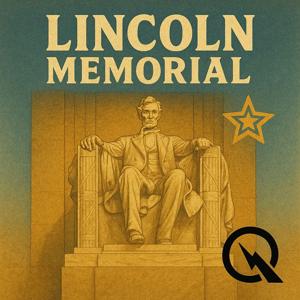
This is your Lincoln Memorial monument podcast.
Hey there, history buffs and monument maniacs! It's your boy Higgs coming at you live from the National Mall in Washington D.C., where I'm staring up at one of the most iconic landmarks in American history - the Lincoln Memorial. This place is straight fire, fam, and I'm about to drop some serious knowledge bombs about how it came to be, what's gone down here, and why it's such a big freaking deal.
So picture this: It's 1867, just two years after Lincoln got assassinated, and Congress is like "Yo, we need to honor this dude with an epic monument." But get this - it took over 40 years for them to actually get their act together and make it happen. Talk about government efficiency, am I right?
Finally in 1911, they set up this Lincoln Memorial Commission and were like "For real this time, let's build this thing." They tapped architect Henry Bacon to design it, and this guy was not messing around. He went full-on Greek temple vibes, modeling it after the Parthenon in Athens. Why? Because democracy, baby! Lincoln saved the Union, so Bacon wanted to connect him to the OG birthplace of democratic ideals.
Now, building this beast was no joke. Construction kicked off in 1914 and took a solid 8 years. We're talking 38,000 tons of marble, limestone, and granite from all over the country. The statue of Lincoln inside? That bad boy is 19 feet tall and weighs 175 tons. Daniel Chester French sculpted it, and legend has it he based Lincoln's hands on casts of the president's actual mitts. Talk about attention to detail!
But here's where it gets wild - when they dedicated this bad boy on May 30, 1922, the crowd was segregated. Yeah, you heard that right. A memorial to the Great Emancipator, and they couldn't even let Black and white folks sit together. The only integrated section was where the Union veterans were chilling. Pretty messed up, right?
That's not the only drama that went down, though. Check this - in 1939, the Daughters of the American Revolution were like "Nah fam" when African American opera singer Marian Anderson wanted to perform at Constitution Hall. So what did she do? She was like "Cool, I'll just sing at the Lincoln Memorial instead." And sing she did, in front of 75,000 people and millions more on the radio. It was a major mic drop moment for civil rights.
But the real game-changer came in 1963 when Martin Luther King Jr. delivered his "I Have a Dream" speech from those very steps. Over 200,000 people showed up for the March on Washington, and King's words echoed across the nation. It was like the memorial finally lived up to its true purpose - a symbol of freedom and equality for all Americans.
Since then, this place has been ground zero for protests, celebrations, and just about every major national moment you can think of. Vietnam War protests? Check. Massive concerts and gatherings? You bet. Obama's pre-inauguration concert in 2009? Yup, right here at Honest Abe's crib.
But it's no
This content was created in partnership and with the help of Artificial Intelligence AI.