
Sign up to save your podcasts
Or

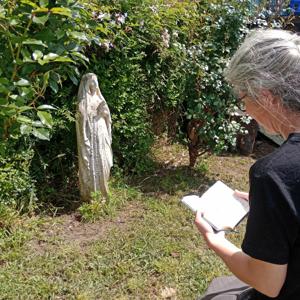


This video was a quick one, back to my usual mumbling speedy voice.
Here’s the final annotated calendar:
Hopefully it’s clear enough to point you in the right direction. Most proper copies of the Little Office will have a section on Rubrics or Instructions which should explain the same information.
Here are my source PDFs:
* 2025
* 2026
* 2027
I made 2027 so far ahead of time in order to include it in my Planner for next year. You can get a printed copy at Lulu or browse a PDF version on Gitlab. I probably should have spruiked it in the video. Well, if anyone buys a copy I’ll know you read through to the end of the article! Or you can leave a cryptic comment somewhere.
SpiRItui or SPIriTUi? What’s the difference, who cares and why?
This puzzle jumped out at me a while ago. I started listening and assembled a few examples, but it wasn’t until this tripped up one of my choir members that it seemed worthwhile to put an explainer together. Today we’ll briefly look at why mastering this word will help you, what the different endings mean and why Spiritus is so odd in Latin. In the recording I will include clips from Pope Pius XII, Pope John Paul II and Pope Benedict XVI and Cardinal Burke.
First, a warning, don’t be a fusspot. It is very common and normal for people speaking Latin to mix things up. Most of the time it’s not worth correcting someone’s pronunciation. As long as you’re generally intelligible, then we can live with funny quirks.
Except if you’re singing a psalm in a tone with a final of two accents, then you will need to know the accent in Spiritui falls on the RI and not the TU. This occurs in Mode 5 and Mode 7.
As choir leader, I care that people sing the right note on the right syllable, so although I do my best to remember that pronunciation can vary, I am in a wonderful position where I have the final say on how things are sung in my choir. That said, you probably go with what your choirmaster says, but I’ll plough ahead because I think I’m right and because it’s one of those details which is interesting in a small way.
Now, the word Spiritus is an interesting case. It ends with “US” which makes you think it’s a normal 2nd declension noun, but turns out it’s a member of a much smaller group, the 4th declension nouns. However, it is frequently paired with the adjective “SANCTUS” which follows the 2nd declension noun endings. Most of the time, in Latin, your adjectives and nouns share endings, so you can be tempted to say Spiritus Sanctus, Spirito Sancto, Spiriti Sancti, but in this case that doesn’t always work.
When the Holy Spirit is the Subject of the sentence, as in “May Almighty God bless, you, Father, Son and Holy Ghost” then you do have Spíritus Sanctus. However, when making the sign of the Cross, the Three Persons of the Blessed Trinity are in the Genitive Case, “Of the Father, Of the Son, Of the Holy Ghost” and we use “Spíritus Sancti”. Lastly, the case under the microscope today, in the Gloria Patri, we use the Dative Case, “Glory Be To the Father, To the Son, To the Holy Ghost” and here we have “Spirítui Sancto”.
In Latin the last syllable is never accented. The accent falls on either the second last (penultimate) or third last (antepenultimate) syllable. In Classical Latin we talk about the quantity of different syllables, whether it’s long or short. If the penultimate syllable is long, it gets the accent. If the penultimate syllable is short, then the accent goes on the antepenultimate syllable. In Spiritui, the first and last syllables are long, so both middle syllables are short, so the accent falls on the antepenultimate, which is the RI.
So that gives you too much information on why we say SpiRItui in the Gloria Patri.
Hearing people pray the Gloria Patri in Latin is wonderful, regardless of accuracy. A long time ago I made a quick video saying that pronouncing Latin is easy, and I guess there is still some truth in that, but as you can see here, there is usually more out there to learn. I hope this discussion helps you pronounce the Gloria Patri with confidence and accuracy so that if you ever join a choir and sing a Gloria Patri in mode five or seven, then you will easily hit the right notes on the right syllables.
God bless you.
https://www.lobvm.com/hours/roman/1962/office-1/la-en/matins/
I finished with the optional collect to make this a standalone hour. Sorry, I didn’t check the other spoken recordings for consistency. Follow up with Lauds if you like:
Very similar to the last two posts, just subbing out the Psalms for the 3rd Nocturn. This recording was plagued by bird noises. First take it was Sulphur Crested Cockatoos, second take my voice was audibly much more tired and one chicken was hanging around, making her presence felt. So here you can hear one psalm from the first take and two psalms from the second take and you might guess which is which.
Matins is a bit of a tough one. The invitatory stays the same, so you get the hang of that. The responsories have a bit of variation and in Lent where the Te Deum is not said and instead there’s a third responsory, “Felix namquam”. I’m singing the one from the Baronius Press book, which comes from Hartker’s Nocturnale.
But here is Matins for Wednesdays and Saturdays from Septuagesima Sunday through to Holy Wednesday or Holy Saturday if you’re praying in private.
I’ve included the optional ending in case you don’t go straight into Lauds. Feel free to skip this if you have Lauds queued up ready to roll. Hopefully your podcast app allows you to do this.
Booklets in PDF available: littleoffice.brandt.id.au
Support this channel, either via Substack or Buy Me a Coffee
I’m copying from the previous post, just changing the bit to make it 2nd Nocturn. Even the audio pretty much does this. It’s a shortcut. Hope it’s not too aggravating.
Matins is a bit of a tough one. The invitatory stays the same, so you get the hang of that. The responsories have a bit of variation and in Lent where the Te Deum is not said and instead there’s a third responsory, “Felix namquam”. I’m singing the one from the Baronius Press book, which comes from Hartker’s Nocturnale.
But here is Matins for Tuesday and Friday from Septuagesima Sunday through to Holy Wednesday or Holy Saturday if you’re praying in private.
I’ve included the optional ending in case you don’t go straight into Lauds. Feel free to skip this if you have Lauds queued up ready to roll. Hopefully your podcast app allows you to do this.
Booklets in PDF available: littleoffice.brandt.id.au
Support this channel, either via Substack or Buy Me a Coffee
Matins is a bit of a tough one. The invitatory stays the same, so you get the hang of that. The responsories have a bit of variation and in Lent where the Te Deum is not said and instead there’s a third responsory, “Felix namquam”. I’m singing the one from the Baronius Press book, which comes from Hartker’s Nocturnale.
But here is Matins for Sunday, Monday and Thursday from Septuagesima Sunday through to Holy Wednesday or Holy Saturday if you’re praying in private.
I’ve included the optional ending in case you don’t go straight into Lauds. Feel free to skip this if you have Lauds queued up ready to roll. Hopefully your podcast app allows you to do this.
Booklets in PDF available: littleoffice.brandt.id.au
Support this channel, either via Substack or Buy Me a Coffee
The Little Office of the Blessed Virgin Mary is a great treasure from the Church’s rich history of liturgical work. Here is a wonderful way to usher in the morning. There are four psalms and two canticles.
I sort of munged the different versions as the budgerigars were starting to wake up as I reached the end, plus I didn’t have the words for the Commemoration of the Saints handy, so the recording includes the Kyrie from the 1915 version, but ends like the 1962 version.
Booklets in PDF available:
https://littleoffice.brandt.id.au/
Support this channel, either via Substack or Buy Me a Coffee
Completorium is known as Compline or Complin with all the different possible pronunciations. I’m using the Roman Little Office of Our Lady in the 1915 version. The Little Office of the Blessed Virgin Mary is a cut down version of the Divine Office for the Laity or Third Orders. The Gregorian Chant is from the Antiphonale Romanum. The Marian Antiphon, Ave Regina Caelorum is sung in the Simple Tone.
This one was surprisingly easy to put together as I didn’t make so many mistakes. Once upon a time I did have this memorised, but that was a while ago.
Booklets in PDF available:
https://littleoffice.brandt.id.au/
Support this channel, either via Substack or Buy Me a Coffee
Vespers, Vesperae, Evening Prayer for the time from Septuagesima Sunday through Ash Wednesday, First Sunday of Lent right through to Holy Thursday. The Little Office is not prayed publically over the Sacred Triduum, but if you were saying it privately, this is what you could use.
The Divine Office proper to the Sacred Triduum is pretty amazing though and well worth looking into. divinumofficium.com is a good place to start. Tenebrae is the most musical hour (Matins+Lauds) with many fine recordings available on Youtube. The rest are very pared back with minimal singing, but very beautiful in an austere way.
This recording is back in the house at night with some noise removal and filter curve equalising courtesy of Audacity.
Booklets in PDF available:
https://littleoffice.brandt.id.au/
Support this channel, either via Substack or Buy Me a Coffee
The bird noises from about 5 minutes in are Sulphur Crested Cockatoos, which are very common in my part of Australia.
Booklets in PDF available:
https://littleoffice.brandt.id.au/
Support this channel, either via Substack or Buy Me a Coffee
From the publisher's feed