
Sign up to save your podcasts
Or



Nickelodeon shows like Nicky Ricky Dicky and Dawn, iCarly, Drake & Josh, The Thundermans, Victorious, Ned's Declassified School Survival Guide and Henry Danger and Disney shows like Good Luck Charlie, Wizards of Waverly Place, Jessie, Liv & Maddie, That's So Raven, Hannah Montana, and Lizzy Mcguire gave very different message and morals about parenting than older shows like Father Knows Best, Growing Pains, Family Ties, The Adventures of Ozzie & Harriet, or The Brady Bunch, and as a consequence, parents raised their kids in very different ways depending on which era they grew up in.
You were more shaped by your generation than your parents. Parents’ influence matters less than you think—backed by 40 years of twin adoption studies. Happiness, intelligence, success and values are more impacted by being a zoomer or a boomer. No Millennials allowed.
In Casey Simpson's Living History episode on John Locke, the focus is on Locke's role as a pivotal Enlightenment thinker and the "father of liberalism." The episode explores his ideas of the social contract, natural rights to life, liberty, and property, and the concept of government by consent, which influenced the U.S. Declaration of Independence. It highlights Locke's empiricism, particularly his "tabula rasa" theory, emphasizing knowledge gained through experience. The episode also touches on his advocacy for religious toleration and separation of powers, shaping modern democratic principles.
In the Living History episode featuring Oliver Cromwell, we explored his rise from modest gentry to Lord Protector of England. The episode delved into his pivotal role in the English Civil War, leading the Parliamentarians to victory against the Royalists. It highlighted his controversial rule, marked by military campaigns in Ireland and Scotland, and his complex legacy as both a revolutionary and a divisive figure. Through vivid reenactments, the episode brought Cromwell’s turbulent era to life, showcasing his impact on British history.
In this episode of Casey Simpson's Living History podcast, King Charles I, the 17th-century monarch of England, Scotland, and Ireland, is the featured guest. The conversation explores Charles I’s reign, emphasizing his commitment to the divine right of kings, which fueled tensions with Parliament and ignited the English Civil War. Charles discusses his Personal Rule, the Bishops’ Wars, and the escalating conflicts that led to his 1649 trial and execution. The episode touches on key moments, such as the Siege of Drogheda, where Cromwell’s forces killed thousands, with surviving Royalist soldiers deported to Barbados as indentured laborers. Casey Simpson draws out Charles I’s perspective on his controversial policies, his vision for monarchy, and the chaotic events that defined his reign, providing listeners with an engaging window into this transformative period.
Thanks to our patrons: Bob Pflugfelder Eric Guy Van Natta Matt Gillespie
This podcast is possible thanks to our Patrons: https://patreon.com/TheLivingHistoryPodcast?utm_medium=unknown&utm_source=join_link&utm_campaign=creatorshare_creator&utm_content=copyLink
In the Living History episode, host Casey Simpson interviews Charles Darwin, who vividly recounts his transformative voyage on the HMS Beagle. Darwin shares his awe at discovering diverse species in the Galapagos, leading to his groundbreaking theory of evolution by natural selection. Through engaging storytelling, he reflects on the challenges of publishing On the Origin of Species and its impact on science. The episode, crafted for a young audience, blends adventure and insight, highlighting Darwin’s curiosity and legacy.
Howard Hughes’ remarkable life as an aviator, filmmaker, and billionaire. They discuss his aviation triumphs, including the Spruce Goose, and his Hollywood influence through RKO Pictures. Hughes shares insights into his private struggles with germophobia and his high-profile relationships. The episode paints a vivid picture of a complex 20th-century figure.
On Living History, Casey Simpson interviews Sir Isaac Newton, exploring how his Christian faith fueled his scientific discoveries, including gravity and optics. Newton critiques Freud’s view of religion as an illusion, defends reason against atheism, and addresses modern skepticism. He shares personal struggles with solitude and a 1693 breakdown, emphasizing faith’s role in his resilience. Newton urges listeners to seek truth through reason and faith, seeing the universe as God’s ordered creation.
From the publisher's feed
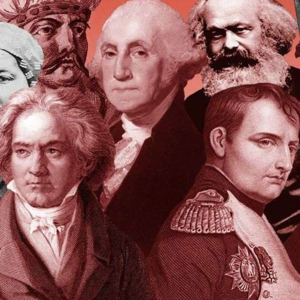
A podcast where the guests are historical figures. Each week features a casual conversation with a major person from history such as John F. Kennedy, Socrates, or Frederick Douglass.