
Sign up to save your podcasts
Or

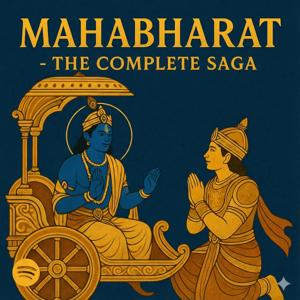


Standing between the two armies, Arjun is overcome by paralyzing grief and refuses to kill his own grandsire and teachers, dropping his Gandiv bow. This episode covers the commencement of the divine dialogue where Lord Krishna transforms from a charioteer into the Supreme Guru. He deconstructs Arjun’s illusion (Moha) by revealing the eternal nature of the Soul and the philosophy of Nishkama Karma (duty without attachment), urging the warrior to rise above his emotions and fight for the establishment of Dharma.
The Kurukshetra War is about to begin, but before the first arrow is fired, the strict codes of 'Dharma Yuddha' must be established. And how did a blind king witness the greatest battle in history?
🎧 Listen to the complete Mahabharat Saga here: https://bit.ly/3N68Rln
In Episode 58, we enter the Jambukhanda Vinirmana Parva (the opening of the Bhishma Parva). As the two colossal armies of the Pandavas and Kauravas stand face-to-face, the leaders convene to agree upon the rules of engagement. We explore the authentic textual rules of honorable warfare: equals must only fight equals, charioteers battle charioteers, and the unarmed, retreating, or surrendered must be spared.
Meanwhile, Maharishi Ved Vyas visits Hastinapur to offer King Dhritarashtra a profound gift: the vision to witness the war firsthand. But consumed by fear and unable to watch the slaughter of his own kin, the King refuses. Instead, the boon of Divya Drishti (Divine Vision) is bestowed upon his charioteer, Sanjay. Discover how Sanjay becomes the omniscient narrator, transcending space and time to relay every brutal and divine moment of the Kurukshetra war back to the blind King.
⏳ Episode Chapters (Timestamps):
[00:00] - Intro
[00:18] Recap
[00:32] Jambukhanda Vinirmana Parva Begins
[01:24] Rules of War
[03:35] Sanjay Receives Divya Drishti (Divine Vision)
[04:30] Sanjay Describes Bad Omens
[06:45] Sanjay Describes Jambudweep & Bharat
[08:40] 4 Yugas
[09:56] Sanjay Describes World Continents
[10:50] Conclusion
[11: 20] Next Episode: Bhagwad Gita
Follow the journey & join the community:📱 Instagram: https://bit.ly/4l2Gq4b
About This Podcast:This series is a faithful retelling of the epic Mahabharat, sourced directly from the authentic Sanskrit texts and Critical Editions; free from the exaggerations of TV adaptations.
#Mahabharat #KurukshetraWar #DharmaYuddha #RealMahabharat #HinduMythology #VedVyas #SanjayDivyaDrishti #BhishmaParva
As the massive armies finally mobilize for the Kurukshetra war, a critical strategic impossibility haunts the Pandava high command: how do you eliminate a supreme military leader who possesses the divine right to choose his own time of death? The answer lies buried in the Ambopakhyan Parva, a profound masterclass in the absolute, terrifying power of systemic injustice and long-term, generational vengeance. When Duryodhana presses Grandsire Bhishma about his single tactical blind spot, the preceptor reveals the dark, heavily suppressed history of Princess Amba; a woman whose life, agency, and reputation were completely destroyed by his own misguided adherence to rigid, absolute vows.
Stripped of her future, rejected by her betrothed, and humiliated by the patriarchal establishment, Amba refused to surrender to despair. Instead, she weaponized her profound trauma. In an unparalleled display of sheer, single-minded psychological obsession and extreme ascetic endurance, she secured a divine guarantee to become the exact instrument of Bhishma's assassination in her next life. Reborn as Shikhandi to King Drupad, her very existence transforms into the ultimate, inescapable consequence of Bhishma's past actions.
From a modern analytical perspective, this episode is a brilliant case study of long-term strategic retaliation and the catastrophic cost of ignoring collateral damage in leadership. It fundamentally deconstructs the myth of Bhishma’s invincibility, proving that even the most impenetrable physical and political armor cannot protect a leader from the ghosts of their own systemic failures. Amba’s transformation into Shikhandi isn't just a tale of rebirth; it is the ultimate engineered weapon designed specifically to hack the ethical algorithm of the Kuru Commander, perfectly setting the stage for his inevitable, tragic downfall.
Who were the most powerful warriors in the Kurukshetra War? Before the battle begins, Bhishma conducts the ultimate military SWOT analysis, ranking every fighter—but his assessment of Karna sparks a massive internal revolt.
🎧 Listen to the complete Mahabharat Saga here: https://bit.ly/3N68Rln
In Episode 56, we dive into the Rathatirtha Sankhyana Parva. Accompanied by modern 2D digital illustrations of the epic's heroes, we explore how Bhishma classifies the warriors into four distinct ranks: Maharathi, Atirathi, Rathi, and Ardharathi. While warriors like Drona and Ashwatthama receive high praise, Bhishma publicly humiliates Karna, labeling him a mere 'Ardharathi' (half-warrior) due to his arrogance, the loss of his divine armor, and Parashurama’s curse.
Discover Karna's explosive reaction and his fatal vow to boycott the war as long as Bhishma leads. We also explore the ranking of the Pandava army, why Arjun is considered an unmeasurable system of war rather than just a fighter, and the shocking strategic weakness Bhishma reveals to his enemies regarding Shikhandi.
⏳ Episode Chapters (Timestamps):[00:00] The Pre-Battle Tension & SWOT Analysis[01:37] The 4 Ranks: Maharathi, Atirathi, Rathi & Ardharathi[02:53] Ranking the Kaurava Army (Drona & Ashwatthama)[04:10] The Ultimate Insult: Karna is a "Half-Warrior"[05:21] Karna's Vow to Boycott the War[06:08] Ranking the Pandava Army & Abhimanyu[07:12] Why Arjuna is Unranked (Off the Charts)[08:13] Bhishma's Fatal Weakness: Shikhandi[09:22] The Impact on the Kurukshetra War
Follow the journey & join the community:📱 Instagram: https://bit.ly/4l2Gq4b
About This Podcast:This series is a faithful retelling of the epic Mahabharat, sourced directly from the authentic Sanskrit texts and Critical Editions—free from the exaggerations of TV adaptations. We bridge the gap between ancient philosophy and modern psychology to bring these timeless lessons to a new generation.
#Mahabharat #Karna #Bhishma #Maharathi #KurukshetraWar #RealMahabharat #HinduMythology #RathatirthaSankhyanaParva
On the absolute brink of the Kurukshetra war, physical weapons are put on hold while a masterclass in psychological warfare takes center stage. In the Uluka Dutagamana Parva, Duryodhan deploys Shakuni’s son, Uluk, as his final envoy to the Pandava camp. However, this is not a diplomatic mission for peace, it is a highly calculated, strategic move designed to inflict emotional damage and goad the enemy into acting out of blind rage rather than tactical reason.
In the modern world of high-stakes negotiations and competitive business, making your opponent lose their temper is a proven tactic to force unforced errors. Duryodhana understands this perfectly. Through Uluka, he delivers deeply researched, highly targeted personal insults to break the morale of each Pandava. He relentlessly mocks King Yudhishthir’s so-called righteousness, ridicules Arjun’s humiliating year disguised as a eunuch in Virat's kingdom, and taunts Bheem’s gluttony and unfulfilled vows of revenge.
The tension in the Pandava camp reaches a volatile boiling point as Bheem and Sahadev erupt in fury, completely provoked and ready to execute the messenger on the spot. Yet, this episode beautifully highlights the stoicism, emotional intelligence, and emotional regulation required of true leadership. Lord Krishna and Yudhishthir maintain their absolute composure, strictly upholding the ancient rules of diplomacy while sending back a chilling, cold-blooded counter-challenge. This chapter strips away the physical combat to explore the raw human psychology of provocation, ego management, and the immense mental discipline required right before the ultimate clash of empires.
As the colossal armies mobilize for Kurukshetra, the Pandavas appoint Dhrishtadyumn as their Commander-in-Chief, while Bhishma assumes command of the Kaurava forces. Lord Balaram, refusing to choose between his brother Krishna and his student Duryodhan, declares his neutrality and departs for a pilgrimage, withdrawing from the war entirely. In Hastinnapur, Drithrashtra ask Sanjay to narrate the events happening in Kurukshetra.
Duryodhan’s arrogance reaches its peak when he attempts to imprison Lord Krishna, triggering the awe-inspiring Viswaroop Darshan (Cosmic Form), proving that Krishna is not a mere envoy but the universe itself. The narrative then shifts to the most emotional turning point of the epic: the revelation of Karna’s birth secret. Despite pleas from both Krishna and his mother Kunti to switch sides, Karna chooses friendship over lineage, promising Kunti that he will spare four of her sons, making the war a personal duel between him and Arjun.
As Krishna attempts to negotiate peace, the great sages narrate ancient tales to warn Duryodhan about the perils of arrogance. Sage Narada recounts the extensive saga of Rishi Galava’s impossible quest for 800 "moon-white" horses and the tragic sacrifice of Princess Madhavi to fulfill a Guru Dakshina. The episode culminates in the powerful lesson of King Yayati, who was cast down from heaven solely due to his pride, a direct mirror to Duryodhan’s stubbornness, which remains unshaken despite these divine warnings.
Before departing for Hastinapur, Krishna consults the Pandavas, leading to a surprising debate where even the volatile Bheem suggests peace, while Draupadi, weeping, demands war to avenge her humiliation. Krishna arrives in the enemy capital and makes a powerful political statement by rejecting Duryodhan’s lavish royal feast, declaring that one should only eat where there is love or hunger. Instead, he chooses the humble hospitality of Vidhur’s home.
The sun rises on the Kuru court as Sanjay finally delivers the Pandavas' official ultimatum: return the kingdom or face total annihilation by Arjun and Bheem. This message acts as a catalyst, instantly shattering the unity of the Kaurava camp. While elders like Bhishma and Drona urge Dhritarashtra to make peace to save the lineage, Karna and Duryodhan vehemently reject any compromise, leading to a heated verbal clash. The episode exposes the deep internal fractures (Phoot) in Hastinapur, proving that the war is being driven by Duryodhan's ego rather than the consensus of the court.
From the publisher's feed