
Sign up to save your podcasts
Or

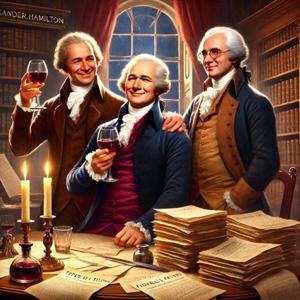


Ever wonder how the United States' foundational ideas continue to shape our modern governance? Join me, Charlie Jett, as I uncover the true significance of the Federalist Papers in crafting the bedrock of American democracy. We revisit the Constitutional Convention of 1787, where the visionary efforts of Alexander Hamilton, James Madison, and John Jay forged essays that not only advocated for a new Constitution but also meticulously outlined enduring principles of governance. Through Hamilton's call for a formidable central government, Madison's strategies on managing the intricacies of a large republic, and Jay's focus on unity and justice, these founding figures laid the groundwork for a nation still grappling with the same questions of power and governance today.
In this episode, we shine a spotlight on key Federalist Papers, dissecting their relevance and impact on contemporary political structures. Hamilton's Federalist No. 70 champions the necessity of a dynamic, singular executive, while Madison's No. 39 navigates the fine line between federal and national elements inherent in the Constitution. We also evaluate the foresight of these essays against today's realities, such as the evolving role of the Electoral College and the persistent challenge of factions. Despite shifts in interpretation and application, the Federalist Papers' core insights into human nature and governance remain as pertinent as ever, guiding the principles that underpin our political landscape.
Visit my website at Critical Skills | By the Author of WANTED: Eight Critical Skills You Need To Succeed (criticalskillsblog.com)
In Federalist Paper No. 1, Alexander Hamilton introduces the series of essays advocating for the ratification of the U.S. Constitution. He emphasizes the significance of a strong, unified federal government for national stability and prosperity. Hamilton outlines the inadequacies of the Articles of Confederation and addresses the critical decision facing Americans: to accept the new Constitution or continue with a weaker government. He warns against the dangers of disunity and factionalism, urging readers to consider the benefits of a consolidated union that can effectively govern and protect the nation. This paper sets the stage for the arguments to follow.
https://criticalskillsblog.com/2024/05/01/federalist-paper-1-a-call-to-unity-and-vigilance/
Visit my website at Critical Skills | By the Author of WANTED: Eight Critical Skills You Need To Succeed (criticalskillsblog.com)
The Anti-Federalists were a diverse group who opposed the 1787 Constitution, fearing it concentrated too much power in a centralized government. Despite being labeled "anti-American," their commitment to individual liberties and skepticism of government overreach led to the adoption of the Bill of Rights. Their key concerns included the absence of explicit protections for citizens and the potential for tyranny. Their efforts resulted in the first ten amendments, safeguarding fundamental freedoms and ensuring a balance of power. Their legacy endures as a vital reminder of the need to protect individual rights and prevent the concentration of power.
Visit my website at Critical Skills | By the Author of WANTED: Eight Critical Skills You Need To Succeed (criticalskillsblog.com)
In 1787, Virginia delegate George Mason refused to sign the U.S. Constitution — a shocking act for one of its principal architects. His “Objections to the Constitution” laid out, point by point, the dangers of excessive federal power and the absence of a Bill of Rights. Mason warned that without explicit protections, liberty itself would be at risk.
This episode of Making a Great America tells the story of the Founder who chose principle over popularity — whose dissent gave birth to the Bill of Rights, ensuring that freedom in America would be guaranteed, not assumed.
Visit my website at Critical Skills | By the Author of WANTED: Eight Critical Skills You Need To Succeed (criticalskillsblog.com)
"Centinel I" was published in the Philadelphia Independent Gazetteer on October 5, 1787, written under a pseudonym by Samuel Bryan, a Philadelphia patriot and son of Pennsylvania political leader George Bryan. This essay was one of the earliest and most widely circulated Anti-Federalist critiques of the proposed Constitution, appearing just weeks after the Constitutional Convention concluded. The essay was reprinted in numerous newspapers throughout the states and became one of the most influential Anti-Federalist writings during the ratification debates. Centinel went on to write 23 more essays between October 1787 and November 1788.
Visit my website at Critical Skills | By the Author of WANTED: Eight Critical Skills You Need To Succeed (criticalskillsblog.com)
In 1787, an anonymous writer calling himself “The Federal Farmer” published a powerful essay urging that the new Constitution include a Bill of Rights.
He warned that freedom of the press, religion, and trial by jury must be explicitly protected, not assumed.
“Power,” he wrote, “is of an encroaching nature.”
This episode of Making a Great America tells the story of the Federal Farmer’s calm, reasoned defense of liberty — how his words helped convince Madison and others to enshrine the Bill of Rights, ensuring that American freedom would rest on law, not trust.
Visit my website at Critical Skills | By the Author of WANTED: Eight Critical Skills You Need To Succeed (criticalskillsblog.com)
In Federalist Paper No. 2, John Jay argues for the necessity of a strong, unified government under the proposed U.S. Constitution. He emphasizes the shared heritage, values, and interests of the American people, advocating for a federal government capable of ensuring national security, managing conflicts, and promoting the common good. Jay critiques the weaknesses of the Articles of Confederation, highlighting their inability to provide effective governance. He stresses that a consolidated union is essential for the nation's stability and prosperity, ensuring the protection of citizens' rights and the country's success on the international stage.
Federalist Paper #2: The Case for Unity and Strong Government | Critical Skills (criticalskillsblog.com)
Visit my website at Critical Skills | By the Author of WANTED: Eight Critical Skills You Need To Succeed (criticalskillsblog.com)
Anti-Federalist Paper Brutus No. 1, likely written by Robert Yates, argues against the ratification of the proposed U.S. Constitution. Brutus fears that the Constitution grants too much power to the federal government, risking the erosion of state sovereignty and individual liberties. He contends that a large republic would struggle to adequately represent the diverse interests of its citizens, leading to governance challenges and potential tyranny. Brutus criticizes the necessary and proper clause and the supremacy clause, warning that they grant the federal government excessive discretionary power, ultimately undermining the authority of the states.
Visit my website at Critical Skills | By the Author of WANTED: Eight Critical Skills You Need To Succeed (criticalskillsblog.com)
Anti-Federalist Paper Cato III, likely authored by George Clinton, critiques the proposed U.S. Constitution, expressing concerns about a powerful centralized government. Clinton warns that the President's extensive powers, including control over the military and pardoning authority, could lead to tyranny. He also fears that the Senate, with its long terms and substantial powers, could become an unaccountable aristocratic body. The essay highlights inadequate representation in Congress and potential overreach of the federal judiciary, which might undermine state courts. Clinton urges careful reconsideration and amendments to better protect individual liberties and state sovereignty, advocating for a government that truly safeguards the people's rights.
Visit my website at Critical Skills | By the Author of WANTED: Eight Critical Skills You Need To Succeed (criticalskillsblog.com)
In Federalist Paper No. 3, John Jay argues that a strong, unified federal government is essential for national security and peace. He asserts that a single government will be more effective in avoiding wars and conflicts with foreign nations and between states. Jay emphasizes that a united America can better uphold treaties and international laws, thereby protecting citizens and ensuring the nation's safety and stability.
Federalist Paper #3: The Necessity of Union | Critical Skills (criticalskillsblog.com)
Visit my website at Critical Skills | By the Author of WANTED: Eight Critical Skills You Need To Succeed (criticalskillsblog.com)
From the publisher's feed
Welcome to "Making a Great America," a podcast dedicated to exploring the meticulous thought and effort that went into the design of the Constitution of the United States.
This series…
During the fall of 1787 and the spring of 1788, three remarkable men—John Jay, Alexander Hamilton, and James Madison—worked tirelessly to write a series of essays known as the Federalist Papers. These essays were crafted to convince the citizens of the newly independent states to ratify the Constitution, establishing a constitutional republic that balanced power and safeguarded liberties. Their efforts were instrumental in shaping the framework of the government we know today.
In "Making a Great America," we do not argue for or against any political position.
Instead, we aim to report history accurately, informatively, and with easy listening.
By delving into the writings and ideas of the Founding Fathers, we provide listeners with a deeper understanding of the Constitution's origins and the profound care taken to ensure a balanced and fair government. Our episodes are designed to be engaging and accessible, making complex historical concepts easy to grasp.
We believe that knowledge of our government and its creation is essential to its continued survival. As such, we encourage you to subscribe to our podcast and share it widely with friends, family, and colleagues. Together, let's foster a greater appreciation for the history that continues to shape our nation.
Benjamin Franklin explained to a curious woman after the continental congress finished about what kind of government was created.
His response: "A Republic . . . . IF you can keep it!"