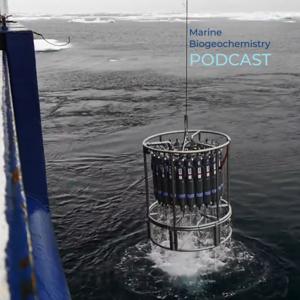
Marine Biogeochemistry Podcast

Marine Biogeochemistry Podcast

By Lennart T. BachScienceEducationEarth Sciences
Download on the App Store

Marine Biogeochemistry Podcast episodes

  • Silicon I - Reverse Weathering - Sonja Geilert
    Why is is reverse weathering called reverse weathering? And, why is reverse weathering the most annoying term when you have to say it repeatedly on a podcast? While the second question remains unanswered, Sonja Geilert from Utrecht University provided the explanation for the first one. Sonja illustrates how authigenic clay formation (i.e. ~reverse weathering) works, what it needs, and why we should study this process much more than we currently do.
    36 min
  • Carbon II - Understanding alkalinity - Andrew Dickson
    Understanding alkalinity is one of the "eight-thousanders" in marine biogeochemistry. Luckily, we have Prof. Andrew Dickson, who has mapped this dangerous territory like few others have before. In this episode, I asked Andrew to go on a trip with a steep learning curve. We navigated acid-base equilibria, organic alkalinity, the future of Certified Reference Materials and could just get around a disastrous debate on pH scales. This was the first episode I ever recorded. So, climbing Mount Everest with zero experience. What could possibly go wrong?!
    1 hr 2 min
  • Phosphorus I - Phosphorus cycling in sediments - Caroline Slomp
    The number of scientists studying marine phosphorus cycling may align to the Redfield ratio. For every 106 scientists studying carbon, there is one studying phosphorus. This is at least the approximation made by Prof. Caroline Slomp, one of our world's experts on the marine P cycle. In this episode, I ask questions how P cycles through marine sediments. The challenge is that understanding the P cycle also requires understanding of how iron, sulfur and other elements interact. It is a complex topic, yet getting an idea of what is going on within seafloor sediments feels very rewarding.
    38 min
  • Carbon I - air-sea CO2 exchange - David Ho
    When CO2 enters the ocean it has to cross the air-sea interface. This is surprisingly slow! And, thankfully reasonably well understood due to scientists like Prof. David Ho. In this episode, I talk with David about the flux of CO2 between the atmosphere and the ocean. David assumed this would be a podcast about marine CO2 removal, which is why he uses its abbreviation "marine CDR" occasionally (sorry for the insufficient briefing David!)
    I had a minor sound carfuffle at the beginning and I had to cut a small part of the intro. We therefore start quite abruptly.
    38 min
  • Introduction // Materials & Methods
    Welcome to the marine biogeochemistry podcast.
    In this brief trailer I introduce myself, how this podcast is structured, who it is intended for, and what it aims to achieve.
    Please share your recommendations for guests, topics, or conversations you believe should be featured.
    This conversation was recorded on the 2nd of April, 2026. More updates on this podcast can be found at www.marine-biogeochemistry.org/podcast
    Cheers,
    Lennart

    4 min
  • Nitrogen I - the who's who in N2 fixation - Mar Benavides
    All life, and certainly this podcast, critically depends on nitrogen (N). It all starts with the fixation of N2 gas to make it available for life, so I reached out to Dr. Mar Benavides from National Oceanography Centre in the UK to ask a lot of dumb, and some extremely sophisticated questions on the matter.
    Thanks Mar for being the Guinea pig on this podcast!
    This conversation was recorded on the 10th of April, 2026. More updates on this podcast can be found at www.marine-biogeochemistry.org/podcast
    55 min

About Marine Biogeochemistry Podcast

From the publisher's feed

Marine biogeochemistry studies how elements like carbon and phosphorus move through the ocean. In this podcast, we explore the processes that drive this cycling. I’m Lennart Bach from the Institute…