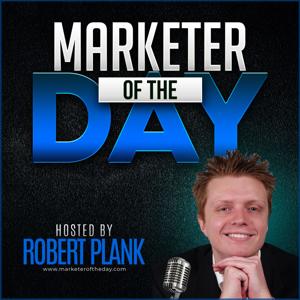
Marketer of the Day with Robert Plank: Business Growth & Entrepreneur Stories

Marketer of the Day with Robert Plank: Business Growth & Entrepreneur Stories

Download on the App Store

Marketer of the Day with Robert Plank: Business Growth & Entrepreneur Stories episodes

  • 508: The Perfect Client Funnel: Generate New Leads Predictably, Solve Problems, and Make Money From Group Coaching with Healthpreneur Fitness Coach Yuri Elkaim
    Yuri Elkaim explains how experts can simplify their businesses by using a predictable funnel to attract qualified clients and deliver results through premium group coaching. His model focuses on doing less while concentrating on two essentials: bringing in new clients and helping them achieve an outstanding result. The Perfect Client Pipeline moves prospects from a Facebook ad to a webinar, an application, and finally a strategy call. Yuri recommends choosing one ideal client, solving one painful problem, and making a clear promise around the desired outcome. Instead of selling another do-it-yourself course, he favors a done-with-you group format combining training with live coaching and accountability. This model allows coaches to charge premium prices while serving multiple clients during only a few coaching hours each week. The key takeaway is to simplify marketing around one predictable funnel and one high-value transformation.
    30 min
  • 507: Build a Business on Purpose and Develop a Systems Mindset: Vision, Mission, Values, Goal Setting and Meetings with Scott Beebe
    Scott Beebe explains how small business owners can escape daily chaos by building their companies around clear vision, structured processes, and consistent implementation. His framework begins with a two-to-six-page Vision Story describing what the business should look like months or years ahead. He then develops practical systems for delegation, bookkeeping, meetings, job roles, goal setting, schedules, and organizational structure. His team uses three eight-to-ten-minute daily huddles plus a weekly meeting lasting no more than one hour. Work is organized around three primary goals within a 12-week plan, keeping attention narrow and measurable. Scott recommends documenting recurring tasks while performing them, using written steps or screen recordings so those activities can eventually be delegated. The most useful takeaway is to adopt a systems mindset by treating every repeated task as an opportunity to create a process that reduces dependence on the owner.
    33 min
  • 506: The One Thing and the Domino Effect: Think Big, Act Small, Get Clarity on Priorities, Time-Block, and Simplify with Geoff Woods
    Geoff Woods explains how identifying one lead domino can simplify your priorities, protect your time, and create outsized progress in business and life. The approach begins by recognizing that 80% of results often come from just 20% of activities. Instead of treating every task equally, Geoff recommends identifying the one thing that makes everything else easier or unnecessary. He uses time blocking to protect space for that highest-priority work before email, meetings, and interruptions take over. His 411 framework creates clarity around yearly, monthly, and weekly priorities while connecting them to larger goals. He also recommends working backward from someday goals to five-year, annual, monthly, weekly, and immediate actions. The most useful takeaway is to think big about the destination, then act small by consistently knocking down the single most important domino.
    34 min
  • 505: Differentiate Yourself in the Marketplace, Provide a Superior Solution and Dial-in Your Ideal Group of Clients with Biohacker and X Gym Founder PJ Glassey
    PJ Glassey explains how a fitness business can stand out by solving specific customer problems better than traditional gyms. He built X Gym around three issues he saw repeatedly: injuries, unwanted muscle bulk, and excessive workout time. His resulting methodology uses controlled movements and time under tension, with workouts lasting just 21 minutes twice a week. New ideas move through a testing sequence involving research, PJ himself, friends and family, employees, and long-term members before becoming part of the system. His core market is busy adults roughly 40 to 70 who want health and fitness without traditional gym demands. Marketing relies heavily on SEO, referrals, newsletters, blogs, and free educational content that establishes expertise. The key takeaway is to differentiate by identifying an underserved group's biggest problems and building a focused solution around them.
    27 min
  • 504: Become Debt Free, Retire Early, Snowball Your Way Out of Debt Using Smart Financial Strategies, and Build a Blog Following with Deacon Hayes
    Deacon Hayes explains how he and his wife paid off $52,000 in debt in 18 months and turned their experience into a thriving personal finance business. Their strategy was simple: increase income, decrease expenses, and direct every extra dollar toward debt. They used Dave Ramsey's debt snowball method, paying balances from smallest to largest and rolling each freed-up payment into the next debt. Deacon also delivered pizzas, sold garage-sale finds online, canceled cable, and replaced an expensive car payment with two lower-cost vehicles. He documented the journey on a blog that eventually grew beyond one million monthly page views after several slow years. That audience later supported affiliate marketing, sponsored content, a book, and other revenue streams. The most useful takeaway is to focus resources on one financial goal at a time and let each completed step create more options for the next.
    26 min
  • 503: Amazon Author Secrets: Get Published, Work Backwards, Stay Motivated, and Sell At Least 26,000 Copies with Writing Coach Frank McKinley
    Frank McKinley explains how authors can publish and sell books without first building a large email list, blog, or audience. He treats the Amazon book page as a sales tool, focusing on the cover, title, subtitle, description, and persuasive bullet points. His first major success, 10 Steps to Effective Leadership, contributed 8,000 copies to more than 28,000 total book sales. He recommends researching natural search terms on Amazon and examining competing books for useful keywords, categories, and sales rankings. When testing improvements, he changes only one element at a time so he can identify what affects sales. To stay motivated, Frank works backwards by defining exactly what the finished book should accomplish before writing it. The most useful takeaway is to keep the process simple, ship before perfection, and continually improve based on what readers respond to.

    27 min
  • 502: Get the Magic Back: Take Action, Make It Simple, Develop Success Habits, Set Clear Goals, and Find Your Motivation with Evan Money
    Evan Money explains how intentional habits, clear goals, and immediate action can help people regain motivation and keep moving toward their dreams. He recommends writing ideas down immediately, including using a waterproof notebook in the shower, because unrecorded ideas are easily lost. His daily framework is to ask, "What's the one thing I can do today to bring me closer to my dream?" and then act on it. He argues that favorable conditions rarely arrive, so progress depends on building routines that work even during difficult days. Evan also recommends removing distractions by creating a tech-free bedroom and keeping phones physically out of reach when focus matters. His broader mindset is that he is either "up or getting up," which makes recovery part of the routine. The key takeaway is to design your environment so taking useful action becomes simpler than relying on willpower.
    43 min
  • 501: Earn More Money from Fewer Clients: Big Goals, Mindset Shifts, and Marketing Experiments with Joe Sanok
    Joe Sanok explains how entrepreneurs can earn more with fewer clients by treating growth as a series of focused experiments instead of chasing perfection. Each year he chooses one big goal designed to make everything else easier and then builds around that priority. For a new membership community, he interviewed 20 ideal clients, built a simple offer, attracted 200 people to a wait list, and sold 50 spots. He recommends automating onboarding, delegating routine work, and protecting mental space for higher-value decisions. His assistant reduces roughly 300 daily emails to 15 that actually require his attention. He also works three days a week by deciding what must stay, what technology can automate, and what someone else can handle. The most useful takeaway is to prioritize what moves the business forward, then experiment, automate, and delegate everything else.
    29 min
  • 500: Productivity Tools to Get Your Head in the Game: 16X Multiplier, The One Thing Scorecard, and 80/20 Gamification with Copywriter Kevin Donlin
    Kevin Donlin explains how simple visual tools can help business owners focus on the few marketing actions that produce dramatically better results. His One Thing Scorecard uses a 3-by-5 card, seven boxes, and a daily checkmark to build momentum around proven activities. The method combines Dan Kennedy's daily marketing discipline with Jerry Seinfeld's "don't break the chain" approach. Kevin's 16x Pathfinder applies the 80/20 principle by contrasting high-value work with low-value activities such as excessive email, news, and social media. He illustrates the difference with eight dimes representing 80 cents of productive output versus a nickel representing wasted effort. Batching also reduces cycle time, including the mental ramp-up before and after interruptions. The key takeaway is to identify your highest-value actions, make them visually obvious, and systematically replace low-value work with them.
    32 min
  • 499: Goal Setting, Finances, Budgeting and Growing with Ruby Tan
    Ruby Tan explains how disciplined budgeting and the Profit First methodology can help families and entrepreneurs gain control of their finances and build lasting financial freedom. After her husband lost his job, their household income dropped dramatically while the mortgage and other expenses continued. She responded by separating necessities from wants, cutting expenses, using rewards strategically, and maintaining a detailed budget. Within roughly five to seven years, her family paid off their mortgage, and she later completed her degree without student loan debt. Ruby now applies similar principles to businesses by separating incoming revenue among profit, owner pay, taxes, vendor obligations, and operating expenses. She warns that tax deductibility does not automatically make a business expense necessary or wise. The most useful takeaway is to "prepare the umbrella before it rains" by intentionally setting money aside before financial emergencies arrive.
    22 min

About Marketer of the Day with Robert Plank: Business Growth & Entrepreneur Stories

From the publisher's feed

Marketer of the Day with Robert Plank is a daily business podcast for entrepreneurs, solopreneurs, consultants, agency owners, coaches, authors, speakers, and expert-led service businesses that want…