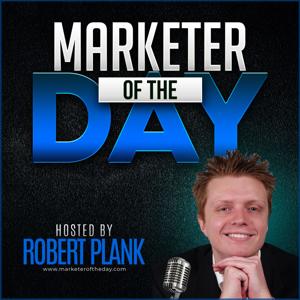
Marketer of the Day with Robert Plank: Business Growth & Entrepreneur Stories

Marketer of the Day with Robert Plank: Business Growth & Entrepreneur Stories

Download on the App Store

Marketer of the Day with Robert Plank: Business Growth & Entrepreneur Stories episodes

  • 788: MindMeister Mind Mapping: Organize Your Ideas, Create Incredible Presentations, Run Meetings and Communicate in New Ways with Michelle Matus
    Mind mapping helps people capture scattered ideas, discover connections, and turn complex projects into organized action. Michelle Manus explains that MindMeister supports fast brain dumps, drag-and-drop organization, images, links, doodles, comments, chat, and collaborative voting. Teams can separate free-form brainstorming from later evaluation, allowing creativity to flow without premature self-censorship. Shared maps also improve meetings by combining agendas, supporting documents, discussion notes, and action items in one visual workspace. Podcasters can create public, searchable show-note maps containing guest information, key takeaways, video clips, and relevant links. Those maps can be embedded on websites, updated in real time, and converted into tasks through MeisterTask for execution. The most useful takeaway is to begin with an unrestricted visual brain dump, organize it afterward, and save the finished structure as a reusable template.

    31 min
  • 787: Grow and Disrupt: Simplify the Psychology of Sales, Marketing and People with Stephanie Scheller
    Successful events require relentless marketing, careful preparation, and the willingness to adapt when plans fail. Stephanie Scheller explains how her team used a 25-page safety manual, 25 percent venue capacity, health checks, masks, waivers, and virtual options to continue producing live experiences. She emphasizes that events are roughly 20 percent planning and 80 percent marketing. Because tickets can cost $3,000 or $7,000, organizers must combine compelling promotion with a strong, reassuring sales process. Her framework includes building a deep bench of tactics, evaluating results, adjusting scripts only after meaningful testing, and using scholarships when seats remain empty. Violin practice illustrates the same process: slow down, identify the weak mechanic, correct it, and repeat until performance improves. The most useful takeaway is to commit carefully, prepare backup plans, and keep taking action until momentum carries the goal forward.
    36 min
  • 786: Grow your Team, Foster Culture, and Stop Work Burnout with Stephen Christopher
    Entrepreneurs can escape burnout by building a company that grows without depending on their constant involvement. Stephen Christopher describes spending roughly two and a half years developing leaders and transferring the CEO role to someone who wanted it. Stepping away exposed how closely his identity and sense of value were tied to the business. He later returned in a limited role focused on vision, relationships, coaching, sales, and content rather than daily operations. His business growth model moves from an owner-dependent infant stage to a teenage stage where the company needs its own identity and leadership. Clear boundaries are essential because even casual comments from an owner can redirect employees or undermine the CEO. The most useful takeaway is to define your unique contribution, empower others to lead, and use meditation and journaling to make more conscious choices.
    40 min
  • 785: Write Your Book to Express Yourself and Your Business with Lin Eleoff
    A short nonfiction book can turn your expertise into authority, attract ideal readers, and lead them toward becoming paying clients. Lin Eleoff recommends creating a focused book of roughly 50 to 100 pages instead of pursuing a long, traditional manuscript. The process begins with clarifying your message, identifying your ideal reader, and organizing your knowledge into a distinct framework. Rather than giving away every implementation detail, the book should explain the problem, provide hope, and demonstrate why your approach works. Stories, personal experience, and a fresh perspective help readers connect with the author while distinguishing the book from competing titles. The finished material can also support emails, blog posts, podcast topics, and a coaching program, with a 90-day writing goal keeping the project manageable. The most useful takeaway is to treat the book as a strategic business asset, not merely a product to sell.
    34 min
  • 784: Smarter Than a Startup: Buy, Manage and Run a Business the Risk-Reduced Way with David Barnett
    Buying an established business can provide customers, cash flow, financing options, and a safer foundation for pursuing new ideas. David Barnett explains that existing profits make acquisition financing more realistic than borrowing for an unproven startup. Buyers can also use underused resources, such as a pizzeria's commercial kitchen, to test complementary products without major additional investment. He warns that seller's discretionary earnings must still cover debt service, taxes, replacement equipment, and fair compensation for the owner's labor. Because a 10 percent sales decline can sometimes create a 30 percent profit decline, buyers need substantial financial breathing room. Risk can be reduced through careful valuation, realistic projections, expert guidance, and financing clauses that allow flexibility when revenue falls. The most useful takeaway is to purchase dependable cash flow rather than speculate on a distressed business whose losses may continue indefinitely.
    24 min
  • 783: Eliminate Mental Blocks: Achieve Greatness Using Neuro-Linguistic Programming (NLP), Self Hypnosis, Mindfulness, and the Emotional Freedom Technique (EFT) with Charles Crenshaw
    Hypnosis, NLP, EFT, and meditation can help people change stubborn habits, reduce stress, and regain control of everyday problems. Charles Crenshaw explains how Neuro Linguistic Programming borrows successful mental patterns and applies them to areas where someone feels stuck. He describes using these tools for smoking, nail biting, teeth grinding, phobias, anxiety, procrastination, and unwanted routines such as immediately baking cookies after work. During a live EFT demonstration, a brief sequence of tapping points produced a reported 30 percent improvement in energy and mood. Charles connects these methods to self-regulation, emphasizing imagination, concentration, breath awareness, and access to personal resources. Self-hypnosis adds a specific suggestion while the mind is calm, such as preparing to perform confidently during an important task. The most useful takeaway is that practical mind-body techniques can be tested directly and reused independently whenever old patterns return.
    28 min
  • 782: Purpose, Passion, Reinventing, Rediscovering, and Realigning Yourself with Barbara McCollough and Lorna Lyons
    Midlife restlessness can become a path to renewed purpose when you combine inner reflection with a clear understanding of your strengths. Barbara McCollough describes a 30-year life bonus and explains how unconscious programming can keep people feeling too old, stuck, or uncertain. Her inside-out approach uses meditation and mindful awareness to access the deeper 95 percent of consciousness shaping choices and creativity. Lorna Lyons adds an outside-in process built around strengths assessments, personal values, and interests people have postponed for years. Together, their framework helps people identify natural abilities, uncover meaningful goals, and move from inherited roles toward aligned work. Examples include a six-figure professional who changed careers and a high achiever who declined a coveted teaching role to pursue a creative project. The most useful takeaway is to notice your restlessness, study what energizes you, and pair that insight with deeper inner work before making your next move.
    29 min
  • 781: Alexa Skills, Voice Search, Smart Speakers, and Artificial Intelligence with Terri Jones
    Voice technology gives entrepreneurs a practical way to make content easier to discover, use, and monetize. Terri B. Jones explains how Alexa skills can deliver podcasts, flash briefings, trivia, safety tips, games, promotions, and local business updates. She notes that Amazon opened skill development to everyday creators in 2017 and that roughly 100,000 skills were available at the time. Businesses can build skills directly, hire a developer, or use a no-code platform with ongoing hosting. Terri also highlights everyday productivity uses, including Gmail schedules, shopping lists, timers, smart lights, Ring devices, and in-car listening. Her framework starts with choosing useful content, matching it to a voice format, and selecting the right technical path. The key takeaway is to enter voice platforms early with one simple, valuable experience before the market becomes crowded.
    25 min
  • 780: Use Your Benefit Corporation to Make a Difference Environmentally and Socially with Kerry Worden
    Benefit corporations help entrepreneurs turn business activity into measurable social and environmental impact. Kerry Worden explains that the structure requires companies to state their public purpose in organizing documents and report annually on what they actually accomplished. He emphasizes third-party verification through B Lab, which helps distinguish accountable action from greenwashing and empty corporate promises. The framework can support causes such as biodiversity, sustainable agriculture, girls' sports, humane treatment, diversity, and inclusion. Businesses of any size can participate, from a three-person firm to a company like Patagonia, though owners should expect extra reporting time and setup costs of roughly a couple thousand dollars. Kerry also shows how financial planning, mortgages, insurance, and responsible investing can align assets, debt, and risk with a deeper mission. The most useful takeaway is simple: define the change your company will make, document it, and prove it every year.
    24 min
  • 779: I Love Cambridge: Serve Your Community with Your Business and Podcast with Walter Monteiro
    Community-focused podcasting can help professionals build stronger networks, support local businesses, and remain visible to future clients. Walter Monteiro interviews entrepreneurs and service providers throughout Cambridge, Kitchener, and Waterloo to introduce their work to nearby residents. Each guest shares the interview with a separate audience, allowing both parties to gain exposure and develop valuable connections. Walter strengthens those relationships with brief personalized video messages that communicate tone and sincerity better than standard emails. He notes that consistent follow-up is especially important in real estate, where former clients may gladly return but lose contact with their original agent. Relaxed, unscripted conversations also produce more authentic interviews than rigid lists of repeated questions. The most useful takeaway is to create genuine local relationships and maintain them through simple, personal, consistent communication.
    24 min

About Marketer of the Day with Robert Plank: Business Growth & Entrepreneur Stories

From the publisher's feed

Marketer of the Day with Robert Plank is a daily business podcast for entrepreneurs, solopreneurs, consultants, agency owners, coaches, authors, speakers, and expert-led service businesses that want…