
Sign up to save your podcasts
Or



Navigating NYC Security Deposit Laws
This episode offers a deep dive into the legal framework surrounding security deposits for renters in New York City, breaking down the rules designed to protect tenants' hard-earned money from unfair landlord practices.
Key Takeaways & Legal Boundaries
The Tenant's Toolkit: Pre-Move-Out Inspections
The hosts highlight a powerful tool available to renters: the mandatory move-out inspection. Tenants have the legal right to request a walkthrough inspection with the landlord, which must be offered and take place no earlier than two weeks before the move-out date.
This inspection allows landlords to point out what they consider "damage" while the tenant still has the keys. This gives the tenant the opportunity to fix minor issues themselves (e.g., filling nail holes with spackle) rather than being surprised by inflated repair invoices after they have vacated the property.
The Reality Check
The episode concludes with a brief discussion on the gap between legislative theory and real-world enforcement. While the laws heavily favor and empower the tenant on paper, the burden of enforcement—such as taking a landlord to small claims court if they refuse to cooperate—still ultimately falls on the renter.
The NY Rent Registration Rules and Penalties Guide
Topic: Annual Rent Registration for NYC Rent-Stabilized Buildings With the July 31 filing deadline approaching, this episode breaks down what owners, boards, and property managers need to know about registering rent-stabilized units with New York State Homes and Community Renewal (HCR/DHCR) — and the real cost of getting it wrong. Cover:
What annual registration is — owners of rent-stabilized units must file an annual registration statement with DHCR for every covered unit by July 31 each year. The filing reflects the rents, tenancy, and services in effect on April 1 of the registration year, and is submitted through DHCR's online registration system (ARRO/ORRA).
The tenant-copy requirement — registration isn't done when you hit submit. Owners must give each tenant in occupancy a copy of the portion of the registration that applies to their unit, and the safest practice is to serve it by regular mail with a Certificate of Mailing for proof.
The penalties — why this is not a deadline to slide on. Anything filed after July 31 is deemed delinquent, and under DHCR Operational Bulletin 2024-1 the owner faces a $500 penalty per unregistered unit, for every month it stays delinquent — on top of other sanctions. A notice of delinquency gives owners 21 days to fix it before a Commissioner's order locks in the fines.
The rent-freeze trap — the quieter penalty that hits the rent roll. Until you file, you can't collect a rent increase or even apply for one, and failure to register triggers a retroactive rent freeze. Filing a late registration eliminates that freeze going forward, but only if it's done before a tenant files an overcharge complaint.
The fix-it-later problem — prior years aren't a simple resubmit. Because of the 2014 Rent Code Amendments, correcting a past registration generally requires an administrative order from DHCR unless you're responding to a directive from DHCR, HPD, or a court — so accuracy in the current filing matters.
Don't forget HPD — DHCR rent registration is separate from the annual NYC HPD building registration. Owners of multiple dwellings (3+ residential units) must register the building annually with HPD, and a building without valid HPD registration can't certify violations, get a violation dismissed, or bring a nonpayment case to recover possession.
Practical takeaway for boards and property managers — pull your DHCR rent roll now, reconcile every stabilized unit against your April 1 snapshot before you file, serve tenants their copies and document it, and confirm HPD registration is current too. File well before July 31, don't wait until the portal is jammed, and keep proof of submission on record.
https://hcr.ny.gov/rent-registration
The NYC Summer Boiler Maintenance and Compliance Guide
Topic: Post-Heating Season Boiler Maintenance for NYC Buildings
NYC's heating season officially ended May 31. Discuss why summer is the critical window for boiler preventative maintenance in NYC residential and commercial buildings. Cover:
The summer maintenance window — boilers are offline June–September, making it the only time for full annual overhauls without disrupting tenants.
What an annual overhaul includes — vacuuming and cleaning of the fireside and waterside, tube cleaning and inspection, burner tune-up, checking refractory, gaskets, safety valves, low-water cutoffs, and controls; combustion efficiency testing.
Why it matters — extends equipment life, prevents mid-winter breakdowns and emergency repair costs, improves fuel efficiency, and catches problems while parts and contractors are available rather than during peak season.
NYC compliance angle — NYC heating season runs October 1 through May 31, when owners must maintain legally required indoor temperatures (Housing Maintenance Code). Summer maintenance helps avoid heat complaints and HPD violations. Also cover NYC DOB annual boiler inspection and filing requirements for low- and high-pressure boilers, and related obligations like Local Law 87 (energy audits/retro-commissioning) and Local Law 97 (emissions) where boiler efficiency plays a role.
Practical takeaway for boards and property managers — schedule overhauls early in summer, don't wait until September when contractors are booked, document everything for compliance filings, and budget for repairs identified during inspection.
From the publisher's feed
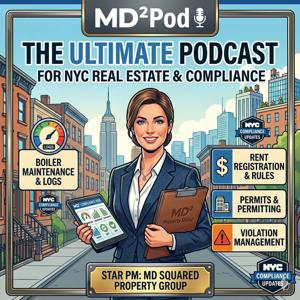
The MD Squared Property Group Podcast is a practical, no-fluff guide to managing residential property in New York City. Each episode breaks down the regulations, deadlines, building systems, and…
From compliance deadlines like rent registration and Local Law obligations, to seasonal building maintenance, vendor management, and the realities of running a NYC property, we cut through the jargon and focus on what matters: protecting your building, staying compliant, and avoiding costly surprises.
Brought to you by MD Squared Property Group, a New York City property management company. Whether you sit on a board, manage a portfolio, or own a building, this is your shortcut to smarter, more confident property decisions.