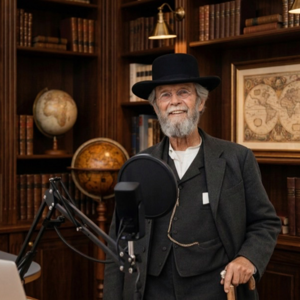
This episode explores the unconventional, journey of Dr. Andrew Taylor Still toward discovering Osteopathic Manual Medicine (OMM). The episode draws on an essay written by Jason Haxton, who is the director of the Museum of Osteopathic Medicine, Kirksville, Missouri. It details how Dr. Still's philosophy did not emerge overnight, but from a series of personal encounters and frontier medical cases where structural correction unlocked natural healing.
Listeners will hear how Dr. Still first found relief from his own childhood migraines by resting his neck across a plow-line rope, and later eased boyhood dysentery by throwing himself over a log. As a frontier doctor, his anatomical insights grew through remarkable trials: using iron picket pins and traction to reset a Mexican freighter's dislocated neck in Kansas, and adjusting the dislocated neck of a bride-to-be who fell down the stairs right before her wedding.
The crucial breakthrough came during a winter blizzard, when Dr. Still treated a woman suffering from severe pneumonia-like symptoms, only to discover her ribs had been drastically dislocated by a swinging dead hog carcass. By manually resetting her ribs, her pain and fever vanished almost instantly, proving that structural abnormalities can produce the exact same physiological symptoms as systemic diseases. This revelation solidified Dr. Still's core philosophy: when the body's form is properly aligned, its natural systems can flow, heal, and maintain health.
Listeners can dive deeper into these fascinating historical accounts—including the letters and journals of Dr. Still and his student, Dr. Ernest E. Tucker—by visiting the original source material: ATSU News: From Logs to Hogs, Mexican Freighters to Blushing Brides.