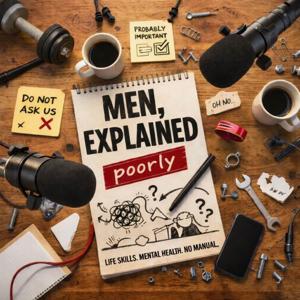
Men Explained, Poorly

Men Explained, Poorly

Download on the App Store

Men Explained, Poorly episodes

  • Avoidance: A Man’s Most Developed Skill
    Why deal with something today when you can put it off until tomorrow — or hide in the bathroom until everyone forgets about it?

    This week on Men Explained, Poorly, Rick Robinson and the guys tackle one of man's most finely tuned abilities: avoidance. At least, that's what they're supposed to be talking about.

    Instead, the conversation wanders through procrastination, marriage, last-minute school projects, the strange ways men deal with problems, Wil Wheaton, Star Trek, calculus, questionable ice cream choices, Godzilla, and enough unnecessary side quests to accidentally prove the episode's premise.

    Along the way, the guys stumble onto a more serious question: Do men avoid problems because they don't care — or because experience has taught them that confronting some problems only creates new ones?

    It's an hour-long demonstration of avoidance disguised as a discussion about avoidance. In other words, another perfectly normal episode of Men Explained, Poorly.Adult language and themes. Listener discretion advised.
    1 hr 2 min
  • I Can Fix That: Famous Last Words of the American Male
    Every man eventually encounters something broken and confidently utters four dangerous words: “I can fix that.”

    Rick Robinson, Ordinance Packard, Vincent Charles, Jeff, and the Trainwreck Radio ER Men Explained Poorly panel examine the distinctly male refusal to admit defeat when confronted by a malfunctioning appliance, computer, automobile, relationship, or household project.

    The conversation explores the Gen X experience of repairing things before the parents came home, lessons inherited from Depression-era fathers and grandfathers, and the frustration of living in a disposable economy where a replacement circuit board can cost more than an entirely new machine.

    The panel also tackles modern vehicles that require proprietary software, computers that become too expensive to repair, the lost art of the Chilton manual, disastrous do-it-yourself adventures, and the questionable belief that enough duct tape, spare parts, money, and stubbornness can fix almost anything.

    Along the way, the discussion wanders through dangerous ex-girlfriends, classic Cadillacs, William Shatner, suspicious junk drawers, language lessons, viral social-media posts, and the enduring conviction that those leftover screws probably belong somewhere.

    1 hr 4 min
  • Condolulations, College Cuisine, and Midget Vampires
    What begins as a battle with Restream quickly becomes an hour of mortality, questionable terminology, gourmet cafeteria food, misunderstood movies, and tiny vampires.


    Rick Robinson, Ordy Packard, Vincent Charles, and Jeff discover that a cloud-based studio can keep a show alive even after its host temporarily disappears. While Rick attempts to restore his audio, the remaining panel discusses prescription-drug vacations, promotion anxiety, modern sexual labels, and why Tuesday feels wrong.

    Vincent reflects on learning that his former wife had died and the complicated emotions that followed. That leads naturally—or as naturally as anything does on this show—to elaborate funeral plans, open bars, mysterious men in black, cremation jokes, browser histories, and the newly invented word “condolulations.”

    The conversation then turns to Hudson Hawk, Deep Space Nine, college dining halls serving food that belongs in an expensive restaurant, beef Wellington as an upper-class corn dog, trains as apex predators, and the joy of introducing family members to gloriously terrible movies.

    Finally, the panel assembles a Halloween viewing list involving Ankle Biters, Once Bitten, Saturday the 14th, Love at First Bite, and the possibility of an entire evening devoted to scary aliens and midget vampires.

    It’s what happens when four men have no formal topic, malfunctioning technology, and absolutely no adult supervision.

    1 hr 1 min
  • How to Stay Strong as You Age — Even When the Pickle Jar Wins
    Getting older does strange things to a man.

    One minute you’re lifting a couch, moving a 300-pound printer, digging up the yard, or doing something your 25-year-old self would recognize immediately. The next minute you’re losing a fifteen-second wrestling match with a jar of Nutella and wondering why your ankle hurts when you didn’t even do anything.

    This week on Men Explained Poorly, Rick, Vincent Charles, Ordnance Packard, and the resident Alien tackle the strange phenomenon of dad strength — that unpredictable combination of old-man muscle, stubbornness, muscle memory, experience, and absolutely terrible judgment that convinces men they can still do everything they did 30 years ago.

    The guys trade stories about grip strength disappearing at exactly the wrong moment, old injuries coming back for revenge, stamina becoming more important than raw strength, and discovering that being able to do something is very different from being able to recover from doing it.

    But underneath the jokes is a real conversation about staying strong as you age. They get into functional strength versus “gym muscles,” flexibility, recovery, bodyweight exercise, staying physically active, and why maintaining strength may matter more than chasing the body you had when you were 25.

    Because getting older doesn’t necessarily mean you can’t still move the couch.

    It just means you might need two days to recover afterward.

    And the pickle jar may still win.

    Men Explained Poorly — A Podcast for Men Who Still Think.
    1 hr 2 min
  • Men Explained Poorly: The Influencer’s Guide to Dying Alone
    Male influencers promise purpose, power, and the “high-value” life—but too often, what they’re really selling is rented luxury, manufactured outrage, and their followers’ own insecurity.

    Prompted by the latest allegations and legal troubles surrounding Andrew and Tristan Tate, Rick and the panel examine how the manosphere turned masculinity into a marketing scheme. They discuss fake online lifestyles, the lack of fathers and mentors, the appeal of loud personalities to directionless young men, and the way algorithms reward creators who become increasingly brash, extreme, and dishonest.

    Beneath the jokes is a serious question: when young men genuinely need guidance, why are the worst possible people so eager to provide it? The panel also considers authenticity, audience addiction, the corrupting effects of online fame, and why real masculinity shouldn’t require a ring light, a rented sports car, or a referral code.
    58 min
  • Ask Us Anything!
    This week on Men Explained Poorly, the guys open the floor for an Ask Us Anything episode — which naturally means the questions barely survive contact with the panel.

    What starts as a loose audience Q&A turns into a full Men Explained Poorly tour through Star Trek obsessions, Eddington mania, Airplane!, old movie theaters, Canadian wildfire smoke, Tuvix, Sneako, Sam Neill movies, Starfleet Academy pitches, Titanic recasting, Conan, Dredd, Iron Sky, Mount Hideaway Mysteries, and the eternal danger of letting this group near a simple prompt.

    Along the way, the panel debates what movies deserve another look, which Star Trek ideas should be launched directly into space, why some celebrity deaths hit harder than others, and how quickly a group of grown men can turn a normal question into a deeply unnecessary rabbit hole.

    It is exactly what an Ask Us Anything episode should be: chaotic, funny, wildly inappropriate, occasionally thoughtful, and very poorly explained.
    1 hr 5 min
  • Men Explained Poorly: Dealing with Detritus: Filtering the Noise Before It Filters You
    This week on Men Explained Poorly, the guys take on the daily noise that keeps life turned up to eleven: breaking news alerts, social media outrage, clickbait, notifications, drama, fake urgency, bad advice, and all the mental junk that piles up until you cannot hear yourself think.

    The conversation wanders in true MEP fashion through lost keys, cursed pocket knives, old-school car keys, game shows, Star Trek, Firefox, Xanadu, and the fine art of going completely off the rails — but underneath the chaos is a real question: how do men decide what deserves their attention?

    From logging off when the noise gets too loud to focusing on family and what is actually within your control, the panel works through the difference between staying informed and letting the world keep you angry all the time. Sometimes the best filter is discipline. Sometimes it is perspective. Sometimes it is friends, jokes, and a good rant that remind you not everything deserves a piece of your peace.
    1 hr 3 min
  • 06-16-26 Men Explained Poorly: Why Men's Mental Health Matters
    This week on Men Explained Poorly, Rick, Amish, Vincent, and Delaney take on men’s mental health in the only way this show can: with brutal honesty, dark humor, bad jokes, pop culture detours, and a surprising amount of sincerity hiding underneath the chaos.

    The crew talks about why so many men learn to keep things bottled up, what happens when opening up gets used against them later, and why “just talk about it” is a lot more complicated than it sounds.

    From compartmentalizing stress to choosing the right outlets, setting boundaries, leaning on humor, and knowing when to get actual help, this episode lands somewhere between group therapy and a bar conversation that got way too real. Also discussed: emotional armor, Gen X coping skills, bad days, trust issues, The Simpsons as therapy, retro games, politics-induced rage, and why sometimes the healthiest thing a man can do is laugh with people who understand the mess. Content Note: Adult language, adult humor, and candid discussion of mental health.

    This episode includes AI-generated content.
    1 hr 2 min
  • 06-02-26 Men Explained Poorly: Boys, Flags, and Broken Pride
    Tonight on Men Explained Poorly, we’re asking a question America probably needs before the 250th birthday candles get lit: Did the decline of healthy masculinity help kill patriotism?
    When boys are taught that strength is suspicious, fathers are optional, sacrifice is outdated, competition is harmful, and national pride is cringeworthy, should we be shocked when fewer young men feel connected to country, community, duty, or legacy?

    Tonight, we’re digging into the collapse of civic pride, the difference between healthy masculinity and broken models of manhood, and whether America can rebuild patriotic confidence without rebuilding the men who are supposed to help carry it forward.
    1 hr 2 min

About Men Explained, Poorly

From the publisher's feed

This is a podcast for men, by men.

Society loves to tell men what we’re doing wrong—but never bothers to tell us how to do it right. There’s no rulebook, no roadmap, and no grace when we…