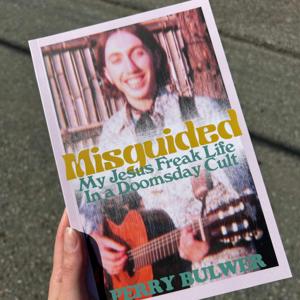
Chapter One - Gotta Serve Somebody
Music featured in this chapter:
Gotta Serve Somebody - Bob Dylan
Sixteen Tons - Tennessee Ernie Ford
Murder Most Foul – Bob Dylan
Abraham, Martin and John - Dion
Into the Ocean - Blue October
How Great Thou Art - Elvis Presley
Sgt. Pepper’s Lonely Hearts Club Band - The Beatles
All You Need Is Love - The Beatles
I open my memoir with a flash-forward to the time I first heard Bob Dylan’s song “Gotta Serve Somebody”. Here is the first paragraph:
I believed God was speaking directly to me through the car radio the day I first heard Bob Dylan singing “Gotta Serve Somebody”. The lyrics surprised me so much I pulled over to the curb to make sure I was hearing them right. I didn’t know that Dylan had converted to evangelical Christianity, so he seemed like an odd messenger for that clearly Biblical message. Hearing those familiar words reactivated the dormant dogma I had been indoctrinated with. I immediately recalled a Bible verse I memorized seven years earlier, after I dropped out to follow Jesus with the Children of God.
To avoid the copyright issue of citing lyrics from the song, I instead cited the Bible verse that Dylan paraphrases in his song.
No man can serve two masters: for either he will hate the one, and love the other; or else he will hold to the one, and despise the other. Ye cannot serve God and mammon. Matthew 6:24
Here is how Dylan paraphrased that scripture in his song Gotta Serve Somebody:
You’re gonna have to serve somebody
Well, it may be the devil or it may be the Lord
But you’re gonna have to serve somebody
By the way, there is an “easter egg” in that first sentence, where I write “I believed God was speaking directly to me through the car radio...”. I wonder how many readers made the connection between that and the 1977 movie Oh, God!, in which George Burns plays God. There’s a scene where he speaks through the car radio to the character played by John Denver that he is trying to recruit.
After that flash-forward introduction to my story, I describe my family and first 16 years of my childhood. I write about my existential fear of spending my life in the drudgery of mill work as “a cog in the machine”.
Dylan’s song sent me right back to the moment I first learned that scripture from a Jesus freak street preacher. As he showed me those words from his pocket Bible he pointed to the pulp and paper mill in the distance where my father worked, explaining that the factory represented mammon, a Biblical term for money, material possessions and related greediness. I was an impressionable, immature 16-year-old in grade eleven, worried about my future and the lack of options the small, forest industry mill-town held for me. Then that stranger appeared and offered me an alternative way of life.
My father, maternal grandfather and uncles all worked in the logging industry, either in the woods harvesting the trees, or in the mills that processed the logs into lumber or paper. Even my mum worked in the plywood mill before she got married. So, growing up it seemed to me that there was an unexpressed expectation that I would wear the same working class boots just like most in my family and community did. As a teen, I dreaded the thought of following my father’s footsteps in the factory, becoming merely a cog in the machine. It was not a life I wanted, but I had no guidance from reliable mentors showing me other possibilities.
I felt trapped in that town, so when that evangelist offered me a way out of the valley into what I thought would be a life of freedom I grabbed the chance to escape. Within weeks I would become a COG of a different sort, but still controlled by the machinations of others. Biblical truth did not set me free, as promised. Instead, I became a prisoner of Christian dogma, bound by spiritual chains.
Sixteen Tons by Tennessee Ernie Ford
You load sixteen tons, what do you get?
Another day older and deeper in debt
Saint Peter don’t you call me, ‘cause I can’t go
I owe my soul to the company store
In this chapter I also describe two events that had a major impact on my childhood, reminding me of the impermanence of life: the assassination of John F. Kennedy in 1963 and the huge tsunami that hit Port Alberni hours after the 1964 earthquake in Alaska.
I was sent home from school after John F. Kennedy’s assassination in 1963. I was in grade three when the shocking news reached my little four-grade River Bend Elementary school that November 22nd morning. The principal sadly explained that the US President had died and that out of respect the school would close for the rest of that Friday. It was the first time I saw an adult cry. Over that weekend I was fascinated by the constant television coverage of events, including the shooting of Lee Harvey Oswald, the first murder ever televised live, and Kennedy’s elaborate two-day state funeral.
Murder Most Foul – Bob Dylan. In this epic 17-minute song Dylan not only describes Kennedy’s assassination in great detail, but he references many songs from that era that capture the zeitgeist of the 1960s culture, which I describe in the early chapters of my memoir as having a huge influence on my teen anxieties.
‘Twas a dark day in Dallas, November ‘63
A day that will live on in infamy
President Kennedy was a-ridin’ high
Good day to be livin’ and a good day to die
Being led to the slaughter like a sacrificial lamb
He said, “Wait a minute, boys, you know who I am?”
“Of course we do, we know who you are”
Then they blew off his head while he was still in the car
Shot down like a dog in broad daylight
...
The day they blew out the brains of the king
Thousands were watching, no one saw a thing
It happened so quickly, so quick, by surprise
Right there in front of everyone’s eyes
Greatest magic trick ever under the sun
Perfectly executed, skillfully done
Wolfman, oh Wolfman, oh Wolfman, howl
Rub-a-dub-dub, it’s a murder most foul
...
Hush, little children, you’ll understand
The Beatles are comin’, they’re gonna hold your hand
...
I’m goin’ to Woodstock, it’s the Aquarian Age
Then I’ll go over to Altamont and sit near the stage
Put your head out the window, let the good times roll
There’s a party going on behind the Grassy Knoll
...
The day that they killed him, someone said to me, “Son
The age of the Antichrist has just only begun”
Abraham, Martin and John by Dion
Anybody here seen my old friend John?
Can you tell me where he’s gone?
He freed a lot of people, but it seems the good, they die young
I just looked around and he’s gone
Five months after that assassination, a tsunami hit Port Alberni on Easter weekend 1964. It was caused by a magnitude 9.2–9.3 earthquake in Alaska, known as the Good Friday earthquake, the largest ever to hit North America. I refer to the tsunami as a metaphor for the “spiritual wave” that would soon sweep me out of my family’s life.
Those two momentous tragedies, the assassination and tsunami, had a significant impact on my young psyche, impressing on my eight-year-old mind the impermanence of life. Disaster or tragedy could strike at any time, and things could change in a moment. The tsunami also portended two pivotal, life-changing events that would wash over my world on two other Easter weekends, in 1966 and 1972. The first, involving two uncles, was a personally traumatic tragedy that triggered existential questions about death and the meaning of life. The second was my encounter with the Children of God, part of a wave of Jesus People who came to Canada from California and swept me out of my family’s life.
Some of these lyrics in the song Into the Ocean by Blue October express the essence of my existential crisis as a “normal boy” trying to figure out my life.
Into the Ocean by Blue October
I’m just a normal boy
That sank when I fell overboard
My ship would leave the country
But I’d rather swim ashore
Without a life vest, I’d be stuck again
Wish I was much more masculine
Maybe then I could learn to swim
I want to swim away, but don’t know how
Sometimes it feels just like I’m falling in the ocean
Let the waves up, take me down
Let the hurricane set in motion, yeah
Let the rain of what I feel right now come down
This first chapter also describes in detail my childhood Catholic indoctrination, and how it made me more susceptible to the manipulations and tactics of cult recruiters who took advantage of my Catholic beliefs.
Father Sigismond Lajoie, or Siggy as we called him, approached my mum and I with the idea that I become an altar boy. The notion of playing a part in Mass, wearing robes and assisting the priest, appealed to me. I always enthusiastically took part in the call-and-response prayers of the Catholic liturgy, and I especially loved singing hymns with their unifying, spine-shivering emotional power. Father Siggy’s favourite hymn was “How Great Thou Art”, which we sang at nearly every Sunday service. Perhaps Elvis Presley’s 1967 hit recording of the song had something to do with that.
How Great Thou Art sung by Elvis Presley
As a young teen in the late 1960s and early 1970s I was heavily influenced by the counter-culture. I wrote:
For my 12th birthday in 1967 I got my first album, the boundary-breaking Sgt. Pepper’s Lonely Hearts Club Band. A few months earlier, in June, I watched the Beatles sing “All You Need Is Love” to hundreds of millions of people around the world on the first TV show broadcast globally by satellite. It was the Summer of Love. The short-lived hippy movement had erupted earlier, in January, when 30,000 people with flowers in their hair held the Human Be-In in San Francisco, ending that summer with the three day Monterey Pop Festival.
The counterculture, anti-establishment, anti-war, pro-drugs spirit of the sixties played a large role in my adolescence. I was attracted to the psychedelia of both the Beatles and the Flower Children, so I changed my greasy 1950s hair style to a Beatles mop top and started growing it long. It wouldn’t be long before psychedelic experiences on LSD opened the “doors of perception” to what I interpreted as the spirit world, and I walked into the arms of Jesus freaks, the spiritual offspring of hippies.
Sgt. Pepper’s Lonely Hearts Club Band
All You Need Is Love - The Beatles
This is a public episode. If you would like to discuss this with other subscribers or get access to bonus episodes, visit perrybulwer344598.substack.com