
Sign up to save your podcasts
Or



You can send me your favorite microbe or suggest a future guest at [email protected]
See photos from today's episode on Instagram @myfavoritemicrobe
Thank you again to my special guests:
Cecilia Vargas obtained her BS, MS, and PhD degrees in Chemical Engineering from Rutgers University. Her MS research project involved Anaerobic Degradation of Chlorinated Hydrocarbons. After graduating, she worked as a research scientist at Johnson & Johnson for 9 years, then decided to return to Rutgers for a postdoctoral position with Max Häggblom. During that time, she researched the anaerobic dehalogenation process, looking at brominated and fluorinated compounds, as well as PCB’s and Dioxins. She eventually transitioned into several teaching positions (DeVry, Union County College, Rutgers), finishing her career as an Assistant Dean at Rutgers School of Engineering. She has been retired for 4 years. She enjoys time at the beach with her grandkids and has taken up paddleboarding and sourdough baking.
https://www.linkedin.com/in/cecilia-vargas-91a74810/
Victoria Knight-Connoni is Director of Microbiology at Rapid Micro Biosystems. Her team is developing solutions that accelerate the detection of microbial contamination in the manufacture of biologics and pharmaceutical products. Victoria has spent her career in industrial microbiology working at several biotech companies focused on natural product discovery using microbes as the source of products. She has built and characterized large bacterial and fungal strain collections at multiple companies. Victoria holds a doctorate in microbiology from the University of New Hampshire and completed a postdoc at Rutgers University. https://www.linkedin.com/in/vknightconnoni/
Max Häggblom is a Distinguished Professor and Chair of the Department of Biochemistry and Microbiology at Rutgers University. An internationally recognized environmental microbiologist, his research explores the remarkable diversity, physiology, and ecology of microorganisms and their roles in transforming our environment. His work has a particular fascination with bacteria possessing “unusual appetites”—microbes capable of degrading environmental contaminants, metabolizing unusual chemicals, respiring rare metalloids, or thriving in extreme environments such as Arctic soils. Häggblom earned his Ph.D. in General Microbiology from the University of Helsinki and has spent decades studying microbes across soils, sediments, marine environments, and animal microbiomes. He is a Fellow of both the American Academy of Microbiology and the American Association for the Advancement of Science and serves as Editor-in-Chief of FEMS Microbiology Ecology. His research highlights just how inventive—and surprising—the microbial world can be.
https://dbm.rutgers.edu/personnel/faculty/max-haggblom
To learn more about Dr. Norberto Palleroni: https://enviromicro-journals.onlinelibrary.wiley.com/doi/10.1111/1462-2920.14415
or here: https://dbm.rutgers.edu/news/memoriam-norberto-j-palleroni
If you would like to read more about the history of the Brooklyn Bridge, read David McCullough's The Great Bridge: The Epic Story of the Building of the Brooklyn Bridge.
You can send me your favorite microbe or suggest a future guest at [email protected]
See photos from today's episode on Instagram @myfavoritemicrobe
Welcome to My Favorite Microbe, the podcast where each episode features a fascinating conversation with a special guest who answers one deceptively simple question:
What's your favorite microbe... and why?
Together, we'll uncover little-known facts, explore the history, separate scientific truth from common misconceptions, and hear the personal stories that make microbiology so captivating.
I can't wait to introduce you to some remarkable people... and the remarkable microbes they love.
This is My Favorite Microbe.
One question. One guest. One unforgettable microbe.
From the publisher's feed
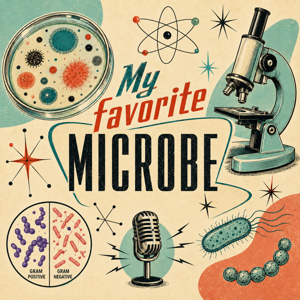
My Favorite Microbe is a podcast that explores the fascinating world of microbiology through conversations with the people who know it best.
Each episode begins with one simple question:…
Scientists, clinicians, educators, and industry leaders share the microbes that have inspired their careers, challenged their thinking, or changed the course of science. Along the way, you'll discover remarkable stories, little-known facts, surprising historical connections, and the truth behind some of microbiology's most common misconceptions.
From bacteria to fungi and other microscopic life, every episode reveals how these tiny organisms have shaped medicine, biotechnology, food, public health, and our understanding of the living world.
Whether you're a microbiologist, healthcare professional, student, or simply curious about the unseen world around you, My Favorite Microbe offers engaging conversations that celebrate both the science and the people behind it.
One question. One guest. One unforgettable microbe.