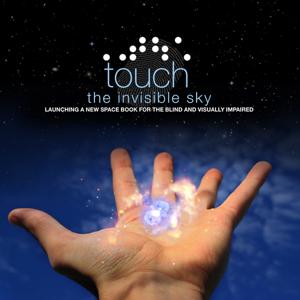
NASA's Touch the Invisible Sky Audio Podcasts

NASA's Touch the Invisible Sky Audio Podcasts

By NASA/Chandra X-ray CenterNatural Sciences
Download on the App Store

NASA's Touch the Invisible Sky Audio Podcasts episodes

  • Chapter 8: The Antennae Galaxies
    The galaxy pair NGC 4038 and NGC 4039 is commonly referred to as the Antennae Galaxies because their distorted streamer-like spiral arms look like insect antennae. Initially two separate spiral galaxies, gravity drew NGC 4038 and 4039 together in a titanic collision.
    5 min
  • Chapter 9: Final Thoughts
    Imagine that you could only hear sound from the middle three keys on a piano and were asked to name a song, or were only allowed to touch one petal of a plant, and were asked to name the flower. The universe revealed to us by optical telescopes is immense and breathtaking, but it is not even half the story.
    2 min
  • Chapter 6: Kepler's Supernova Remnant
    Four hundred years ago, the famous astronomer Johannes Kepler (best known as the discoverer of the laws of planetary motion), was startled by the sudden appearance of a "nova" of "new star" in the western sky, rivaling the brilliance of the nearby planets. Although the nova was new to the night sky, the event was actually the death of an old star, now called a supernova.

    5 min
  • Chapter 7: Whirlpool Galaxy (M51)
    Galaxies are collections of millions to billions of stars gravitationally bound together. Galaxies come in different shapes and sizes, and fall into three broad categories: spiral (shaped like a pinwheel), elliptical (like a ball, sometimes round and sometimes squashed) and irregular, with no obvious shape or structure. Our own Milky Way galaxy is a spiral.
    5 min
  • Chapter 4: Eta Carinae
    Of the estimated three hundred billion stars in our galaxy, Eta Carinae may well be the biggest and brightest of them all. Weighing in at 150 times the mass of our Sun, it is five million times as luminous!
    4 min
  • Chapter 5: Crab Nebula
    A supernova is the dramatic end of a supergiant star's life. The Crab Nebula is the remnant of a powerful supernova which was visible from Earth in the year 1054. This supernova was so bright that it could be seen in the daytime sky for 23 days, and it was documented by astronomers throughout the Far East. The Crab Nebula is found in the constellation of Taurus and got its name because its outer shape roughly resembles a Crab's pincer.
    4 min
  • Chapter 2: Multi-Wavelength Telescopes
    All telescopes perform basically the same function. They gather as much light as possible from a faint astronomical object, and focus the light onto a detector. Historically, the gathering of light was done by a lens or concave mirror, and the detector was a photographic plate, or simply the astronomer's eye. to study the invisible universe, the mirrors and the detectors in a particular telescope need to be highly specialized to detect the part of the electromagnetic spectrum they are designed to study. Four such telescopes follow.
    4 min
  • Chapter 3: The Sun
    The star that dominates our daytime sky and provides the heat and light to support life on Earth is, of course, the Sun. In astronomical terms it is very close, 150 million kilometers (93 million miles), so we can study its properties in great detail. Light from the Sun takes just over eight minutes to reach the Earth. For comparison, light from the next nearest star takes four years to reach us.
    6 min
  • Introduction (Narrated by Simon Steel)
    The Universe is huge. Almost everything that we know about distant objects in the Universe comes from studying the light that is emitted or reflected by them. On Earth, geologists can study rocks by collecting them. Astronauts traveled to the Moon in 1969 and collected moon rocks, but the stars and galaxies are so far away that the primary way we can learn about them is from their light.
    2 min
  • Chapter 1: Kinds of Light
    When we think of light, we think of sunshine or the colors of the rainbow. But colors, like sounds, are limited by the range of our senses. Just as there are sounds that we cannot hear because the pitch is too high or low for our ears to detect, so there are colors whose color pitch is too high or low for our eyes to detect. We think of light as the colors of the rainbow, which really is just a tiny part of a much broader spectrum that our eyes cannot see
    6 min

About NASA's Touch the Invisible Sky Audio Podcasts

From the publisher's feed

Multi-wavelength astronomy - the study of the universe at wavelengths beyond the visible, has revolutionized our understanding and appreciation of the cosmos. Hubble, Chandra, and Spitzer are examples…

More shows like NASA's Touch the Invisible Sky Audio Podcasts

HD - NASA's Jet Propulsion Laboratory by High Definition Video

HD - NASA's Jet Propulsion Laboratory

82 Listeners

The Beautiful Universe: Chandra in HD by

The Beautiful Universe: Chandra in HD

48 Listeners

NASA ScienceCasts by NASA Science

NASA ScienceCasts

36 Listeners

NASA's The Incredible Two-Inch Universe Activity (Audio & ASL) by NASA/Chandra X-ray Center

NASA's The Incredible Two-Inch Universe Activity (Audio & ASL)

1 Listeners

NASA's Sun-Earth Day Video Podcasts by NASA's Sun-Earth Connection Education Forum

NASA's Sun-Earth Day Video Podcasts

4 Listeners

Podcast for audio and video - NASA's Jet Propulsion Laboratory by Video and audio podcasts

Podcast for audio and video - NASA's Jet Propulsion Laboratory

28 Listeners

Houston We Have a Podcast by National Aeronautics and Space Administration (NASA)

Houston We Have a Podcast

1,250 Listeners

Small Steps, Giant Leaps by National Aeronautics and Space Administration (NASA)

Small Steps, Giant Leaps

72 Listeners

NASA's Curious Universe by National Aeronautics and Space Administration (NASA)

NASA's Curious Universe

887 Listeners