
Sign up to save your podcasts
Or

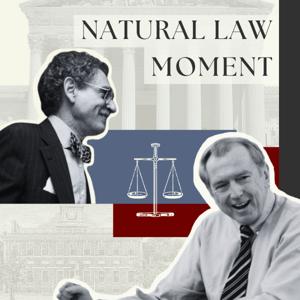


It was only a matter of time before we at Natural Law Moment were tempted to do a crossover episode of our podcast with another podcast, and indeed we gave into temptation. But it was with good reason. Our friends at the 3 Whisky Happy Hour Podcast, its co-hosts Steve Hayward and John Yoo in particular, made for just the perfect inaugural crossover episode of Natural Law Moment, in which we take up with Steve and John questions of legal positivism and the natural law challenge to it.
This episode was recorded in front of a live audience that the Institute gathered during the Federalist Society's 2026 National Lawyers Convention in Washington, D.C. Plenty of laughs, but also a few unexpected twists and turns of substance as well.
In March of this year the Supreme Court handed down two decisions that should have been seismic for the American family. Yet while most of the conservative legal world is satisfied with them as victories, and that’s whatour two cohosts Hadley Arkes and Gerry Bradley will argue is problematic for mainstream legal conservatism. Before we hear from our cohosts, a brief primer on both cases.
First, in Mirabelli v. Bonta, California required schools tohide a child’s social gender transition—new names, new pronouns, the whole identity project—from the child’s own parents unless the child consented. The Court stepped in on the emergency docket and said those policies likely violateparents’ free-exercise and substantive-due-process rights, triggering a fascinating set of dueling opinions from Justices Barrett and Kagan, the subject of our discussion. Weeks later came Chiles v. Salazar in which Colorado banned licensed counselors from any talk therapy that tries to help a minor align with biological sex or reduce same-sex attraction, while allowing the opposite. An 8–1 Court, in an opinionby Justice Gorsuch, called that move of Colorado’s viewpoint discrimination and demanded strict scrutiny. Both cases are indeed victories. But notice what they carefully avoided: any serious, substantive account of why parental authorityexists, what its natural boundaries are, and how far the state may go before it becomes a usurper. That is the central failing of modern conservative jurisprudence. We keep winning cases on process, speech, or thin historical tradition while refusing to grapple with the natural-law substance of thefamily itself.
For this special America 250 edition of the Natural Law Moment Podcast, we turn to the Declaration of Independence and its crucial importance as the statement that founding our country as a regime rooted in the Natural Law — a foundationthat remains urgently relevant in this, our natural law moment. We mildly dip into the Supreme Court's recent decision in Trump v. Barbara in a discussion over citizenship and consent for a teaser of future discussions over the recent Supreme Cour term as well.
Since we are without Prof. Gerry Bradley for this episode, I am his understudy along with our regular co-host Prof. Hadley Arkes, the Founder and Co-Director of the James Wilson Institute. Don't forget to like, rate, and subscribe to Natural Law Moment!
Join Natural Law Moment for the next installment of a look back into the lives of our co-hosts Profs. Arkes and Bradley before they became the storied teachers they would become.
This latest episode focuses on Hadley Arkes's intellectual formation at the University of Chicago in the early 1960s as a graduate student of the legendary philosopher and political scientiest Leo Strauss. Our co-hosts explore the ingredients that made the University of Chicago of that era such a vibrant place, a place where Arkes would never have wanted to leave "to study abroad." Arkes recounts classroom interactions between Strauss and his students as well as the philosophic developments that would come to be associated with a revival of conservative thought on the American Founders and Lincoln. And don't miss what Arkes says that Strauss might say to our leaders of today.
Join co-hosts Hadley Arkes and Gerry Bradley for the first of something we expect to become a regular feature on Natural Law Moment, a look back into the lives of Profs. Arkes and Bradley before became the storied teachers they would become.
This latest episode focuses on how young Gerry Bradley was thrust into the rough and tumble world of the law as a young prosecutor in the Manhattan District Attorney’s office in the early 1980s. The conversation explores how the practice of law as a young prosecutor in the New York of that era was an education like none other, with the sordid business of prostitution, drugs, and homicide providing regular fodder for the work of young Bradley well before be entered academia to become a professor of criminal procedure. Arkes and Bradley delve into how moral decisions infuse the work of a prosecutor along with all those entrusted to maintain law and order in the city.
Subscribe to Natural Law Moment on Apple Podcasts
Subscribe to Natural Law Moment on Spotify
Follow Natural Law Moment on YouTube
Learn more about the James Wilson Institute
Join Natural Law Moment’s hosts Hadley Arkes and Gerry Bradley for a pointed discussion of the Supreme Court and the federal judiciary in American public life.
Since the confirmation of three Supreme Court justices appointed by President Trump, progressives have publicly questioned the legitimacy of the Court, threatening to pack it beyond nine members. Yet now even with the significant progressive challenge to the Court as an institution, some conservatives have begun to muse whether the judiciary writ large, now from time to time in stark opposition to the executive branch, could jeopardize its legitimacy with rulings far sweeping. This discussion has urgency since rulings of Supreme Court affect America’s public life and as ever, the moral and legal course of the country. Tune in today!
In the wake of the assassination of Charlie Kirk, Natural Law Moment's co-hosts Hadley Arkes and Gerry Bradley consider Kirk's legacy as an advocate for free speech. They mourn Kirk's loss as well as distill his incredible memorial service. Finally, Arkes and Bradley discuss why free speech on the campuses has gained an added relevance, given that Kirk's assassination occurred as he was engaging students in public at Utah Valley University.
Our fifth episode represents a first for Natural Law Moment, our first featuring a guest. And we could think of no better a first guest than to welcome one of the oldest and dearest friends of Hadley Arkes and Gerry Bradley, Robert George. Robby as he is known to his friends, is the McCormick Professor of Jurisprudence and Director of the James Madison Program in American Ideals and Institutions at Princeton University. Prof. George joined Natural Law Moment for a lively and wide-ranging discussion of his new book Seeking Truth and Speaking Truth from Encounter Books. The book, which we highly recommend and you can find at fine booksellers nationwide, is a collection of essays that challenges the “Age of Feeling” by appealing to reason in the pursuit of sound moral understanding on crucial and contentious topics including human dignity, the definition of marriage, philosophy of law, constitutional law, the nature of civil liberties, free markets, and more.
Robert P. George is McCormick Professor of Jurisprudence and Director of the James Madison Program in American Ideals and Institutions at Princeton University. He has served as Chairman of the U.S. Commission on International Religious Freedom and on the U.S. Commission on Civil Rights and the U.S. President’s Council on Bioethics. He has also been the U.S. member of UNESCO’s World Commission on the Ethics of Scientific Knowledge and Technology. He was a Judicial Fellow at the U.S. Supreme Court, where he received the Justice Tom C. Clark Award. A Phi Beta Kappa graduate of Swarthmore, he holds the degrees of JD and MTS from Harvard University and the degrees of DPhil, BCL, DCL, and DLitt from Oxford University. He is a recipient of the U.S. Presidential Citizens Medal and Princeton University’s President’s Award for Distinguished Teaching. He is Of Counsel to the law firm of Robinson & McElwee and a member of the Council on Foreign Relations.
Join us for this fourth episode in our new Natural Law Moment podcast! Hadley Arkes and Gerry Bradley take up the challenge of analyzing the Court's decision in U.S. v. Skrmetti, a case about a Tennessee law prohibiting sex-transition surgeries and treatments for minors. They drill down to the core question, whether these surgeries are defensible or if they are child-mutilation, a question that the Court studiously avoided. They consider what this will mean for lower courts as they judge cases surrounding the issue, including medical malpractice, detransitioners, women's sports, parental rights, and more. Recognizing the real truths regarding gender and sex provides the clearest answer to all of these questions, but the Court has refused to follow that path.
Hadley Arkes has been a member of the Amherst College faculty since 1966, and since 1987 he has been the Edward Ney Professor of Jurisprudence. He has written five books with Princeton University Press: Bureaucracy, The Marshall Plan and the National Interest (1972), The Philosopher in the City (1981), First Things (1986), Beyond the Constitution (1990), and The Return of George Sutherland (1994). His more recent books have been with Cambridge University Press, including Natural Rights and the Right to Choose (2002), and Constitutional Illusions and Anchoring Truths: The Touchstone of the Natural Law (2010). His newest book is Mere Natural Law (2023) from Regnery. His articles have appeared in professional journals. Apart from his writing in more scholarly formats, he has become known to a wider audience through his writings in the Wall Street Journal, the Weekly Standard, and National Review. He has been a contributor also to First Things, a journal that took its name from his book of that title.
He was the main advocate, and architect, of the bill that became known as the Born-Alive Infants’ Protection Act. Prof. Arkes first prepared his proposal as part of the debating kit assembled for the first George Bush in 1988. On August 5, President Bush signed the bill into law with Professor Arkes in attendance.
Professor Arkes has been the founder, at Amherst, of the Committee for the American Founding, a group of alumni and students seeking to preserve, at Amherst, the doctrines of “natural rights” taught by the American Founders and Lincoln. That interest has been carried over now to the founding of a new center for the jurisprudence of natural law, in Washington DC: the James Wilson Institute, named for one of the premier legal minds among the American Founders.
Gerard V. Bradley is Co-Director of the James Wilson Institute. He served as professor of law at the University of Notre Dame from 1992 to 2024, where he taught Legal Ethics and Constitutional Law. At Notre Dame he directed (with John Finnis) the Natural Law Institute and co-edited The American Journal of Jurisprudence, an international forum for legal philosophy. He served as president of the Fellowship of Catholic Scholars for many years and has been a visiting fellow at the Hoover Institute of Stanford University. He is also a senior fellow at the Witherspoon Institute.
Bradley received his B.A and J.D. degrees from Cornell University, graduating summa cum laude from the law school in 1980. Before teaching at Notre Dame, he served in the Trial Division of the Manhattan District Attorney’s Office and taught at the University of Chicago College of Law. In 2009, he was a Visiting Professor of Politics at Princeton University.
Bradley has published over one hundred and fifty scholarly articles and reviews, and is the author and editor of twelve books, such as Catholic School Teaching: A Collection of Scholarly Essays (2019) and Unquiet Americans: U.S. Catholics, Moral Truth, and the Preservation of our Civil Liberties (2019).
Join us for the third episode of the Natural Law Moment! In an episode recorded before the Supreme Court decided U.S. v. Skrmetti, Professors Arkes and Bradley take up the issue of parental rights in our jurisprudence. Does deference to parental rights truly encompass a right to opt-out of regime that would regulate surgeries and therapies related to gender dysphoria for minors? The framework for understanding the stakes of the case was notably silent on the moral questions at the heart of parental rights as well. They discuss the cases and state statutes leading up to Skrmetti, among them: Buck v. Bell, Skinner v. Oklahoma, Brown v. Board of Education. They also discuss how the Supreme Court will consider the contours of parental rights again next term in Chiles v. Salazar. The question Arkes and Bradley consider behind all these cases is that of the legitimacy of moral normativity in legal jurisprudence. Tune in!
Hadley Arkes has been a member of the Amherst College faculty since 1966, and since 1987 he has been the Edward Ney Professor of Jurisprudence. He has written five books with Princeton University Press: Bureaucracy, The Marshall Plan and the National Interest (1972), The Philosopher in the City (1981), First Things (1986), Beyond the Constitution (1990), and The Return of George Sutherland (1994). His more recent books have been with Cambridge University Press, including Natural Rights and the Right to Choose (2002), and Constitutional Illusions and Anchoring Truths: The Touchstone of the Natural Law (2010). His newest book is Mere Natural Law (2023) from Regnery. His articles have appeared in professional journals. Apart from his writing in more scholarly formats, he has become known to a wider audience through his writings in the Wall Street Journal, the Weekly Standard, and National Review. He has been a contributor also to First Things, a journal that took its name from his book of that title.
He was the main advocate, and architect, of the bill that became known as the Born-Alive Infants’ Protection Act. Prof. Arkes first prepared his proposal as part of the debating kit assembled for the first George Bush in 1988. On August 5, President Bush signed the bill into law with Professor Arkes in attendance.
Professor Arkes has been the founder, at Amherst, of the Committee for the American Founding, a group of alumni and students seeking to preserve, at Amherst, the doctrines of “natural rights” taught by the American Founders and Lincoln. That interest has been carried over now to the founding of a new center for the jurisprudence of natural law, in Washington DC: the James Wilson Institute, named for one of the premier legal minds among the American Founders.
Gerard V. Bradley is Co-Director of the James Wilson Institute. He served as professor of law at the University of Notre Dame from 1992 to 2024, where he taught Legal Ethics and Constitutional Law. At Notre Dame he directed (with John Finnis) the Natural Law Institute and co-edited The American Journal of Jurisprudence, an international forum for legal philosophy. He served as president of the Fellowship of Catholic Scholars for many years and has been a visiting fellow at the Hoover Institute of Stanford University. He is also a senior fellow at the Witherspoon Institute.
Bradley received his B.A and J.D. degrees from Cornell University, graduating summa cum laude from the law school in 1980. Before teaching at Notre Dame, he served in the Trial Division of the Manhattan District Attorney’s Office and taught at the University of Chicago College of Law. In 2009, he was a Visiting Professor of Politics at Princeton University.
Bradley has published over one hundred and fifty scholarly articles and reviews, and is the author and editor of twelve books, such as Catholic School Teaching: A Collection of Scholarly Essays (2019) and Unquiet Americans: U.S. Catholics, Moral Truth, and the Preservation of our Civil Liberties (2019).